
Thank you for visiting nature.com. You are using a browser version with limited support for CSS. To obtain the best experience, we recommend you use a more up to date browser (or turn off compatibility mode in Internet Explorer). In the meantime, to ensure continued support, we are displaying the site without styles and JavaScript.
Advertisement
Nikki Forrester is a science journalist based in Davis, West Virginia.
You can also search for this author in PubMed Google Scholar
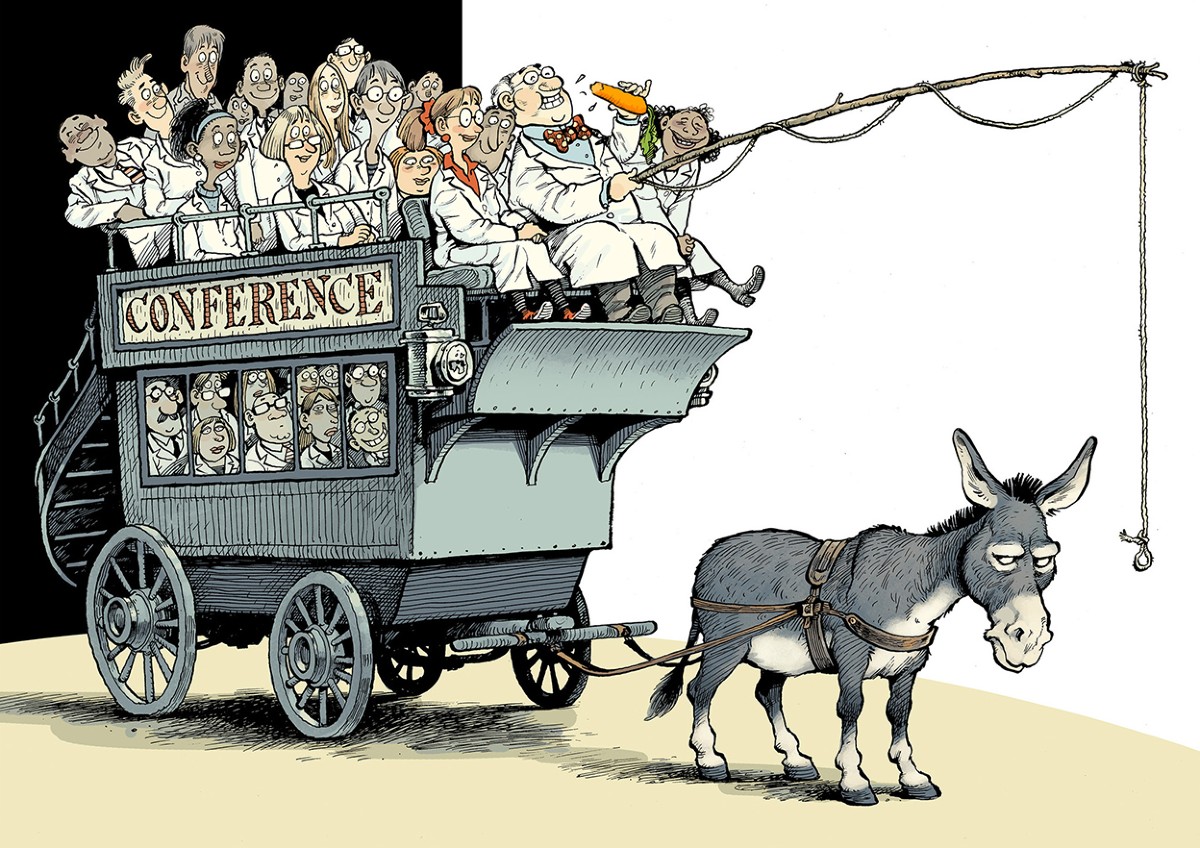
Illustration: David Parkins
Dear Nature,
I’m a scientist based in the United Kingdom. A few years ago, I was verbally encouraged to organize an international conference by staff at a university. At the time, I wasn’t employed at the university or elsewhere in a full-time position, but I’d like to work there in the future. I agreed to the request because the staff suggested it would raise their group’s profile and also help to set me apart in future job applications. I asked repeatedly to be compensated for my conference efforts, and had to wait a long time for the institution’s ambiguous responses. I also could not easily pull out of my commitment to host the event, because it would have negatively affected the attendees and required me to pay a significant cancellation fee.
My request for compensation was eventually declined, but only after I had delivered the conference. I calculate my efforts to be the equivalent of nearly two years of full-time work. I feel embarrassed, pained and stuck. How can an institution be made to pay? And how can I prevent this situation from happening again? — A distressed scientist
Nature’s Careers team reached out to two researchers and an employment lawyer for advice.
“This story has all the hallmarks of uncompensated labour done by faculty” members, says Hava Rachel Gordon, a sociologist at the University of Denver in Colorado. “It happens all the time, whether they belong to an institution or are doing work for another institution.”
Gordon notes that academics often view themselves as passionate scholars, scientists and teachers. “We don’t often think of ourselves as workers,” she says. “And the problem is, then we are easily taken advantage of.”
All the sources noted that one of the challenges of working in academia is defining what the job itself entails. Along with research, teaching and service, many faculty members engage in mentorship, public outreach, administrative work and other tasks. Some of this work is paid, but compensation for other labour, such as reviewing grant proposals or giving conference presentations, might take the form of increased stature in the field or enhanced job prospects.
However, there is also uncompensated or invisible labour, which is neither rewarded nor recognized in merit reviews1.
Studies have found that women and faculty members of colour spend more time on campus service, diversity-related service, student advising and teaching than do their male and white peers, and this can delay career progression by taking time away from research2,3.
The time tax put on scientists of colour
The time tax put on scientists of colour
“A lot of these requests are done informally without contracts, sometimes without even a paper trail. We call it a hallway ask,” says Gordon, referring to a 2018 article by KerryAnn O’Meara, a higher-education researcher at Columbia University in New York City, describing how the most agreeable and productive faculty members are often stopped in corridors and asked to take on various service tasks.
Gordon emphasizes that she understands why the distressed scientist agreed to organize this conference, but notes that it’s difficult to demand payment without a contract in place.
“I think the real problem here is that the parties didn’t make an arrangement ahead of time,” says David Belfort, founding partner of the employment-law firm Bennett & Belfort in Cambridge, Massachusetts. “The scientist needs to put their foot down and tell the institution that they’re willing to do the work, but that it needs to be compensated, because they can’t work for free for two years with the expectation that they’re going to get a job offer out of it.”
Belfort acknowledges that the situation is tricky, given that conference organizing is often voluntary, ancillary work conducted by individuals who are paid, full-time employees at universities. “The odd thing here is that if they had received an offer of a position at this institution, they likely would be content. However, there is no quid pro quo — the institution is not required to offer any role going forward — but they may be entitled to back pay for their work.” For instance, if the distressed scientist had carried out this work in certain US jurisdictions, Belfort says, they could claim a violation of state-minimum-wage laws.
or
doi: https://doi.org/10.1038/d41586-025-00452-1
This article is part of a series in Nature in which we share advice on career issues faced by readers. Have a problem? E-mail us at naturecareerseditor@nature.com
Gordon, H. R., Willink, K. & Hunter, K. J. Divers. High. Educ. 17, 285–296 (2024).
Article Google Scholar
O’Meara, K., Kuvaeva, A., Nyunt, G., Waugaman, C. & Jackson, R. Am. Educ. Res. J. 54, 1154–1186 (2017).
Article Google Scholar
Rodríguez, J. E., Campbell, K. M. & Pololi, L. H. BMC Med. Educ. 15, 6 (2015).
Article PubMed Google Scholar
Download references
 Should I climb the career ladder as a manager, or will I regret leaving the lab bench behind?
How do I tell someone that I can't write them a strong letter of recommendation?
How ‘animal methods bias’ is affecting research careers
Career Feature
How a PhD travel fellowship enriched an international cell-biology meeting
Career Column
How researchers can work fairly with Indigenous and local knowledge
Career Feature
China’s supreme court calls for crack down on paper mills
News
‘Devastating’ cuts to NIH grants by Trump’s team put on hold by US judge
News
Want to get a species protected? Publish in a small, niche journal
Nature Index
Trump team ‘survey’ sent to overseas researchers prompts foreign interference fears
News
Could libraries band together to ensure open access for all?
Nature Index
‘Science is happening’: Israeli and Palestinian scientists continue collaborations amid conflict
News
Join a cutting-edge research team in brain-computer interaction and neuromodulation for clinical applications.
Shanghai, China
Fudan University
Applications are invited for additional Schaller Research Group Leaders in the field of infectious diseases
Heidelberg, Baden-Württemberg (DE)
The Chica and Heinz Schaller Foundation
Applications are invited for additional Schaller Research Group Leaders in the field of Neuroscience
Heidelberg, Baden-Württemberg (DE)
The Chica and Heinz Schaller Foundation
Senior PI&Junior PI,Aiming at the cutting-edge scientific problems and/or core technologies、original scientific problems and/or key technologies.
Haikou, Hainan (CN)
International Center for Aging and Cancer, ICAC
Xiaoliang Sunney XIE’s Group is recruiting researchers specializing in Alzheimer's disease (AD).
Beijing, China
Changping Laboratory
Should I climb the career ladder as a manager, or will I regret leaving the lab bench behind?
How do I tell someone that I can't write them a strong letter of recommendation?
An essential round-up of science news, opinion and analysis, delivered to your inbox every weekday.
Sign up for the Nature Briefing newsletter — what matters in science, free to your inbox daily.
© 2025 Springer Nature Limited
About The Author





More Stories
Advancing the Safer Internet Initiative for Everyone
Youth in Action: Contributing to a More Connected and Inclusive Digital Future
Advancing a Connected Future for Indigenous Communities