
Thank you for visiting nature.com. You are using a browser version with limited support for CSS. To obtain the best experience, we recommend you use a more up to date browser (or turn off compatibility mode in Internet Explorer). In the meantime, to ensure continued support, we are displaying the site without styles and JavaScript.
Advertisement
You can also search for this author in PubMed Google Scholar
You can also search for this author in PubMed Google Scholar
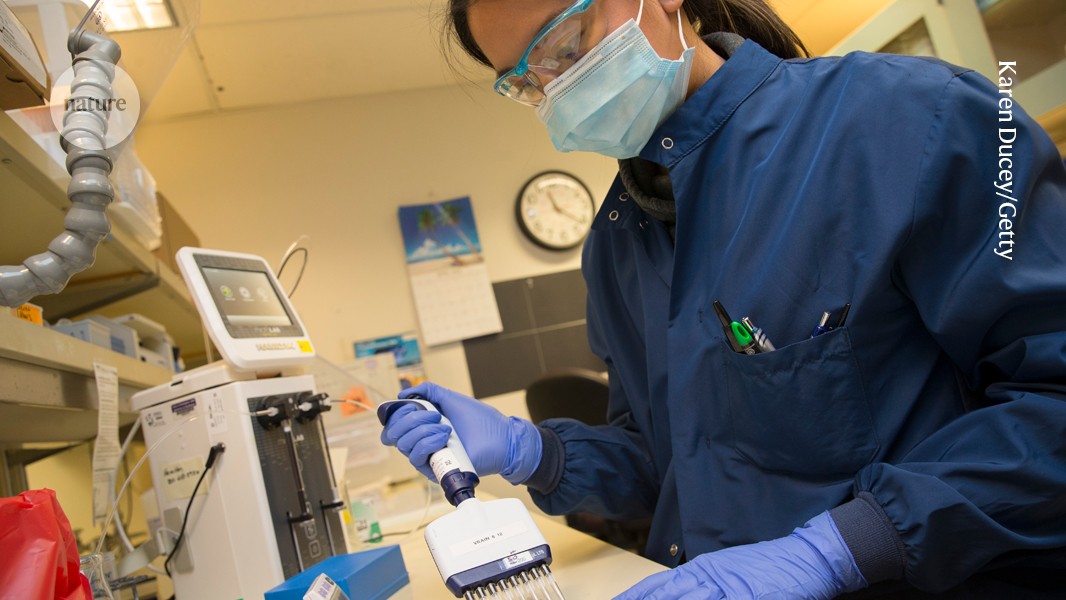
Early-career scientists fear that their chances of making a life in the US research scene are slipping away. Credit: Karen Ducey/Getty
The first in her family to go to university, Suzanne Autrey pushed herself to the brink chasing an academic career. She is now an assistant professor at Northern Illinois University in DeKalb, and takes delight in teaching geology to other first-generation university students. “I know first-hand that a degree to them doesn’t just change their lives,” Autrey says. “It changes their families’ lives.”
Now, like some other early-career scientists in the United States, Autrey feels her dream of a research career slipping away. The tick-tock of her tenure clock echoes in her ears as she checks and rechecks the status of two crucial grant applications. Both are stalled at the US National Science Foundation, an agency facing the prospect of large budget cuts. She can’t do the research needed to support her tenure bid without those grants. “I’m dead in the water if I can’t get one,” she says.
Revealed: NIH research grants still frozen despite lawsuits challenging Trump order
Revealed: NIH research grants still frozen despite lawsuits challenging Trump order
After a month of repeated threats to US science funding, many early-career researchers such as Autrey are fearing for their careers. These scientists are especially vulnerable: graduate students, postdocs and scientists who are just starting their own laboratories are the researchers most likely to be living pay checque to pay checque, most reliant upon federal grants for their income and least likely to have job security. Some are considering changing jobs, leaving the country, or abandoning research altogether.
“Disruption and uncertainty are the enemy of science,” says Donna Ginther, an economist at the University of Kansas in Lawrence. And when disruption and uncertainty strike, she adds, “the people who lose their jobs are students and postdocs”.
If that happens now, science in the United States could undergo its own generational shift, she says: “Early-career scientists are the future.”
During its chaotic first month, US President Donald Trump’s administration moved to sharply curtail federal funding for research. Some of the administration’s changes, such as freezing research funds and curtailing reimbursement for overhead costs on federal grants, have been temporarily blocked by the courts. But the administration’s push to shrink the size of the government is clear, and many researchers fear that the system of federal support they have come to rely on is eroding.
Chaos erupts in US science as Trump’s team declares freeze on federal grants
Chaos erupts in US science as Trump’s team declares freeze on federal grants
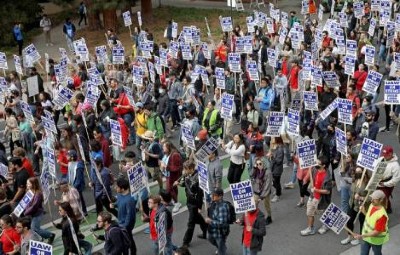
Their anxiety was on display at a protest in Washington DC on 19 February, when about 250 graduate students, postdoctoral researchers and research technicians gathered outside the US Department of Health and Human Services to protest the chaos unleashed by mass layoffs, leadership changes and promises of budget cuts at federal agencies. “Last week aged me a year,” says Alexander Jordan Lara, a research fellow at the National Institute of Dental and Craniofacial Research, a part of the National Institutes of Health (NIH) in Bethesda, Maryland. Lara’s career is in limbo after his principal investigator, a high-ranking NIH scientist, abruptly retired on 11 February amidst the turmoil created by the Trump team’s directives , leaving the fate of the laboratory and its members up in the air.
That fear radiates beyond employees of federal agencies. At the University of Maryland in College Park, an NIH diversity grant pays neuroscience postdoc Haroon Popal’s salary. Popal counts himself lucky: this year’s salary has already been allocated. But the Trump administration has threatened any funding that falls under the rubric of diversity, equity, and inclusion (DEI) initiatives, and Popal is not counting on getting paid next year. He’s looking for other jobs now, especially any that do not rely on federal funds — even if that means leaving science. “I love my research,” he says, “but I cannot afford to lose a pay check.”
Faced with that uncertainty, some young scientists might choose to leave the country rather than leave science, says Ginther. But the United States churned out more than 34,000 science PhDs in 2023. Not all of them will choose to stay in science, but whether those who do and seek to leave the United States could be absorbed by other countries is unclear. “I don’t know that the world’s scientific enterprise can absorb the potential loss of talent that we’re creating in the United States,” says Ginther.
The United States has long attracted scientific talent from around the globe. Just a few weeks ago, Adam Pavlinek, a developmental neuroscientist at King’s College London, had planned to start a postdoc at an NIH laboratory later this year. Now, he tracks the recent firings at federal agencies and waits to learn of the fate of the team that he had hoped to join.
NIH pay rise for postdocs and PhD students could have US ripple effect
NIH pay rise for postdocs and PhD students could have US ripple effect
or
doi: https://doi.org/10.1038/d41586-025-00550-0
Reprints and permissions
 More than 40% of postdocs leave academia, study reveals
 Are PhDs losing their lustre? Why fewer students are enrolling in doctoral degrees
 ‘Devastating’ cuts to NIH grants by Trump’s team put on hold by US judge
 The postdoc experience is broken. Funders such as the NIH must help to reimagine it
Trekking across Nepal to bridge its gender gap in the sciences
Career Q&A
UK PhD students welcome 8% pay boost, but demand more to meet rising living costs
Career News
How leading a postdoc network boosted my career prospects
Career Column
Revealed: NIH research grants still frozen despite lawsuits challenging Trump order
News
NASA embraced diversity. Trump’s DEI purge is hitting space scientists hard
News
‘Targeted and belittled’: scientists at US environmental agency speak out as layoffs begin
News
UK PhD students welcome 8% pay boost, but demand more to meet rising living costs
Career News
Trump’s siege of science: how the first 30 days unfolded and what’s next
News
Revealed: NIH research grants still frozen despite lawsuits challenging Trump order
News
POSTDOCTORAL POSITION is available at an NIH-funded lab to study the role of inflammasome, nucleic acid sensing and interferon signaling in neutrop…
Wauwatosa, Wisconsin
Versiti, Blood Research Institute
The University of Chicago's Department of Medicine is searching for full-time faculty members to join the Center for Translational Data Science.
Chicago, Illinois
University of Chicago – Center for Translational Data Science
APPLICATION CLOSING DATE: March 12th, 2025 Human Technopole (HT) is an interdisciplinary life science research institute, created and supported b…
Milan (IT)
Human Technopole
Researchers in the fields of life sciences, healthcare, or the intersection of medicine, industry, and information technology.
Yiwu, Zhejiang, China
International School of Medicine, Zhejiang University
The School of Science and Engineering (SSE) at The Chinese University of Hong Kong, Shenzhen (CUHK-Shenzhen) sincerely invites applications for mul…
Shenzhen, China
The Chinese University of Hong Kong, Shenzhen (CUHK Shenzhen)
More than 40% of postdocs leave academia, study reveals
Are PhDs losing their lustre? Why fewer students are enrolling in doctoral degrees
‘Devastating’ cuts to NIH grants by Trump’s team put on hold by US judge
The postdoc experience is broken. Funders such as the NIH must help to reimagine it
An essential round-up of science news, opinion and analysis, delivered to your inbox every weekday.
Sign up for the Nature Briefing newsletter — what matters in science, free to your inbox daily.
© 2025 Springer Nature Limited
About The Author



More Stories
Closing AI’s Language Gap: Why the Internet Society Is Joining a Global Commitment
What Happens When a Community Wires Itself: Lessons from Colville on the Power of Indigenous-Led Connectivity
From Curiosity to Confidence: CodificaKids Builds Digital Trust in Rural Brazil