

Thank you for visiting nature.com. You are using a browser version with limited support for CSS. To obtain the best experience, we recommend you use a more up to date browser (or turn off compatibility mode in Internet Explorer). In the meantime, to ensure continued support, we are displaying the site without styles and JavaScript.
Advertisement
Tim Hornyak is a freelance science and technology journalist in Tokyo.
You can also search for this author in PubMed Google Scholar
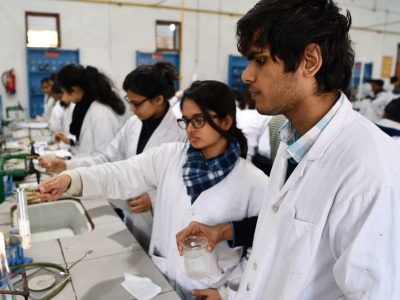
A PhD student works in a clean room at the University of Tokyo.Credit: Yuichi Yamazaki/AFP via Getty
In response to a decline in the number of PhD holders in Japan, the Japanese government has announced plans to not only stop the trend but reverse it, by tripling the number by 2040.
Japan is the only major economy that has recorded a dip in PhD numbers since 2000. In 2022, there were 14,382 new PhD admissions across the country — down 21% from a high of 18,232 in 2003.
As a proportion of the population, there are now fewer PhD holders in Japan than in many other leading research countries. According to Japan’s National Institute of Science and Technology Policy (NISTEP), in 2020, the country had 123 PhD graduates per million people, well below the rate of 315 per million in Germany and 313 per million in the United Kingdom for that year, and 285 per million in the United States in 2019.
A survey published by NISTEP in 2021 revealed that many doctoral students in Japan feel demoralized because of financial uncertainty, career insecurity and a lack of career progression.
To address the problem, Japan’s Ministry of Education, Culture, Sports, Science and Technology (MEXT) announced a three-pillared plan in March, with a focus on boosting career opportunities as well as institutional support and outreach for PhD students. The government is hoping to promote a cultural shift that raises the status of PhD holders in Japanese society.
“We want to create an environment that increases the number of people aiming for doctoral degrees, produces many excellent candidates, and realizes a fruitful life for each candidate and the sustainable development of society as a whole,” Mitsunari Yoshida, director of the Policy Division in MEXT’s Higher Education Bureau, told Nature Index.
The first pillar of the initiative focuses on diversifying career choices, to ensure that doctoral candidates have a more active role in research outside academia, such as in local and central government, start-up companies and other private-sector groups.
2024 Research Leaders
2024 Research Leaders
This focus on industry and government roles aims to address a long-standing cultural issue in Japan, namely that having a PhD might actually limit someone’s chances of being hired.
“The greatest obstacle is the perception that once one gets a PhD in a subject, one is regarded as an expert in that particular field,” says Ken Mogi, a researcher in neuroscience at Sony Computer Science Laboratories in Tokyo, and a visiting academic at the University of Tokyo. “With that image comes the assumption that a person with a PhD is inflexible in work in the real world. For that reason, Japanese companies are typically not forthcoming in employing people with PhDs, discouraging students to consider a career with a PhD.”
MEXT plans to promote long-term, paid internships for PhD students in the private sector, as part of a broader effort to entrench internships in Japanese society.
Symbolic of this is Cooperative Education Through Research Internships, a programme introduced in 2021 with the support of 45 universities and 45 companies, including major Japanese brands. The paid internships run for at least two months, are eligible for academic credit, and aim to support doctoral researchers by matching them to companies and diversifying their career options. The ministry wants to increase the number of PhD candidates in these internships to 5,000 by 2030, up from 3,000 as of May this year.
As its second pillar, MEXT wants to raise the quality of graduate schools by providing extra funding and tracking their progress.
MEXT will part-fund PhD students’ living and research expenses through the Support for Pioneering Research Initiated by the Next Generation (SPRING) scheme, which is run by the Japan Science and Technology Agency to support outstanding doctoral students; and the Japan Society for the Promotion of Science’s Research Fellowship for Young Scientists programme, which supports doctoral students to pursue innovative research of their own choosing.
“Financial issues are significant in Japan, and many PhD students are struggling,” says Tomokazu Iwabuchi, a PhD student in urban planning at Kyushu University in Fukuoka.
After years of taking on part-time jobs during his master’s programme, Iwabuchi says he can now spend more time focusing on PhD research because he was chosen for the university’s Future-Creation course, which is part of the SPRING programme. Doctoral students on the programme receive ¥200,000 (US$1,360) per month to cover living expenses and language training, up to ¥850,000 yen per year in research expenses, and a 50% reduction in tuition fees.
In 2023, Iwabuchi started his own consulting business rooted in his research on urban planning and geographic information system (GIS) data. “I’m really happy to hear that the government is putting more resources into supporting PhD students,” he says. “I hope they will have more career options in the near future.”
The third pillar is about boosting student motivation by supporting more outreach programmes. One example is the Future Doctoral Festival, an annual gathering in Tokyo at which doctoral students give presentations and take part in panel discussions related to their research. The goal of initiatives such as this is to showcase the appeal of pursuing a PhD, not just to students, but also to leading figures in the public and private sectors.
or
doi: https://doi.org/10.1038/d41586-024-02718-6
Nature Index’s news and supplement content is editorially independent of its publisher, Springer Nature. For more information about Nature Index, see the homepage.
 Japanese research is no longer world class — here’s why
 ‘I feel disposable’: Thousands of scientists’ jobs at risk in Japan
 How Japan’s disciplinary strengths are shifting focus
 Japan’s leading international partnerships
 How Japanese science is trying to reassert its research strength
How to find your place in science through an industry postdoc
Career Feature
A 60-minute guide to landing your next job in science
Career News
China’s regional cities are now major players in world science
Nature Index
2025 must be the year when the rules of global finance are reformed
Editorial
‘The next five years will be a crucial time’: meet the analyst shaping space policy
Spotlight
To spur climate action, educators must get personal
World View
Give ‘science for peace’ a chance
Editorial
How Elon Musk’s partnership with Trump could shape science in the US — and beyond
News
Why Asia is leading the field in green materials
Nature Index
Human Technopole (HT) is an interdisciplinary research institute in Milan (Italy) created and supported by the Italian government to develop innova…
Milan (IT)
Human Technopole
Postdoctor in tumor immunity Reference number PAR 2024/1129 The University of Gothenburg tackles society’s challenges with diverse knowledge. 56 00…
Gothenburg (Stad), Västra Götaland (SE)
University of Gothenburg
Founded in 2018, Westlake University is a new type of non-profit research-oriented university in Hangzhou, China, supported by public a…
Hangzhou, Zhejiang, China
Westlake University
Job advertisement The University of Veterinary Medicine Hannover (TiHo) is inviting applications for a W3 Professorship in "Buiatrics" (m/f/d), whi…
30559, Hannover (DE)
Stiftung Tierärztliche Hochschule Hannover
Developing methods for low sample inputs for proteomics in high resolution mass spectrometry, with applications in neuromuscular diseases
Dortmund, Nordrhein-Westfalen (DE)
Leibniz-Institut für Analytische Wissenschaften – ISAS – e.V.
Japanese research is no longer world class — here’s why
‘I feel disposable’: Thousands of scientists’ jobs at risk in Japan
How Japan’s disciplinary strengths are shifting focus
Japan’s leading international partnerships
How Japanese science is trying to reassert its research strength
An essential round-up of science news, opinion and analysis, delivered to your inbox every weekday.
Sign up for the Nature Briefing newsletter — what matters in science, free to your inbox daily.
© 2025 Springer Nature Limited
About The Author


More Stories
Community Snapshot—September
Why Internet Infrastructure Decisions Rarely Stay Localized
A Safer Internet Starts with Taking Action: Introducing the Online Trust and Safety Hub