
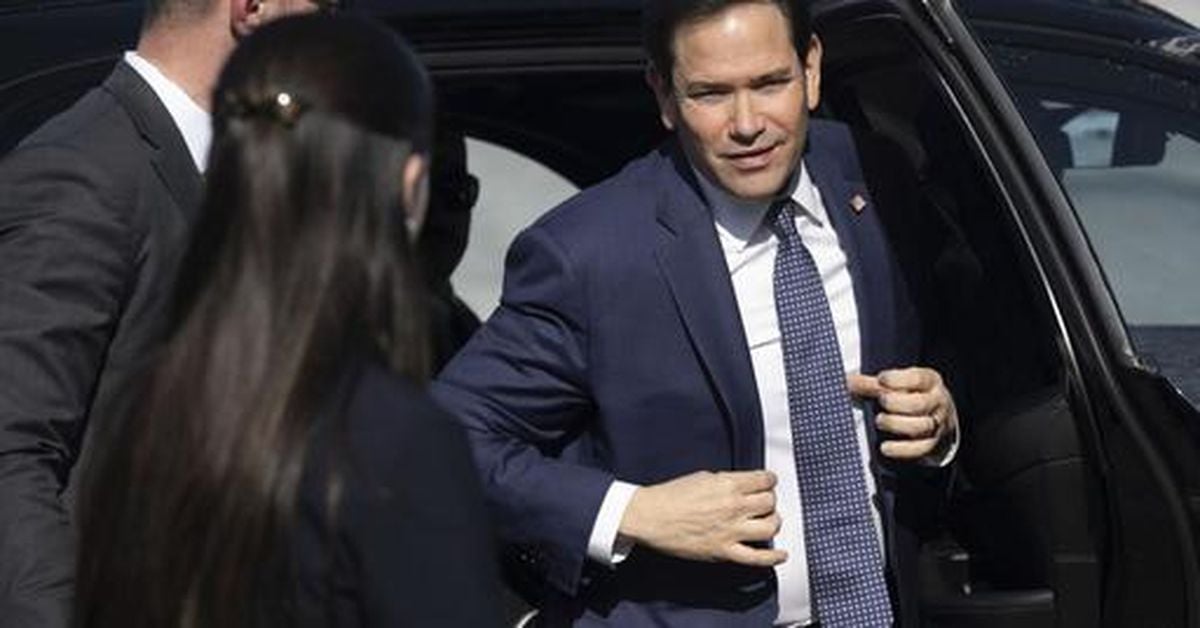
The United States has expelled South Africa’s ambassador to Washington, Ebrahim Rasool, following accusations that he is a “race-baiting politician” who harbors animosity toward the U.S. and its president, Donald Trump. Secretary of State Marco Rubio announced the move on March 14, 2025, stating that Rasool was “no longer welcome in our great country.” This decision marks a significant downturn in U.S.-South Africa relations, which have rapidly deteriorated since Trump resumed office.
Rasool’s expulsion comes after a series of remarks he made during a webinar organized by a South African think tank, where he characterized Trump as a leader of a white “supremacist” movement. His description provoked anger among U.S. officials, particularly from Rubio, who reposted an article from the right-wing outlet Breitbart, highlighting Rasool’s comments. The tensions can be traced further back to Trump’s administration, which has been characterized by an aggressive stance against South Africa’s land expropriation policies aimed at correcting historical racial disparities.
Pivotal criticism has emerged regarding these policies; Trump himself has made accusations against South Africa for purportedly “confiscating land” and mistreating certain demographic groups, without providing substantial evidence. Political analysts like Patrick Gaspard, former U.S. ambassador to South Africa, assert this expulsion and the escalated tensions signal the lowest point in bilateral relations since Trump’s election.
Responding to Rasool’s expulsion, the South African presidency expressed its regret, emphasizing the importance of maintaining diplomatic relations with the U.S. Chrispin Phiri, spokesperson for the Department of International Relations and Cooperation, mentioned on social media that the South African government plans to pursue diplomatic channels to address the situation. The matter comes at a time when South Africa’s government is already grappling with criticism from the U.S. over its land expropriation law and its case against Israel at the International Court of Justice.
Rasool, a seasoned politician and an anti-apartheid activist, had previously served as the ambassador from 2010 to 2015 before his return to the position in January 2025 during Biden’s administration. Shortly after the expulsion was announced, Rasool said in a message to friends and family he was looking forward to returning to South Africa without any regrets. His sentiments reflect a resilience molded by years of political struggle.
During the webinar, Rasool’s comments detailed his views on the effects of Trump’s administration on Africa. He articulated his belief that Trump was “mobilizing a supremacism” and attempting to promote “white victimhood” narratives as demographic shifts in the U.S. were underway. This assertion has elicited divided opinions, with some viewing his comments as an honest depiction of American politics while others criticize him for overstepping diplomatic boundaries.
Following the expulsion, South African President Cyril Ramaphosa referred to the decision as “regrettable,” suggesting that Rasool had made significant progress before the incident unfolded. Officials within the South African government, however, have described Rasool’s actions as a breach of diplomatic conduct, with some indicating it was an “isolated incident” that should not define future relations.
In the U.S., bipartisan support for Secretary Rubio’s actions has emerged, with Jim Risch, Chairperson of the Senate Foreign Relations Committee, endorsing Rubio’s remarks as appropriate. Rasool’s perspective and the timing of his comments suggest a broader context of increasing scrutiny on diplomatic relations influenced by domestic politics in the U.S.
In the ongoing discourse, Rasool’s history as a politically engaged individual further fuels the controversy. As a child affected by apartheid policies, Rasool’s activism began early in life, culminating in his imprisonment during anti-apartheid protests. His connections to prominent historical figures, such as Nelson Mandela, highlight his entrenched position within the fabric of South African politics.
As South Africa continues to navigate the fallout from Rasool’s expulsion, voices from within the country, such as long-time friends and fellow activists, have come to his defense, asserting that his critique of U.S. policies stems from a place of genuine concern for socio-political realities. They contend that targeting Rasool may be rooted in his advocacy for Palestinian rights and his Muslim identity, suggesting deeper layers of complexity in this diplomatic incident.
The U.S.-South Africa relationship, underlined by a history of shared struggles against colonialism and injustice, faces uncertainties as new political dynamics emerge. Observers of international relations note that the path to rebuilding trust between the two nations will require nuanced engagement and a willingness to address the underlying tensions that have come to define this latest diplomatic row.
We’ve launched what we proudly call the “Intelligent Journalism” era: a bold approach to journalism that prioritizes verifiable facts, eliminates unnecessary fluff, restores the rigor of classic journalistic principles, and delivers news in a clear, compelling format—all powered by our innovative AI algorithms.
Support Intelligent Journalism with a tip to help us understand the stories you love most, so we can bring you more of what matters!
We always aim for accuracy, but we recognize that errors can occasionally slip through. We value your feedback and are committed to making corrections whenever needed. If you spot a factual mistake in our stories, please let us know, and we’ll address it promptly.
Please use this feedback form solely for reporting factual errors, rather than for sharing personal opinions. We appreciate your help in keeping our content accurate and reliable.
We always strive for thorough and accurate reporting, and we value any verified information that can help us better understand the stories we cover. If you have relevant knowledge, insights, or evidence related to a news piece we’ve reported, we encourage you to share it with us. Please remember that we require credible proof or documentation to ensure the integrity of our journalism.
When submitting your tip, explain your connection to the case and provide verifiable evidence. This can include links to documents, photographs, recordings, or other supporting materials, as long as they are securely hosted on reputable cloud-based platforms like Google Drive or Dropbox. We cannot accept direct uploads. Please include your contact information (email and phone number) if you would like us to follow up with you regarding your tip. Our editorial team will review your submission, and if necessary, we will reach out for more information. Your help plays a crucial role in helping us deliver accurate, reliable news to the public.
THE PINNACLE GAZETTE, a platform established by Bayesian Tinkering Labs LLC, is your premier source for the latest news across a diverse array of topics. Our website offers comprehensive coverage on science, technology, current events, art, and sports, ensuring that you stay informed and gain fresh perspectives.
About The Author




More Stories
Empowering Parents in Rwanda Through Digital Literacy Training
Advancing the Safer Internet Initiative for Everyone
Youth in Action: Contributing to a More Connected and Inclusive Digital Future