
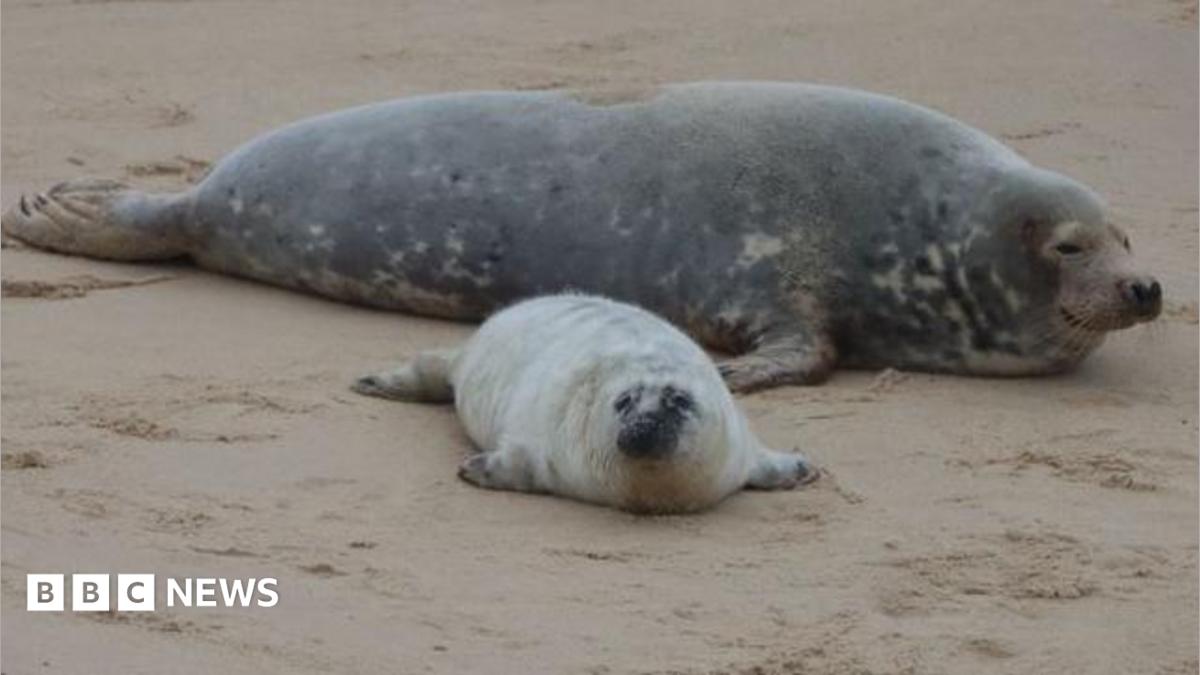
Thousands more seals, along a stretch of shoreline, were discovered in a new scientific study combining drone cameras and Artificial Intelligence
A new scientific study using the latest technology has counted 2,300 more seals on a stretch of beach – and could go on to help conservation efforts.
Volunteers on the ground counted 6,200 seals along a 8km (4.9-mile) run of shoreline around Winterton-on-Sea in Norfolk.
But more than 8,500 seals were counted by drone cameras and the use of artificial intelligence (AI).
"This difference is likely due to the drone's aerial perspective," said Gabriella Fasoli, a scientist at Natural England, which is running a pilot project.
"[It] provides a unique viewpoint from above, allowing for a more accurate count by detecting seals that may be hidden or less visible from the ground."
AI was used to analyse drone images and automatically detect the seals, while also distinguishing between adults and their white pups even in close groups
Seal populations have previously been monitored through observations made on the ground and aerial surveys.
Natural England, which advises the government on the natural environment, said this had sometimes caused problems in collecting accurate data.
It had proved particularly challenging in hard to reach areas.
In December, a specialist team sent up a drone with high-resolution cameras to capture images from 110m (360ft) above, as part of the two-year pilot.
However, while the new methods – which minimise disturbance to the animals – will enhance the accuracy of assessing the UK seal population's size, Natural England say volunteers will still remain crucial in recording numbers.
The drone camera was launched from Winterton-on-Sea in December
Emma Milner, the agency's senior marine mammal specialist, said the project had shown there was now a "cost and time efficient alternative" to monitoring seal populations.
"This cutting-edge technology will help contribute to a comprehensive national picture of seal populations, allowing us to better understand population changes over time," she said.
She added it would also let it "assess the impact of human activity on these crucial habitats, enabling better conservation efforts".
The UK hosts 35% of the global population of grey seals and is an important breeding ground, according to Natural England.
Special permission was given to fly the drones, with best practice also followed to not disturb the animals.
People are not allowed to fly drones over the seals without the appropriate permissions, Natural England warned.
Do you have a story suggestion for Norfolk?
Follow Norfolk news on BBC Sounds, Facebook, external, Instagram, external and X, external.
Seal mothers 'may be moving to less crowded sites'
Seal colony thriving 'thanks to secluded site'
Watch: Birth of seal pup caught by wildlife camera
Natural England
Empty flower shop set to go under the hammer
Huge £200m Norfolk road scheme WILL go ahead after being spared government axe
Art exhibition exploring evolution of mythologies opens in Norfolk
Opportunistic scrap metal thief stole tables and chairs from seaside street
On this week: February 22-28, 2014
Glitz and glamour at roaring 20s fundraiser
Trump says Europe should provide security guarantees for Ukraine ahead of Starmer talks
Israel releases Palestinian prisoners after Hamas hands over four hostages' bodies
Water sector needs 'urgently' fixing says minister
Pamela Anderson on missing out on Oscars, ditching makeup and 'innocence' of Baywatch
'Putin will strike again' and Starmer heads to DC
Cousin marriage: What new evidence tells us about children's ill health
Musk, tariffs and tensions – takeaways from Trump's first cabinet meeting
Leaked recordings challenge Greek account of deadly shipwreck
'I need help': Freed from Myanmar's scam centres, thousands are now stranded
Inside the Taliban's surveillance network monitoring millions
What an AI-generated video of Gaza reveals about Trump tactics
US Politics Unspun: As Trump starts his second term, cut through the noise with Anthony Zurcher's newsletter
A new murder dredges up old crimes
Exploring the world beneath our feet
Surgeons at the cutting edge of medicine
A DNA test with life-changing results
Copyright © 2025 BBC. The BBC is not responsible for the content of external sites. Read about our approach to external linking.
About The Author




More Stories
What Happens When a Community Wires Itself: Lessons from Colville on the Power of Indigenous-Led Connectivity
From Curiosity to Confidence: CodificaKids Builds Digital Trust in Rural Brazil
Community Snapshot—August