
Thank you for visiting nature.com. You are using a browser version with limited support for CSS. To obtain the best experience, we recommend you use a more up to date browser (or turn off compatibility mode in Internet Explorer). In the meantime, to ensure continued support, we are displaying the site without styles and JavaScript.
Advertisement
Scientific Reports volume 15, Article number: 5910 (2025)
Metrics details
In order to achieve more efficient, accurate and intelligent substation equipment management and overall work efficiency of the substation, improve the work quality of the substation, innovate the data transmission mode and basic algorithm of the distribution network, and improve the traditional shortcomings and defects. With the increasing digitalization of distribution network equipment (DNE), real-time update algorithms for digital twin (DT) models have become a focus of research on digitalization of DNE. However, traditional real-time update algorithms for DT models still have problems such as poor real-time and accuracy, robustness, and scalability. The article first described the problems existing in the traditional DT model of DNE. Then it used IoT sensors and optical devices to collect data related to DNE; then it used the Savitzky–Golay filtering algorithm to denoise the data. This article combined the IoT and optical imaging technology to construct a DT model; by using the recursive least squares method again, key parameters and state parameters were extracted from the constructed DT mechanism model, achieving real-time updates of the DNE DT model. Finally, to verify the application effect of the IoT and optical imaging technology in real-time update algorithms for DT models of DNE, this paper compared them with traditional parameter sensitivity analysis and state estimation. The research results showed that in the real-time and accuracy testing of test case 13, the algorithm used in this paper had a time of 0.014 s and an accuracy of 93.2%. The parameter sensitivity analysis method had a time of 0.045 s and an accuracy of 80.4%. The state estimation method took 0.056 s and had an accuracy of 82.7%. In addition, the robustness and scalability of the real-time update algorithm for the DNE DT model using the method proposed in this article are significantly better than the other two traditional methods. The results show that the real-time update algorithm of the DT model of DNE based on the IoT and optical imaging technology has better real-time performance, higher accuracy, and better robustness and scalability. This study highlights the significant impact of the IoT and optical imaging technology on the accuracy, robustness, and real-time performance of real-time update algorithms for DT models. This provides more solutions for real-time monitoring, prediction, and control of DNE.
As the technology develops rapidly, the application of the IoT and optical imaging technology is becoming increasingly widespread in various industries1,2. These technologies provide new solutions for real-time monitoring, prediction, and control of DNE. DT (Digital Twin) models, in the current research and development, through the algorithm update research of DT model in substations and distribution networks, DT model can well help distribution equipment and distribution networks improve their own operation and maintenance service capabilities, rapidly improve work efficiency, achieve new breakthroughs and innovations in algorithms, and ensure the normal operation of distribution networks. Through the effective application of DT model in the theoretical and technical level has been highly valued and recognized by scholars in various fields in the world.
The distribution network is an important component of the power system, and its operating status directly affects the quality and reliability of power supply. However, traditional distribution network monitoring methods have problems such as low work efficiency, low accuracy, and lack of real-time performance. To address these issues, this study aims to study real-time update algorithms for DT models of DNE on account of the IoT and optical imaging technology3,4. With the access of distributed power supply, the distribution system often includes distributed power generation, such as photovoltaic, energy storage, etc., which is called active distribution network. Distribution network has the characteristics of many points, wide area, line length, large change and poor communication environment5.
Wang Jinjiang proposed a DT model updating scheme based on parameter sensitivity analysis to enhance the adaptability of the model. He found through research that the constructed DT model can perform accurate diagnosis and adaptive degradation analysis. Vijayakumar, K proposed a method of applying DT to manufacturing facilities to maintain real-time updates and simulations of models, in response to the issue of significant time and cost required for digital updates of current manufacturing facilities. He stated that any facility change request can be made within this DT model and simulated in real-time to obtain the fastest decision6.
DT model and its algorithm can greatly enhance the active regulation ability of distribution network. Accelerate the development of new distribution terminals with active planning, perception, service and other functions, consolidate the physical basis for safe and stable access to large-scale new energy sources, and improve the safe operation of distribution networks7,8,9,10,11,12. At the same time, increase the application of flexible power electronics technology, improve the power quality, power supply reliability and operation economy of the urban distribution network, improve the active adjustment ability of the power grid power flow transfer, and strongly support the construction of the urban distribution energy Internet13,14,15,16. DT model algorithm in the specific calculation of data and behavior and the application of digital model, in order to maintain the stability of digital space, the digital algorithm will be transformed according to different physical conditions and specific situations in specific application scenarios, forming an inherent digital model. Another aspect is to match and apply DT model according to the specific field used through physical evolution. In order to achieve the maximum technical advantages of DT model17,18,19,20.
DT is virtual replicas of real physical entities in computers, which can be viewed as abstract digital models of data and behavior of objects of interest. To keep the properties of DT in the virtual space, it is useful to keep updating, changing and evolving the DT model in real time according to the successive changes of the corresponding physical factors. Due to the various advantages of DT technology, DT has sparked discussions among many scholars21,22,23,24. To address the main barriers to service quality in the industrial IoT, Lu Yunlong utilized operational data from IoT devices to construct a DT model and proposed an asynchronous model real-time update scheme. He found through experiments that this method improves communication efficiency and reduces transmission energy costs. Guo Liang pointed out that the DT virtual model needs to update the digital information of physical entities in real time. The IoT technology can provide real-time comprehensive data collection and effective interconnection between virtual models and physical entities for DT. He believed that the IoT technology was one of the key technologies to achieve DT25. These scholars’ research on DT models can help enrich their theoretical content, but there are also some shortcomings. Although scholars have already involved updating the DT model in their research, there is little exploration of real-time update algorithms for the model. This leads to low efficiency, low accuracy, and lack of real-time performance of the DT model for DNE26.
Real-time update algorithms are of a great importance in the DT model of DNE. It can enable DT models to reflect the status and changes of DNE in real time, thereby providing more accurate and reliable data support for the power industry9. Therefore, some scholars have conducted research on real-time update algorithms. In order to provide status updates to the monitor through a simple queue, Yates, Roy D proposed a new real-time update method for calculating the timeliness measurement of finite state continuous time queuing systems. This method makes the complexity of evaluation comparable to the complexity of finding a stationary distribution of finite state Markov chains, and can achieve real-time state updates. To optimize voltage regulation performance and enhance robustness, Zhang, Hongyu proposed a new real-time parameter update algorithm based on the static model. It can quickly and accurately identify model parameters and update them in real-time, so that the control law can ensure the required control performance over a wide operating range, and its effectiveness has been verified through experiments. Scholars’ research on real-time update algorithms can provide certain theoretical support for this study. Because its research focus does not belong to the DT model of DNE, and it has not optimized the algorithm by combining the IoT and optical imaging technology. This makes it difficult for the research to be well promoted and applied, making it difficult to meet the real-time updating needs of DT models for DNE.
For a better study of real-time update algorithms for DT models of DNE, this paper combines the IoT and optical imaging technology to achieve real-time updates of the algorithm based on the research of the DT model of DNE. It optimized the performance of the DT model for DNE, and through empirical research, it was found that the method proposed in this paper has better real-time and accuracy updates, higher algorithm efficiency, and better robustness and scalability. Compared with traditional methods, the innovation of this study lies in the attention to the importance of IoT and optical imaging technology in data collection and real-time update algorithm research in the construction of DT models, and their application in real-time update algorithms. This helps to improve model performance, monitor the security status and abnormal situations of DNE in real time, and timely discover potential security risks and threats.
In response to the issues of real-time, accuracy, robustness, and scalability faced by the DT model of DNE, this paper takes the distribution network as the research object and studies the real-time update algorithm of the DT model of DNE. Real-time performance is an important issue that needs to be addressed in the DT model of DNE. The status and changes of DNE are dynamic and need to be reflected in the DT model in a timely manner. However, existing technological methods cannot guarantee real-time performance, resulting in lag or deviation between the model and the actual situation. The real-time update algorithm for the DT model of DNE needs to run efficiently to avoid affecting the normal operation of DNE. However, some complex algorithms may require a significant amount of computing resources and storage space, reducing the efficiency of model operation. Therefore, while ensuring the accuracy and real-time performance of the model, it is necessary to optimize the algorithm complexity and improve the operational efficiency of the model. In addition, the DT model of DNE needs to be able to adapt to different types and scales of DNE. However, due to differences and limitations between different devices, DT models may need to address scalability issues.
Firstly, it is necessary to collect various types of data from the DNE. This article uses methods such as IoT sensors and optical imaging technology to collect the operational status, environment, network unit configuration, network topology structure, etc., of the equipment in the distribution network.
In the distribution network, data collection is the first step. There are many methods for data collection, one of which is to deploy IoT sensors to achieve real-time data collection. This IoT sensor can automatically record and transmit information. In addition, optical imaging technology can also be applied to data acquisition. Optical equipment can be installed in the distribution network line, debugged and calibrated, and then optical imaging technology can be used to capture the image information of the DNE and convert it into digital signals for processing. These digital signals include device status information, location information, etc.
When constructing a DT model for DNE, data collection of DNE is an essential part. In practical applications, it is necessary to comprehensively consider various physical parameters, such as distribution network big data screening coefficients, distribution network signal transmission vectors, etc., in order to establish stable DNE big data portrait labels. The distribution network big data filtering coefficient is usually represented by (:{uptau:}), and generally speaking, the value of this parameter is always within the physical range of([1,+{infty})). The DNE can be expressed as (:underset{o}{to:}): when the fixed distribution network coefficient is (:{upsigma:}), the higher the true value of this physical quantity, the greater the amount of high-capacity power data information collected by the distribution network. After combining the above physical quantities, the data collection results of the distribution network in the IoT working environment can be expressed as:
Among them, (:{text{v}}_{1},{text{v}}_{2},ldots:,{text{v}}_{text{i}}) represent i different distribution inductance coefficients; I is the maximum value result of the electricity monitoring indicator.
In terms of sensor data processing, this article uses LMS (least-mean-square) adaptive filtering method, which covers two parts: filtering and adaptive process. The LMS adaptive filtering method has the advantages of simplicity, ease of implementation, adaptability, good tracking performance, and strong robustness, and has been widely used in the field of sensor data processing. Firstly, it is necessary to calculate the response of the linear filter to the input signal, and then compare the output result with the expected response. The resulting estimation error is used to automatically adjust the parameters of the filter. This adaptive process uses adaptive control algorithms to find suitable tap weights for the lateral filter.
In response to the issues of missing and noisy measurement data, this article uses the mean method to complete the missing data. After all missing data is filled in, the data is sampled every hour. The filled data is denoised using a Savitzky–Golay filter, which significantly reduces outliers in the denoised data. The Savitzky–Golay filtering algorithm is a method that uses the least squares convolution method to fit local regions of data into g-degree polynomials, which can effectively improve the signal-to-noise ratio of the signal. It can also smooth and denoise signals, effectively improving high-frequency noise in prediction data. There are two key parameters in the Savitzky–Golay filtering algorithm: the polynomial fitting order g and the filter window length v. If v is too long, it may lead to the loss of effective signals; if v is too short, it may affect the noise reduction performance of the filter. When g is too high, it may cause new noise to be generated in the distribution network data; when g is too low, it may cause distortion of the distribution network data signal. Therefore, appropriate g and v values should be selected to maintain a balance of effective signals while random denoising. The formula for using Savitzky–Golay filter to denoise data is:
Among them: (:{q}_{s})—Smoothing value for the s-th time; (:v)—Window size; (:{D}_{n})—The coefficients of the weighting function; (:{q}_{s+n})—Unfiltered value of time; (:s+n)—Within the target time interval of (:s=1cdots:m).
By normalizing the filled and filtered data, the saturation of input neurons in the IoT is avoided, thereby improving the accuracy of the model. The normalization formula is:
Among them: (:{B}_{n})—Normalized raw data; (:{A}_{n})—Original input data; (:{A}_{min})—The minimum value in the original data; (:{A}_{max})—The maximum value in the original data.
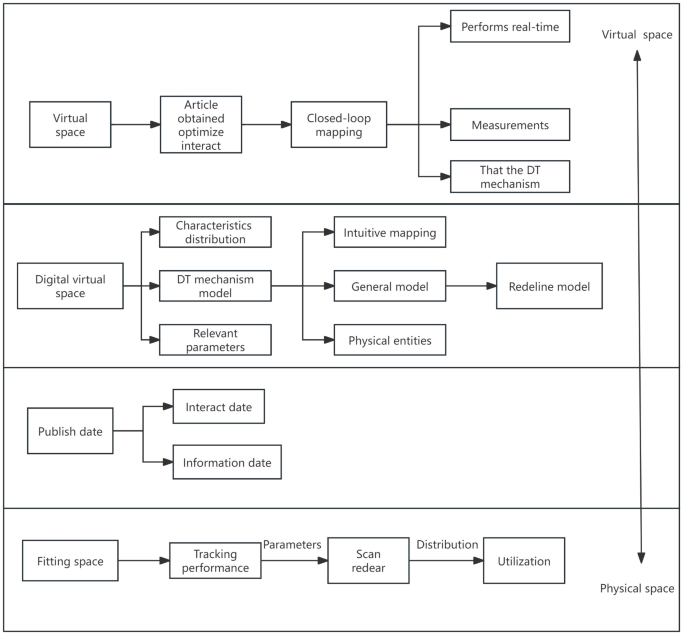
The DT model in this article consists of physical space, DT space, physical data, virtual interaction space, and twin data. The framework structure of the DT model is shown in Fig. 1.
Framework structure of DT model.
The DT model first performs real-time measurements on the controller, encoder, grating ruler, etc., and inputs them into the DT space in Fig. 1. It can monitor and predict DNE, and then interact with DT models through virtual interaction space. After this article, a DT model is applied for virtual debugging, and based on the obtained twin data, decision feedback is given to the DNE to optimize its working status and form a closed-loop mapping mechanism. Its five dimensional formalization can be expressed by the formula:
Among them: (:{ML}_{DT})—DT model; (:PS)—Physical space; (:DTS)—DT space; (:TD)—Twin data; (:VRIS)—Virtual real interaction space; (:CT)—Connection.
The DT mechanism model is an intuitive mapping of physical entities in virtual space. Considering the characteristics of the distribution network, in order to ensure that the DT mechanism model can accurately restore physical entities, this paper uses the multi domain modeling tool Simulink/Simscape to construct the model. Firstly, the power distribution network is divided into three main subsystems: control, electrical, and mechanical. On this basis, each part is divided into modules according to their functions, and some components can be directly used from the modules in the tool library. Then, based on the physical structure and energy flow relationship between each module, the control part, electrical part, and mechanical part are coupled through domain interface modules. It then imports the relevant parameters of the DNE to verify the dynamic characteristics of the DT mechanism model. At the same time, by comparing the differences between actual operation and simulation results, the model parameters were iteratively optimized multiple times, and finally the DT mechanism model of electromechanical integration DNE was obtained.
After in-depth analysis of the DT mechanism model of DNE, a DT mechanism model of DNE was successfully constructed in the Simulink environment. The DNE inputs displacement commands, and then the control part issues commands to each electrical module to control the parameters; then the obtained angular velocity can be input into the mechanical part to drive the movement of the mechanical module. At the same time, the IoT sensor module is used to monitor the current signal, angular velocity signal, and displacement signal of the feed DNE, and these signals are fed back to the control part to achieve closed-loop precise control of the model. Figure 2 displayed the DT mechanism model.
Model of character twin mechanism.
This article uses IoT sensors, optical imaging technology and other related software to collect massive data, and obtains an automatic decision-making model through training and fitting. In order to improve the accuracy of updating DT models, this article adopts the IoT and optical imaging technology to establish a data-driven DT model. Traditional neural networks cannot fully utilize the information obtained in the previous processing step, and there is a certain degree of temporal correlation between the various processes during the processing. Therefore, the use of optical imaging technology can not only mine historical data at a deeper level, but also take into account the temporal characteristics of the data and efficiently construct data-driven DT models. The construction of a data-driven model for DT and the residual compensation method are shown in Fig. 3.
DT data-driven model construction and residual compensation process.
The method in Fig. 3 is mainly based on the mechanism model. This method first uses a large amount of historical data for calculation to obtain the residual of the mechanism model. Then, the input and residual of the model are normalized and treated as inputs and outputs, and the model is driven by training to obtain DT data. This model serves as a residual compensator in parallel with the mechanism model, compensating and correcting the residual of the mechanism model, thereby improving the prediction accuracy of the DT model. This method utilizes the powerful data processing capabilities of optical imaging technology, learns complex dynamic relationships from historical data, and applies them to residual compensation, improving the accuracy of DT models.
In order to construct a DT data-driven model to predict residuals, it is necessary to extract samples from the DNE, which would serve as inputs and outputs. At the input end, it remains consistent with the input of the mechanism model. At the output end, the residual between the predicted values of the model and the actual operating results of the physical entity would be used as the output. Through this approach, DT data-driven models can learn and update in real-time, improving update accuracy.
After establishing a DT model for distribution network design, it is prone to degradation due to its susceptibility to factors such as operating conditions and environment in practical work. Therefore, the established DT model must have dynamic characteristics and its response must conform to the real system state. This is also a key issue that urgently needs to be addressed in achieving real-time updates of DT models for DNE. This article would use IoT technology and optical imaging technology, using recursive least squares method to extract key mechanical parameters and state parameters from the DT mechanism model, and construct a system identification model with significant impact. By obtaining transient response information from measured data through multiple sensors, this paper adopts the recursive least squares method to achieve real-time updates of the DT model. Recursive Least Square (RLS) is a machine learning algorithm that performs linear fitting on a given sample and is used to update the model when solving for the optimal parameter with the minimum mean square error. This method estimates parameters by updating them, combining the current parameters with new data. It uses an iterative calculation method to replace old sample points with new ones, continuously updating the fitting function parameters. The specific real-time update method for DT models is shown in Fig. 4.
Real-time update method for DT model of DNE.
In a DT model of DNE, the observation values of M inputs and outputs can be expressed as (:left{wleft(cright),:zleft(cright),:c=text{1,2},ldots:,:text{M}right}), and the least squares estimation (:widehat{sigma:}) of the batch processed model parameters can be expressed as follows:
In an observable system, the observation data input and output of Group M are represented as (:left{wleft(cright),:zleft(cright),:c=text{1,2},ldots:,:text{M}right}), and the least squares estimate (:widehat{sigma:}) of the system parameters obtained after batch processing is:
Among them: (:gamma:)—data vector matrix; (:F)—Output matrix.
For large-scale input and output data, the least squares estimation method can be used for batch processing. It not only takes up a lot of storage space, but also has a slow operation speed, so recursive least squares method needs to be used. According to the basic principle of recursive least squares method, the least squares estimation of intermittent process at time c is obtained, and its formula is:
Let the covariance matrix (:text{Q}left(cright)) be:
From this, it can be concluded that:
The estimated value at time (:c-1) can be inferred from the above formulas (6) and (7) as follows:
According to the above formulas (8) and (9), it can be inferred that:
So the least squares estimation at time (:c) can be expressed as:
Among them: (:Lleft(cright)) is gain vector, and (:Lleft(cright)=text{Q}left(cright)tau:left(cright)).
In order to achieve real-time updates of DT models, it is necessary to construct recursive state variables. Therefore, this article adopts the recursive least squares method to achieve real-time updates of the DT model by associating it with data. This method is mainly aimed at accurately updating the moment of inertia in the DT model of DNE online30. It continuously adjusts model parameters to better adapt to changes in real-time data, improving the accuracy, robustness, and scalability of model updates.
DNE DT.
To verify the application effect of the IoT and optical imaging technology on the real-time update algorithm of DT models for DNE, this article also needs to conduct practical tests on them. Therefore, this article selects power data from the DR Power database as the test object, and divides the data into multiple datasets after data processing. It randomly selected 13 sets of electricity datasets as experimental test cases to compare the real-time updating performance, accuracy, robustness, and scalability of the DT model real-time update algorithm under the Internet of Cultural Relics and optical imaging technology, traditional parameter sensitivity analysis methods, and state estimation methods. This provides more basis for the widespread application of IoT and optical imaging technology in real-time update algorithms for DT models of DNE. The testing environment and equipment for this experiment are shown in Table 1.
The real-time update refers to the speed at which the DT model updates in real time, that is, the model reflects the state changes of the DNE in a short period of time. The real-time update performance is an important measure of the real-time update algorithm performance of DT models, and models with good real-time performance can reflect the true state of the distribution network. It can help decision-makers obtain real-time data and information, making wiser decisions. At the same time, it can also help managers identify potential problems and risks in a timely manner, and take corresponding preventive measures. The important indicator of real-time updates is algorithm efficiency. Generally speaking, the higher the efficiency of update algorithms, the better the real-time performance of the model. This article tested the required time of algorithms under three methods, and the results are shown in Fig. 5.
Comparison of algorithm time results under three methods.
The horizontal axis 1 to 13 in Fig. 5 represents test cases, and the vertical axis 0 to 0.08 represents time.
For test case 1, the required time for the algorithm under the method proposed in this paper is 0.012 s in Fig. 5. This study continuously analyzed the dynamic characteristics of the newly established DT model, which has innovative and better practical value compared to traditional model applications and imaging. When implementing real-time data sharing of the DT model for DNE, algorithm optimization can significantly enhance and improve the effectiveness value as evident in the changes within graph. The DT model will utilize Internet of Things technology and optical imaging technology, adopting the recursive least squares method to extract key mechanical parameters and state parameters from the mechanism model, and construct a system identification model with significant impact.
The algorithm under the traditional parameter sensitivity analysis method requires 0.036 s, while the algorithm under the state estimation method requires 0.059 s. For test case 6, the required time for the algorithm under the method in this article is 0.018 s. The algorithm under the traditional parameter sensitivity analysis method requires 0.039 s, while the algorithm under the state estimation method requires 0.058 s. For test case 13, the required time for the algorithm under the method in this article is 0.014 s. The algorithm under the traditional parameter sensitivity analysis method requires 0.045 s, while the algorithm under the state estimation method requires 0.056 s.MATLAB 2023Ra software Surt multidimensional model was used for data analysis, and the results were shown in Fig. 6.
Surt multidimensional model.
In Fig. 6, it can be seen that the red area is the sensitivity response time before improvement, and the parameter sensitivity time remains in the low space of the spatial response, with a longer time response and a low reaction period. The yellow region is the sensitivity response time after the improvement of the DT model algorithm, and the parameter sensitivity time remains in the high space of the spatial response, the time response is short and the high-speed reaction period is maintained. There is a significant gap between the two intervals, and the DT model improvement algorithm in the yellow region has more advantages and significant improvement.
It can be seen from this that the algorithm under the method proposed in this article requires the shortest time, followed by the algorithm under the traditional parameter sensitivity analysis method, and the algorithm under the state estimation method requires the longest time. This indicates that the algorithm in this article is more efficient, the model has better real-time performance, and the constructed model can reflect the real state of the distribution network in real time. This helps decision-makers to better obtain real-time distribution network data and information, thereby making more accurate decisions. It also helps managers to promptly identify potential problems and risks, and take corresponding preventive measures.
Accurate DT models can help enterprises achieve more efficient, precise, and intelligent management and decision-making, thereby improving their competitiveness and sustainable development capabilities. Updating accuracy is an important testing indicator for real-time update algorithms of DT models. By evaluating the accuracy of real-time updates of the DT model, it can determine whether the updated model can accurately reflect the status and operation of DNE, and also optimize decision-making. This article tested the updating accuracy of three methods and the error rate of the algorithm, as displayed in Fig. 7.
Update accuracy results.
The horizontal axis 1 to 13 in Fig. 7 represents test cases, and the vertical axis 76–100% represents accuracy.
As shown in Fig. 7, the accuracy of the proposed method for updating test case 1 is 95.2%. The update accuracy for test case 6 is 92.6%, and the update accuracy for test case 13 is 93.2%. The traditional parameter sensitivity analysis method has an accuracy of 75.4% for updating test case 1. The update accuracy for test case 6 is 77.1%, and the update accuracy for test case 13 is 80.4%. The accuracy of the state estimation method for updating test case 1 is 82.6%. The update accuracy for test case 6 is 80.4%, and the update accuracy for test case 13 is 82.7%. It can be seen from this that the updating accuracy of the method proposed in this article is significantly higher than that of traditional parameter sensitivity analysis methods and state estimation methods. This means that the method proposed in this article can accurately reflect the status and operation of DNE. This helps distribution network enterprises achieve more efficient, accurate, and intelligent management and decision-making, and improve their sustainable development capabilities.
In addition, this article also tested the error rates of the algorithms under three methods, and the results are shown in Table 2.
According to Table 2, the error rate of the algorithm under the proposed method of this paper is the lowest among the three methods, ranging from 1.6 to 3.9%. The error rate of the algorithm under traditional parameter sensitivity analysis methods is between 10.3% and 18.9%, and the error rate of the algorithm under state estimation methods is between 14.3% and 19.3%. It can be seen that the error rate of the algorithm under the method proposed in this article is the lowest. This means that the real-time update algorithm for the DT model of DNE in this article is the best, with smaller errors. It can better meet the accuracy requirements of real-time updates of DT models for current DNE.
Robustness refers to the tolerance of the model to changes and disturbances in input data. A robust real-time update algorithm for the DT model of DNE is of great significance for improving algorithm performance, ensuring real-time performance, ensuring model accuracy, optimizing resource allocation, and preventing and solving problems. This article evaluates the data loss and network latency of DT models using three methods over time, in order to analyze the robustness of the models, as shown in Fig. 7.
Data loss and network latency of three methods of models at runtime.
As shown in Fig. 8A, the data loss rate of the paper’s method during runtime is between 0.5 and 4.3%. The traditional parameter sensitivity analysis method has a data loss rate of 2.6–8.8% at runtime, while the state estimation method has a data loss rate of 3.5–8.4% at runtime. It can be seen that as the running time continues to change, the data loss rates of the three methods are gradually increasing. Overall, the data loss rate of the method proposed in this article has grown the slowest. As shown in Fig. 8B, the network latency of the paper’s method during runtime is generally between 15 milliseconds and 32 milliseconds, with an average latency of 22.65 milliseconds. The network latency of traditional parameter sensitivity analysis methods during runtime is generally between 39 milliseconds and 90 milliseconds, with an average latency of 62.3 milliseconds. The network latency of the state estimation method during runtime is generally between 48 milliseconds and 95 milliseconds, with an average latency of 72.65 milliseconds. Among the three methods, the method proposed in this paper has the least network delay. According to the research in Fig. 8A, B, it can be concluded that the proposed method has the best robustness. This also means that the algorithm performance of the method proposed in this article is the best, with the best real-time performance and the highest model accuracy. This is beneficial for optimizing resource allocation and preventing and solving problem distribution network problems.
Scalability testing can evaluate the performance of DT models in handling large-scale DNE and ensure the accuracy of real-time updates. It is of great significance in ensuring model accuracy, improving model reliability, optimizing resource utilization, adapting to different environments and application scenarios, and promoting technological innovation and progress. The network usage rate is usually used for scalability testing. Generally speaking, without considering other situations, the higher the network usage rate, the better the scalability. Therefore, this article tested three methods for network utilization, and the results are shown in Fig. 9.
Network usage results of three methods.
The horizontal axis in Fig. 9 represents test cases, and the vertical axis represents network usage.
As shown in Fig. 9, for test case 1, the network utilization rate of the paper’s method is 85.4%. The network utilization rate of traditional parameter sensitivity analysis is 62.3%, and the network utilization rate of state estimation method is 59.8%. For test case 6, the network utilization rate of the method in this article is 83.2%, and the network utilization rate of traditional parameter sensitivity analysis is 73.1%. The network utilization rate of the state estimation method is 65.4%. For test case 13, the network utilization rate of the method in this article is 83.9%. The network utilization rate for traditional parameter sensitivity analysis is 69.2%, while the network utilization rate for state estimation methods is 70.1%. It can be seen from this that when the test dataset is the same and other factors are not considered, the network utilization rate of the method proposed in this paper is the highest. This also means that the scalability of the method proposed in this article is the best, which is more conducive to processing a large amount of distribution network data. It better ensures the accuracy of real-time updates and has practical application value.
As the current technology develops, the application of the IoT and optical imaging technology is becoming increasingly widespread. The application value of the IoT and optical imaging technology in the field of distribution network DT models still needs to be explored. The focus of this article is on the real-time update algorithm of DT models for DNE based on the IoT and optical imaging technology. The article first introduced the relevant background of the research, then analyzed the advantages and disadvantages of previous scholars in updating DT models, and then conducted in-depth research on real-time update algorithms for DT models of DNE. In the research, this article introduced the IoT and optical imaging technology into the construction of DT models and real-time update algorithms.
The application of DT model machine algorithm strengthens the distribution network as the last link between the power system and the user, and the application analysis of its operation parameters, state parameters, parameter sensitivity and other relevant data has been enhanced. In the traditional research field, the sensitivity debugging of related equipment in the distribution network has always been a difficult problem. How to effectively apply the new algorithm and technology to the practice field has important influence and significance for the power system and equipment. Through experimental research, the operation parameters are verified by rated data, and the distribution network state parameters are run according to the standard, and the improvement effect is remarkable after algorithm optimization.
A data-driven DT model was established using Internet of Things and optical imaging technologies. The DT model, which is based on a novel algorithm addresses the limitations of traditional neural networks in terms of overall data processing capabilities. The model integrates RLS machine learning algorithm with the DT model, and proposes the hypothesis extremity in the boundaries of vibration impact and optical structure impact on metrological analysis. By integrating vibration parameters with the optical model using ray tracing method, and conducting analysis using FFT algorithm, quantified analysis values were obtained. These values were compared with traditional methods, showing significant improvements, thus validating the practical value of effectively constructing data-driven DT model.
In the studies of other scholars, methods suitable for big data analysis are compared to find out the law and guide the construction and operation and maintenance of distribution network. Based on multi-dimensional variable data analysis, the comprehensive evaluation and diagnosis of the distribution network can quickly obtain major technical indicators such as the distribution network reliability rate, line loss rate, and voltage qualification rate, so as to realize the overall evaluation, diagnosis, and analysis of the current status of the distribution network, and provide quantitative data support for finding the weak links of the system. The breakthrough point of the specific strategy is to establish a logical relationship between the operation parameters and the state parameters of the distribution network, find the degree of correlation between the two, and provide data support for the analysis of the current situation of the grid structure and the monitoring of equipment quality27,28,29.
The application of the distribution network DT model and the experiment of intelligent operation and maintenance system are mainly based on cloud computing, Internet of Things and big data technology, and are combined with the operation and maintenance of the distribution room and electricity consumption services to provide users with online and offline distribution operation and maintenance services. The system can realize remote centralized duty, system automatic monitoring, operation data analysis, on-site mobile inspection, equipment life management, energy efficiency analysis and diagnosis, monthly operation analysis, comprehensive evaluation of power distribution station, real-time operation monitoring. Based on the safety analysis, health status evaluation and energy efficiency evaluation functions of the distribution room based on real-time data and big data model, the operation status, management level and power consumption efficiency of the user are objectively and comprehensively evaluated. Automatic analysis report, statistical report, can respond to the user’s data statistical analysis and operation and maintenance report needs; Covering distribution operation and maintenance, metering and price management, floor electricity monitoring, energy management and other panoramic services30. This system can reduce maintenance personnel, eliminate behavioral waste, extend equipment life, reduce maintenance costs, thereby reducing operating costs, and also benefit energy conservation and efficiency.
Finally, to verify its application effectiveness, this article also compared it with two other traditional methods. The research results indicate that compared to the other two methods, the method proposed in this paper has better real time, accuracy, robustness, and scalability in updating, and can process distribution network data more quickly and accurately, reflecting the actual status of the distribution network in real time. It is beneficial for optimizing resource utilization, meeting the needs of different environments and application scenarios, promoting technological innovation, and has good application prospects. At the same time, there are also some shortcomings in the research. The selected data in this article is relatively small, which may have a certain impact on the research results. In addition, the model in this article is only applicable to a single platform and software, and there are still significant doubts about the compatibility of the model. In subsequent research, it is necessary to evaluate the compatibility of the DT model between different platforms and software versions to ensure that the real-time update algorithm can run normally in different environments. In addition, it is also necessary to evaluate the usability and user friendliness of the DT model, so that users can easily manage and update DNE in real-time.
All data generated or analysed during this study are included in this published article.
Zhang, X., Yang, T. F. & Jia, X. H. PON monitoring scheme using wavelength-bandwidth identification of a single fiber Bragg grating. IEEE Photonics Technol. Lett. 33(8), 387–390 (2023).
Article ADS MATH Google Scholar
Wang, T. & Liu, G. Software defined virtualized access network supporting network slicing and green communication. J. Comput. Res. Dev. 58(6), 1291–1306 (2023).
ADS MATH Google Scholar
Li, Z. Y. et al. SVM for constellation shaped 8QAM PON system. ZTE Commun. 20(1), 64–71 (2023).
MathSciNet MATH Google Scholar
Bilal, H. et al. Jerk-bounded trajectory planning for rotary flexible joint manipulator: an experimental approach. Soft Comput. 27(7), 4029–4039 (2023).
Article MATH Google Scholar
Bilal, H. et al. A practical study of active disturbance rejection control for rotary flexible joint robot manipulator. Soft Comput., 1–15 (2023).
Xu, S. et al. Fault estimation for switched interconnected nonlinear systems with external disturbances via variable weighted iterative learning Express briefs. IEEE Trans. Circ. Syst. II. https://doi.org/10.1109/TCSII.2023.3234609 (2023).
Article Google Scholar
Zhang, H., Li, R. & Shi, C. Deep learning technology of internet of things Blockchain in distribution network faults. J. Intell. Syst. 31(1), 965–978. https://doi.org/10.1515/jisys-2022-0064 (2022).
Article MATH Google Scholar
Liang, J. & Wang, L. V. Single-shot ultrafast optical imaging. Optica 5(9), 1113–1127. https://doi.org/10.1364/OPTICA.5.001113 (2018).
Article ADS CAS PubMed PubMed Central MATH Google Scholar
Kang, J. S., Chung, K. & Hong, E. J. Multimedia knowledge-based bridge health monitoring using digital twin. Multimed. Tools Appl. 80(26), 34609–34624. https://doi.org/10.1007/s11042-021-10649-x (2021).
Article MATH Google Scholar
Khan, L. U., Saad, W., Niyato, D., Han, Z. & Hong, C. S. Digital-twin-enabled 6G: vision, architectural trends, and future directions. IEEE Commun. Mag. 60(1), 74–80. https://doi.org/10.1109/MCOM.001.21143 (2022).
Article MATH Google Scholar
He, K., Zhang, X., Ren, S. & Sun, J. Deep residual learning for image recognition. In Proceedings of the IEEE Conference on Computer Vision and Pattern Recognition, 770–778 (2023).
Hunt, R., Flynn, B. & Smith, T. The substation of the future: moving toward a digital solution. IEEE Power Energy Mag. 17(4), 47–55 (2023).
Article MATH Google Scholar
Liu, Y., Xu, Z., Li, G., Xia, Y. & Gao, S. Review on applications of artificial intelligence driven data analysis technology in condition-based maintenance of power transformers. High Voltage Eng. 45(2), 337–348 (2023).
MATH Google Scholar
Ma, P. & Fan, Y. Small sample smart substation power equipment component detection based on deep transfer learning. Power Syst. Technol. 12 (2023).
Liu, L., Qiao, K., Wang, Y., Yang, Q., Li, S. & Z Automatic defect detection based on improved faster rcnn for substation equipment. J. Phys. Conf. Ser. 1544, 012157 (2024).
Google Scholar
Zhang, K., Huang, W., Li, H. & Li, R. A multi-scale attention networks for substation equipment image defect detection. In The Purple Mountain Forum on Smart Grid Protection and Control, 210–220 (2023).
Springer Zhao, L. et al. Object detection of high-voltage cable based on improved faster r-cnn. CAAI Trans. Int. Syst. 14(4), 627–634 (2023).
MATH Google Scholar
Schmid, M., Rath, D. & Diebold, U. Why and how Savitzky–Golay filters should be replaced. ACS Meas. Sci. 2(2), 185–196. https://doi.org/10.1021/acsmeasuresciau.1c00054 (2022).
Article CAS MATH Google Scholar
Chen, L. et al. A techno-economic sizing approach for medium-low voltage DC distribution system. IEEE Trans. Appl. Supercond. 31(8), 1–6 (2023).
MATH Google Scholar
Gutierrez, L., Luis, P., Kyriacos, O. & Luis, F. Quantifying the effects of medium voltage-low voltage distribution network constraints and distributed energy resource reactive power capabilities on aggregators. IET Gener. Trans. Distrib. 15(14), 2019–2032 (2023).
Article MATH Google Scholar
Solat, S., Aminifar, F. & Shayanfar, H. Distributed generation hosting capacity in electric distribution network in the presence of correlated uncertainties. IET Gener. Trans. Distrib. 15(5), 836–848 (2024).
Article Google Scholar
Schroeder, G. N. et al. A methodology for digital twin modeling and deployment for industry 4.0. Proc. IEEE 109(4), 556–567. https://doi.org/10.1109/JPROC.2020.3032444 (2020).
Article MATH Google Scholar
Huang, H., Li, J., Zhao, Q. & Zhi, X. Adaptive update method of digital twin model of feed system based on hybrid drive. Comput. Integr. Manuf. Syst. 29(6), 1840. https://doi.org/10.13196/j.cims.2023.06.005 (2023).
Article MATH Google Scholar
Ullo, S. L. & Sinha, G. R. Advances in smart environment monitoring systems using IoT and sensors. Sensors 20(11), 3113. https://doi.org/10.3390/s20113113 (2020).
Article ADS CAS PubMed PubMed Central MATH Google Scholar
Valsalan, P., Baomar, T. A. B. & Baabood, A. H. O. IoT based health monitoring system. J. Crit. Rev. 7(4), 739–743. https://doi.org/10.31838/jcr.07.04.137 (2020).
Article MATH Google Scholar
Sun, W., Lei, S., Wang, L., Liu, Z. & Zhang, Y. Adaptive federated learning and digital twin for industrial internet of things. IEEE Trans. Ind. Inf. 17(8), 5605–5614. https://doi.org/10.1109/TII.2020.3034674 (2020).
Article MATH Google Scholar
San, O. The digital twin revolution. Nat. Comput. Sci. 1(5), 307–308. https://doi.org/10.1038/s43588-021-00077-0
Elisei-Iliescu, C. et al. Recursive least-squares algorithms for the identification of low-rank systems. IEEE/ACM Trans. Audio Speech Lang. Process. 27(5), 903–918. https://doi.org/10.1109/TASLP.2019.2903276 (2019).
Article MATH Google Scholar
Ma, P. & Wang, L. Filtering-based recursive least squares estimation approaches for multivariate equation‐error systems by using the multiinnovation theory. Int. J. Adapt. Control Signal. Process. 35(9), 1898–1915. https://doi.org/10.1002/acs.3302 (2021).
Article MathSciNet MATH Google Scholar
Brosch, A., Hanke, S., Wallscheid, O. & Bocker, J. Data-driven recursive least squares estimation for model predictive current control of permanent magnet synchronous motors. IEEE Trans. Power Electron. 36(2), 2179–2190. https://doi.org/10.1109/TPEL.2020.3006779 (2020).
Article ADS Google Scholar
Download references
State Grid Zhejiang Electric Power Co., Ltd. Technology Project, 5211SX22001G.
Shaoxing Power Supply Company of State Grid Zhejiang Electric Power Company Limited, Shaoxing, 312000, Zhejiang, China
Jian Shen, Liang Hu, Yang Yang, Yong Li & Peng Lou
You can also search for this author in PubMed Google Scholar
You can also search for this author in PubMed Google Scholar
You can also search for this author in PubMed Google Scholar
You can also search for this author in PubMed Google Scholar
You can also search for this author in PubMed Google Scholar
All authors wrote the main manuscript text. All authors reviewed the manuscript.
Correspondence to Liang Hu.
The authors declare no competing interests.
Springer Nature remains neutral with regard to jurisdictional claims in published maps and institutional affiliations.
Open Access This article is licensed under a Creative Commons Attribution-NonCommercial-NoDerivatives 4.0 International License, which permits any non-commercial use, sharing, distribution and reproduction in any medium or format, as long as you give appropriate credit to the original author(s) and the source, provide a link to the Creative Commons licence, and indicate if you modified the licensed material. You do not have permission under this licence to share adapted material derived from this article or parts of it. The images or other third party material in this article are included in the article’s Creative Commons licence, unless indicated otherwise in a credit line to the material. If material is not included in the article’s Creative Commons licence and your intended use is not permitted by statutory regulation or exceeds the permitted use, you will need to obtain permission directly from the copyright holder. To view a copy of this licence, visit http://creativecommons.org/licenses/by-nc-nd/4.0/.
Reprints and permissions
Shen, J., Hu, L., Yang, Y. et al. Real-time update algorithms for digital twin models of distribution network equipment under internet of things and optical imaging technology. Sci Rep 15, 5910 (2025). https://doi.org/10.1038/s41598-025-85457-6
Download citation
Received:
Accepted:
Published:
DOI: https://doi.org/10.1038/s41598-025-85457-6
Anyone you share the following link with will be able to read this content:
Sorry, a shareable link is not currently available for this article.
Provided by the Springer Nature SharedIt content-sharing initiative
Advertisement
© 2025 Springer Nature Limited
Sign up for the Nature Briefing: AI and Robotics newsletter — what matters in AI and robotics research, free to your inbox weekly.
About The Author


More Stories
Why Internet Infrastructure Decisions Rarely Stay Localized
A Safer Internet Starts with Taking Action: Introducing the Online Trust and Safety Hub
Introducing a New Chapter for the Internet Society Fellowship Program