

February 2025
Early self-service technologies envisioned seamless autonomous shopping, a promise that remained largely out of reach. Can next-generation AI- and IoT-powered solutions finally deliver frictionless self-service that engages consumers and drives business ROI?
Consumer demand for frictionless, autonomous shopping experiences continues to grow, driving sustained adoption of self-service commerce beyond initial retail applications and pandemic necessity.
Next-generation self-service solutions address the shrinkage risks and friction-laden journeys that led retailers to roll back self-checkout installations.
As cutting-edge self-service solutions come to market, businesses are gaining the ability to pursue commerce models unbound by traditional physical and operational constraints.
Get Unlimited Access
Complete the form below for free, unlimited access to all our Data Studies, Trackers, and MonitorEdge reports.
Thank you for registering. Please confirm your email to view all our Trackers.
yesSubscribe to our daily newsletter, PYMNTS Today.
By completing this form, you agree to receive marketing communications from PYMNTS and to the sharing of your information with our sponsor, if applicable, in accordance with our Privacy Policy and Terms and Conditions.
First-generation self-service commerce solutions brought the science fiction of autonomous shopping to life.
As these systems began to move from niche experience to everyday necessity, limitations that affect consumers and businesses came to light. These included practical inefficiencies that frustrated shoppers, implementation headaches that burdened staff and rising inventory losses that strained budgets. Multiple major retailers now find themselves stepping back from self-checkout installations as these operational realities collide with initial aspirations.
The industry did not sit idle. The advent of artificial intelligence (AI) and the Internet of Things (IoT) — networks of interconnected devices enabling real-time data exchange — sparked innovative solutions that address these human and operational challenges simultaneously. In locations from neighborhood stores to busy transit hubs, cutting-edge, smart self-service technologies increasingly deliver the secure, frictionless experiences customers expect while giving businesses the operational insight they need. These advanced solutions do more than address the limitations of their first-gen counterparts — they promise to dissolve the boundaries of traditional commerce itself.
Consumer demand for frictionless, autonomous shopping experiences continues to grow, driving sustained adoption of self-service commerce beyond initial retail applications and pandemic necessity.
The pandemic accelerated the adoption of self-service technologies, driving a nearly 20% rise in self-checkout usage over two years as businesses introduced contactless solutions to meet heightened demand. That momentum endures, with self-checkout deployment projected to double by 2030.
Adoption patterns have also reflected regional needs. In Asia-Pacific, self-service has become a standard response to labor shortages, while Carrefour City+ in Dubai represents the Middle East’s first cashierless store, using AI-powered scanners to deliver speed and precision.
of Gen Z consumers in the U.S. and the U.K. are likely to switch retailers for checkout-free experiences.
Sector-specific growth only solidifies self-service’s permanence. Food and beverage vending sales surged to more than $3 billion in 2023, a 21% year-over-year increase. By early 2023, nearly 9 in 10 shoppers in the United States and the United Kingdom had used some form of frictionless shopping option, including self-checkout and scan-and-go technology. Against the backdrop of ongoing digital transformation, self-service has transitioned from a temporary solution to an essential pillar of modern commerce.
The rise of self-service is closely tied to the story of changing consumer payment preferences. Data from Cantaloupe shows that cashless transactions now account for 69% of all food and beverage vending machine sales, with contactless methods representing 65% of these payments. These changing preferences can boost the bottom line. For example, cashless payments for vending transactions average $2.26 compared to $1.46 for cash — a 55% higher spend per transaction — suggesting untapped revenue potential for businesses that modernize their payment systems. The impact is even greater in micro markets, where 96% of payments are cashless. In other words, frictionless payment offerings improve customer experience and strengthen business performance — a dual benefit that reinforces the strategic value of self-service.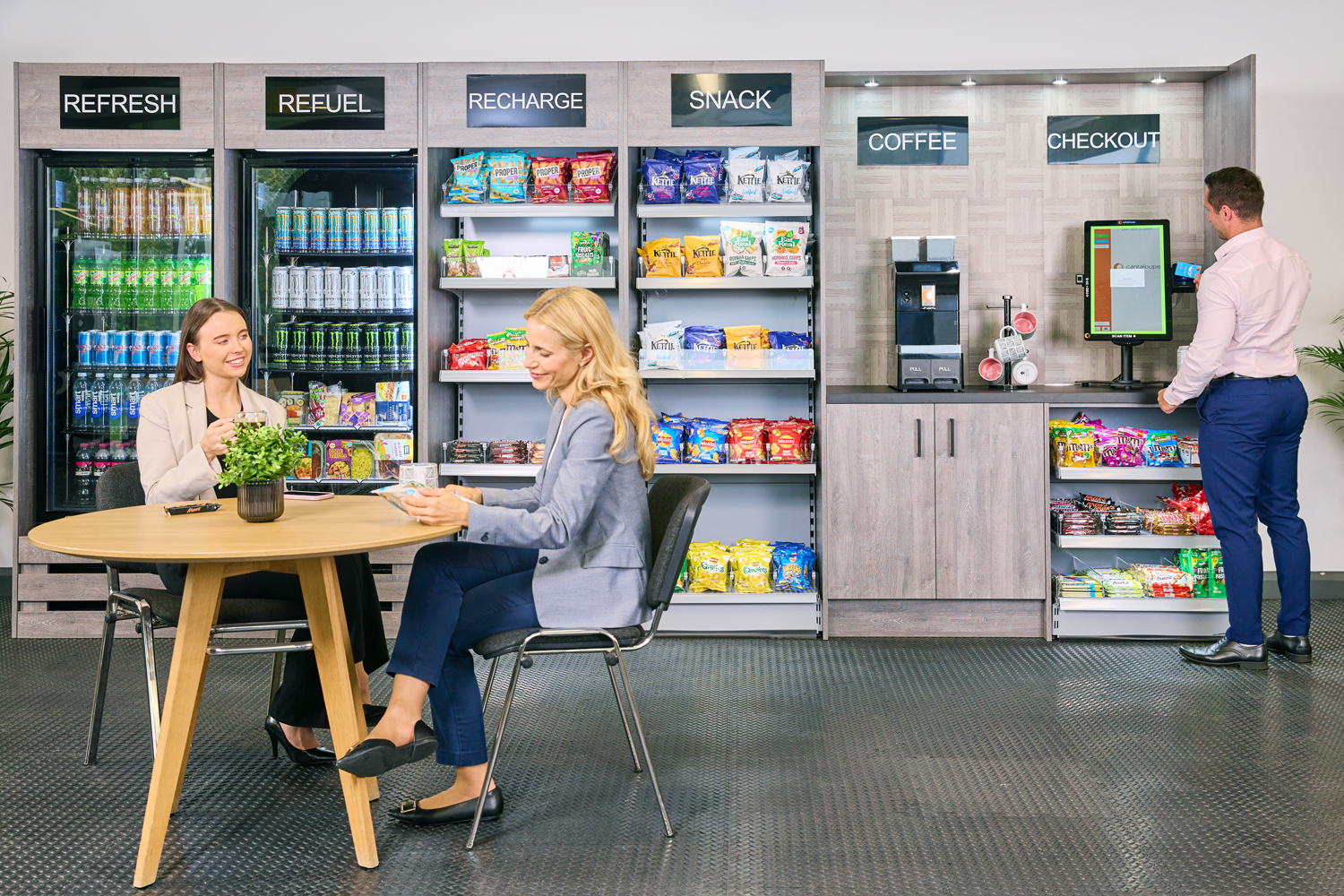
A micro market refers to a self-service, unattended retail space where people can buy food and beverages using a self-checkout kiosk, often found in office break rooms or other locations where people need quick access to snacks and drinks.
Among shoppers ages 18 to 44, 53% favor self-checkout, citing shorter lines, frictionless payment options and even privacy. For Generation Z consumers in the U.S. and the U.K., the draw is particularly strong, with more than half saying they would switch retailers to access checkout-free alternatives and 49% reporting they are likely to spend more when such options are available. Their priorities tell a clear story: Speed (46%), shorter queues (34%) and autonomy (33%) drive their shopping decisions. This points to an opportunity for businesses to expand market share and increase loyalty through improved customer throughput and streamlined experiences.
Next-generation self-service solutions address the shrinkage risks and friction-laden journeys that led retailers to roll back self-checkout installations.
200%
Revenue growth achieved by a leading New York City independent vending operator after implementing smart self-service solutions
Self-checkout’s promise of addressing labor shortages faces challenges from its vulnerability to misuse. ECR Retail Loss Group data shows that 93 global retailers link nearly one-quarter of unknown store losses to these systems. Shrinkage — inventory loss caused by theft or system errors — has prompted major chains, including Walmart and Wegmans, to reduce their self-checkout footprint. Dollar General’s drop in shrink after scaling back self-checkout installations underscores the magnitude of this challenge.
Consumer wariness poses an obstacle, too. A Newsweek poll revealed that 43% of U.S. shoppers support removing self-checkouts, with 40% of this cohort citing the lack of human interaction. These setbacks have become a call to action for self-service commerce providers to strike a balance between delivering frictionless experiences and managing retailer concerns around shrinkage.
Self-service commerce now spans industries as diverse as hospitality, education, entertainment and transportation. Micro markets, for instance, have become a staple in corporate and hospitality settings. Meanwhile, at airports, the versatility of self-service is on full display. From kiosks managing check-ins to smart vending experiences offering food and other must-haves, travelers increasingly rely on the convenience of self-service technologies. In healthcare, self-service kiosks are driving efficiency gains by expediting check-ins, collecting data and minimizing administrative bottlenecks.
Smart Stores — secure, automated retail solutions with theft-prevention measures — symbolize the innovation fueling this cross-sector expansion. Advanced options, such as those developed by Cantaloupe, integrate cameras, weighted shelf technology and machine learning to combat shrinkage and provide real-time inventory monitoring across a self-service retail ecosystem. When paired with management platforms such as Cantaloupe’s Seed™, self-service solutions use predictive analytics to optimize product mix and pricing. The impact on revenue can be substantial. For Barrett Vending, a vending operator in Houston, implementing these solutions delivered an increase in revenue over traditional vending, with an average transaction value of $5.53, compared to $2.18 for traditional vending machines.
As cutting-edge self-service solutions come to market, businesses are gaining the ability to pursue commerce models unbound by traditional physical and operational constraints.
Driven by IoT, AI and mobile innovations, traditional vending machines, micro markets and retail kiosks are modernizing into smart commerce hubs. These systems integrate real-time data to improve consumer experience and enable businesses to scale operations with unprecedented efficiency.
IoT-enabled platforms, for instance, introduce dynamic feedback loops that optimize inventory management, pricing and maintenance across even vast networks of self-service installations. The granular visibility these systems provide into consumer behavior and machine performance empowers data-driven decisions that reduce shrinkage, minimize downtime and boost profitability. This “smart” technology also enables the seamless payment experiences consumers increasingly expect — a capability once constrained by technical and logistical limitations.
Share of vending machine sales finalized through cashless payment methods in 2023
Modern cellular networks and edge computing can now ensure the secure connectivity needed to scale self-service commerce into high-demand and hard-to-reach environments. Zooming out, PYMNTS Intelligence notes that the surge in cashless payments — now representing more than two-thirds of transactions in vending and micro markets — reveals more than shifting payment preferences. Consumers are fundamentally changing the way they navigate commerce itself. In doing so, they are rolling out the red carpet for autonomous self-service commerce unbound by physical and logistical constraints.
Looking ahead, we anticipate self-service commerce will bridge physical and digital retail experiences. As autonomous technologies mature, self-service installations will likely evolve beyond simple transaction points to become smart commerce nodes that interact with consumers, predict their needs and fulfill purchases. These next-gen solutions will also likely integrate mobile ordering, smart lockers and grab-and-go options to better meet hyperlocal demand and seasonal trends. We predict that hybrid models born from these innovations will reconceptualize what’s possible in spaces where traditional commerce was simply impractical.
The new generation of self-service commerce solutions delivers a clear return on investment (ROI) for reducing costs, personalizing experiences and boosting revenue. However, these technologies offer even more: the potential to unlock opportunities that both inspire innovation and exceed consumer expectations.
PYMNTS Intelligence identifies the following emerging strategies driving the future of self-service commerce.
For commerce businesses ready to embrace this transformation, the latest self-service technologies provide a springboard to boundaryless commerce — a future that begins today.
Self-service has evolved from the concept of ‘scan, pay and go’ to leveraging innovative technologies to remove the friction of scanning. We’re now seeing tech that allows the consumer to just ‘grab and go’ after they identify who they are. Whether it is tapping a card or mobile wallet or activating a loyalty account to enter a full smart-aisle concept, we’re seeing these micro-evolutions that continue to eliminate friction in the consumer buying experience.”
Cantaloupe, Inc. (Nasdaq: CTLP) is a global technology leader powering self-service commerce. Cantaloupe offers a comprehensive suite of solutions including micro-payment processing, self-checkout kiosks, mobile ordering, connected point-of-sale systems and enterprise cloud software. Handling more than a billion transactions annually, Cantaloupe’s solutions enhance operational efficiency and consumer engagement across sectors like food & beverage markets, smart automated retail, hospitality, entertainment venues and more. Committed to innovation, Cantaloupe drives advancements in digital payments and business optimization, serving over 30,000 customers in the U.S., U.K., EU countries, Australia and Mexico. For more information, visit cantaloupe.com or follow us on LinkedIn, X, Facebook, Instagram or YouTube.
PYMNTS Intelligence is a leading global data and analytics platform that uses proprietary data and methods to provide actionable insights on what’s now and what’s next in payments, commerce and the digital economy. Its team of data scientists include leading economists, econometricians, survey experts, financial analysts and marketing scientists with deep experience in the application of data to the issues that define the future of the digital transformation of the global economy. This multilingual team has conducted original data collection and analysis in more than three dozen global markets for some of the world’s leading publicly traded and privately held firms.
The PYMNTS Intelligence team that produced this Tracker:
Chief Content Officer: John Gaffney
Senior Writer and Researcher: Randall Brown
Senior Content Editor: Alexandra Redmond
Content Editor: Joe Ehrbar
Senior Research Analyst: Augusto Solari
Research Analyst: Mariano Soler
We are interested in your feedback on this report. If you have questions or comments, or if you would like to subscribe to this report, please email us at feedback@pymnts.com.
About The Author


More Stories
Why Internet Infrastructure Decisions Rarely Stay Localized
A Safer Internet Starts with Taking Action: Introducing the Online Trust and Safety Hub
Introducing a New Chapter for the Internet Society Fellowship Program