
February 6, 2025
(Credit: Baker Hughes)
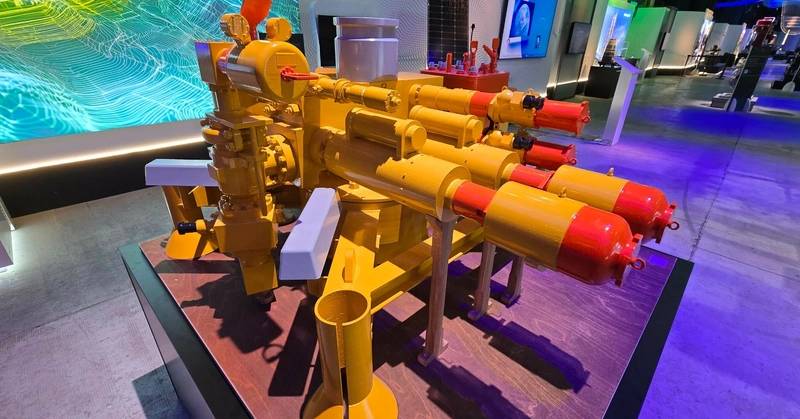
Energy technology company Baker Hughes has launched its new all-electric subsea production system, the industry’s first fully electric topside-to-downhole solution for offshore operations.
The modular system allows for existing tree designs to be seamlessly updated for electric operations, while electro-hydraulic trees currently operating in mature assets can be retrofitted for full electrification.
This transition will result in enhanced production control, increased reliability and lower carbon emissions throughout the life of the field. The elimination of hydraulics will also result in reduced cost, time and complexity of subsea installations.
The all-electric subsea production system is designed for shallow and deep-water developments, making it ideal for subsea carbon capture, utilization and storage fields as well as long offset tieback applications, according to Baker Hughes.
“Hydrocarbons will remain key sources of global energy for decades, and it is essential that these resources are produced with minimal carbon footprint. By electrifying the production value chain, we can enhance operations to be cleaner, safer and more efficient, while continuing to supply the energy required worldwide,” said Amerino Gatti, executive vice president, Oilfield Services & Equipment at Baker Hughes.
Aside from the all-electric subsea production system, Baker Hughes also launched the Hummingbird all-electric land cementing unit and SureCONTROL Plus interval control valves for enhanced control.
All of these technologies will have implications for both traditional oil and gas and new energy applications.
The Hummingbird all-electric land cementing unit is an industry-first, 100% electric solution that replaces diesel engines with grid-connected or battery-powered motors. The Hummingbird’s dual-power functionality performs onshore cementing operations with lower emissions and noise levels compared to traditional solutions.
SureCONTROL Plus interval control valves (ICV) enable electrical remote operations for more efficient zonal control of both subsea and dry tree wells. These ICVs replace numerous hydraulic lines with a single electrical line, simplifying complex installations, reducing rig time and accelerating production while limiting the need for costly interventions.
The system can control a higher number of zones than traditional hydraulic ICVs for enhanced production. The digital telemetry system provides continuous data, which enables improved asset performance management and proactive maintenance of downhole tools.
Acteon, through its geo-services brand UTEC, has completed the first year of a three-year balance of plant inspection contract…
Ocean services provider DeepOcean has secured a subsea survey contract on the Bałtyk 2 and 3 offshore wind developments in…
Norwegian seismic specialist TGS has secured another offshore wind site characterization contract on the U.K. continental shelf…
Sumitomo Electric Industries, together with consortium partner Van Oord, has signed Capacity Reservation Agreement (CRA) with SSEN Transmission…
Ocean Thermal Energy Corporation (OTE Corp) has partnered with Johnson Controls to demonstrate the feasibility of deploying…
High-tech offshore wind services provider Beam has bought Quantum EV remotely operated vehicle (ROV) from SMD, setting out…
Marine Technology Reporter is the world’s largest audited subsea industry publication serving the offshore energy, subsea defense and scientific communities.
Marine Technology ENews is the subsea industry’s largest circulation and most authoritative ENews Service, delivered to your Email three times per week
Subscribe for MTR E-news
About The Author


More Stories
New ITU Report Finds Community Networks Are Key to Reaching the Unconnected
Digital Coercion: How Inaccessible Design Strips Financial Privacy
The Need to Reimagine the WSIS Forum