
Thank you for visiting nature.com. You are using a browser version with limited support for CSS. To obtain the best experience, we recommend you use a more up to date browser (or turn off compatibility mode in Internet Explorer). In the meantime, to ensure continued support, we are displaying the site without styles and JavaScript.
Advertisement
Scientific Reports volume 15, Article number: 4041 (2025)
Metrics details
In the present scenario, the Internet of Things (IoT) and edge computing technologies have been developing rapidly, foremost to the development of new tasks in security and privacy. Personal information and privacy leakage have become the main concerns in IoT edge computing surroundings. The promptly developing IoT-connected devices below an integrated Machine Learning (ML) method might threaten data confidentiality. The standard centralized ML-assisted methods have been challenging because they require vast numbers of data in a vital unit. Due to the rising distribution of information in many systems of linked devices, decentralized ML solutions have been required. Federated learning (FL) was proposed as an optimal solution to discover these privacy issues. Still, the heterogeneity of systems in IoT edge computing environments poses an essential task when executing FL. Therefore, this paper develops an Intelligent Deep Federated Learning Model for Enhancing Security (IDFLM-ES) approach in the IoT-enabled edge-computing environment. The presented IDFLM-ES approach aims to identify unwanted intrusions to certify the safety of the IoT environment. To accomplish this, the IDFLM-ES technique introduces a federated hybrid deep belief network (FHDBN) model using FL on time series data produced by the IoT edge devices. Besides, the IDFLM-ES technique uses data normalization and golden jackal optimization (GJO) based feature selection as a pre-processing step. Besides, the IDFLM-ES technique learns the individual and distributed feature representation over distributed databases to enhance model convergence for quick learning. Finally, the dung beetle optimizer (DBO) model is utilized to choose the effectual hyperparameter of the FHDBN model. The simulation value of the IDFLM-ES methodology is verified using a benchmark database. The experimental validation of the IDFLM-ES methodology portrayed a superior accuracy value of 98.24% compared to other models.
Privacy concerns have become significant with the constant growth of the IoT and edge computing techniques. Personal data and privacy leakage are the foremost problems1. Owing to the vast amount of devices and sensors involved in IoT, they constantly gather and convey different kinds of information such as health status data, geographic location data, personal identification data, etc. If malicious people have attained this kind of information, then it could fake critical safety attacks and confidentiality threats2. Data security is another main privacy problem. Data in IoT are generally dispersed between dissimilar devices, edge nodes, sensors, and cloud servers. This information wants to be transferred and kept, and then the devices and networks employed for transmitting and keeping data face numerous safety assaults3. For instance, hackers attack the system, edge devices are damaged, data centres are stolen, and more. These problems can lead to data leakage and safety hazards. Furthermore, owing to the variation of data setups and principles between dissimilar systems and devices, information cannot be efficiently shared and then used, resulting in the difficulty of data stores4. This restricts the use and efficacy of IoT and centrals to the need for more information organization and diagnosis. This is because several pieces of information have been kept and managed in isolation using dissimilar methods, resulting in data fragmentation and incapacity to attain whole information diagnosis and use. With the high development of information and data transmission, IoT edge computing methods can control more sensitive information, such as personal and business privacy data5.
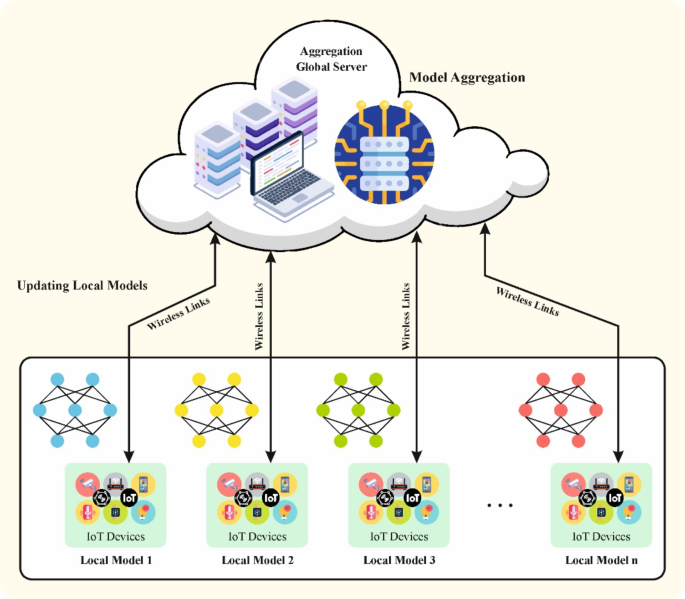
Figure 1 represents the structure of FL with IoT devices. However, IoT edge computing tackles privacy and information storage tasks, and significant problems limit the growth of IoT techniques. FL is crucial to resolving these issues. FL is a distributed ML method which permits many systems to cooperate in learning without revealing raw information6. This method decreases the charge of data storage and transmission and defends confidentiality and data safety in a better way, so it avoids confidentiality leaks and data loss problems. IoT devices have been effortlessly hackable and organized slightly to create IoT-based botnets. These assaults and botnets originate the leak of sensitive data, infringement, and infractions in an extensive IoT-enabled method7. The most general threats in IoT devices are denial of service (DoS), ransomware, distributed DoS (DDoS), and botnet threats. The research group is designing methods to react rapidly and efficiently to these attacks to prevent harmful damage. An intrusion detection system (IDS) is an efficient safety method that constantly inspects system actions for indications of an intrusion8. Intrusion recognition techniques are mainly separated into dual kinds, such as detection-based and deployment-based methods. With the swift expansion of IoT and edge computing, safeguarding sensitive data has become increasingly significant. The production of interconnected devices and sensors continuously collects personal and sensitive data, namely health metrics and location details9. Unauthorized access to this data exhibits crucial risks, comprising potential safety breaches and privacy violations. Furthermore, the dispersed nature of data across various devices and servers adds complexity to its protection, as each component in the network is vulnerable to diverse cyber threats. Addressing these safety and privacy concerns significantly confirms IoT technologies’ safe and efficient utilization10.
FL with IoT devices.
This paper develops an Intelligent Deep Federated Learning Model for Enhancing Security (IDFLM-ES) technique in the IoT-enabled edge computing environment. To accomplish this, the IDFLM-ES technique introduces a federated hybrid deep belief network (FHDBN) model using FL on time series data produced by the IoT edge devices. Besides, the IDFLM-ES technique uses data normalization and golden jackal optimization (GJO) based feature selection as a pre-processing step. Besides, the IDFLM-ES method learns the individual and distributed feature representation over distributed datasets to enhance method convergence for quick learning. Finally, the dung beetle optimizer (DBO) model is utilized to choose the effectual hyperparameter of the FHDBN model. The simulation value of the IDFLM-ES technique is verified using a benchmark database. The key contribution of the IDFLM-ES technique is listed below.
The IDFLM-ES model integrates FL with an HDBN, constructed explicitly for time series data from IoT edge devices. This technique improves data privacy and enables distributed learning across diverse edge devices. Moreover, it optimizes feature selection and model tuning, addressing the difficulties of working with decentralized data.
The IDFLM-ES method implements the GJO technique for feature selection following normalization, which concentrates on improving the relevance and effectiveness of features. This methodology refines the feature set to comprise only the most crucial ones, thereby improving the model’s performance and computational effectiveness.
The IDFLM-ES approach learns individual and dispersed feature representations from various datasets, improving model convergence and speeding up the learning process. This methodology enhances the technique’s comprehensive performance and effectiveness by efficiently managing dispersed and heterogeneous data.
The IDFLM-ES model utilizes the DBO method to fine-tune hyperparameters, optimizing the FHDBN model for improved performance and faster convergence. Optimizing the parameters of the model substantially enhances overall efficiency. This technique confirms accurate parameter alterations, enhancing outputs and more effective learning.
The IDFLM-ES methodology presents a novel incorporation of FL with HDBN, built explicitly for time series data from IoT edge devices. This novel technique handles threats associated with data privacy and dispersed learning while optimizing feature selection and model tuning. By incorporating these techniques, the study improves the effectiveness and efficiency of learning from distributed and sensitive data.
Vaiyapuri et al.11 presented an FL-based IDS employing bird swarm system-based feature selection with classification (FLIDS-BSAFSC) technique in an IoT system. The developed FLIDS-BSAFSC method initially used min-max normalization to pre-process the IoT data. Also, the BSA-FS model has been mainly intended to select feature subsets. Lastly, the social group optimizer process with kernel extreme learning machine technique has been used to identify numerous types of classes. Cui et al.12 proposed a blockchain (BC)-authorized decentralized and asynchronous FL structure for anomaly recognition in the IoT methods that certifies information reliability and averts single-point failure while enhancing effectiveness. Additionally, the projected model project enhanced private FL-based generative adversarial network, which aims to improve data value during the training procedure. In13, a FL-based IDS, FELIDS, is projected. Specifically, the FELIDS method defends data confidentiality over local learning, where systems get an advantage from the information of their peers by allotting only upgrades from their technique with a combination server that generates an amended recognition method. The FELIDS method uses 3 deep learning (DL) classification models. Amiri-Zarandi et al.14 presented a Social IDS (SIDS) model, a trust-oriented FL technique for intrusion recognition in IoT that uses the Social IoT (SIoT) model. The projected methodology influences the social relations between the objects to offer a confidentiality-preserving collaborative device to identify intrusions in IoT systems. In15, an MV-FLID has been developed that trains on many visions of IoT system data in a decentralized setup to identify, categorize, and protect besides assaults. Selamnia et al.16 project novel IDS for C-V2X systems depending on FL. It influences edge computing to construct a forecasting technique and permit low latency ID. Furthermore, the model constructs the FL-based IDS on the highest of a familiar dataset of CIC-IDS2018 that contains the chief network assaults. Feature engineering is first executed on the dataset using the ANOVA technique to reflect only the most valuable features. Halder and Newe17 developed a Hawk, a dispersed anomaly recognition method for identifying cooperated systems in LoRa-permitted IIoT. Initially, Hawk processes a system to sort exact physical layer features, Carrier Frequency Offset (CFO), and then controls the CFO to fingerprint the system, therefore discovering anomalous deviances in CFO behaviour, possibly produced by challengers. Moreover, Hawk employs FL, a distributed ML technique.
In18, an innovative federated semi-supervised learning system is suggested that profits benefit from both labelled and unlabeled data. Initially, an autoencoder (AE) was trained on every system to learn the typical and lowest dimension features. Vakili et al.19 present a service composition method implementing Grey Wolf Optimization (GWO) and the MapReduce framework to optimize the Quality of Service (QoS) model. Heidari et al.20 introduce BC-based FL to maintain data source anonymity, incorporating SegCaps and Convolutional Neural Network (CNN) models for improved image feature extraction and using capsule networks to improve generalization. It presents novel data normalization and utilizes transfer learning (TL) to enhance DL performance, confirming safe and confidential global model training. Amiri et al.21 aim to compute and synthesize DL models utilized in IoT-based bioinformatics and medical informatics, classify them into five main types, and evaluate their efficiency, merits, and challenges to advance study areas. Heidari, Navimipour, and Otsuki22 review the threats and merits of Cloud Non-Destructive Characterization Testing (CNDCT), comparing cloud-based testing with conventional techniques to emphasize the impact of Testing as a Service (TaaS) in this context. Heidari et al.23 introduce an optimal spanning tree algorithm by incorporating an artificial bee colony (ABC) with genetic operators and density correlation. Li et al.24 introduce the Ubiquitous Intelligent FL Privacy Protection Scheme (UIFLPP) model. After cloud aggregation, noise is added before sending the model back to the edge server. Amiri et al.25 conducted a review to explore the incorporation and efficacy of nature-inspired algorithms in IoT-based healthcare. Zuo et al.26 present an ApaPRFL, an intelligent device data-secure FL scheme using edge computing. ApaPRFL utilizes a gradient-based privacy-preserving methodology with secure secret sharing, confirming system stability despite device dropout and improving poisoning detection efficiency while mitigating error rates.
Mahadik, Pawar, and Muthalagu27 incorporate edge computing, FL, and DL approaches to develop an Edge-FL-based IDS that improves HetIoT security by safeguarding data privacy from DDoS attacks. Kavitha et al.28 propose a new trust mechanism framework for the Wireless Mesh Networks (WMNs) model. It utilizes direct trust based on packet-forwarding and indirect trust aggregated through a weighted D-S theory with a novel similarity mechanism. The framework comprises a two-hop observation method and dynamic weight computation to enhance trust evaluation. Shirvani, Ghasemshirazi, and Alipour29 propose an FL-based technique. The approach also utilizes deep AE and FedAvg/FedAvgM methods to improve attack detection and model performance. Heidari, Navimipour, and Unal30 present a BC-based radial basis function neural network (RBFNN) approach. This methodology eases decentralized predictive analytics and effectual DL applications. Heidari et al.31 provide a comprehensive overview of the Internet of Drones (IoD) and Unmanned Aerial Vehicles (UAVs), exploring their applications, recent enhancements, benefits and drawbacks, and detecting areas for further research, with a concentration on ML models used in this domain. Amiri, Heidari, and Navimipour32 propose a novel taxonomy of DL method applications for climate change mitigation. Fenanir and Semchedine33 implement an FL method. The study also proposes a novel SID approach based on FL for efficient computational load dispersion in IoT edge computing. Rajagopal, Supriya, and Buyya34 introduce a BC and FL-based framework using ECG data in microservice-based IoT medical applications, utilizing edge and fog computing for real-time processing. Al-Wesabi et al.35 present the Pelican Optimization Algorithm with FL-Driven Attack Detection and Classification (POAFL-DDC) technique. The model also utilizes decentralized on-device data for attack detection. A DBN method is also employed for detection, while the POA optimizes the DBN hyperparameters. Kaleem et al.36 propose a personalized energy-aware averaging methodology for model aggregation that refines a global model while minimizing data transfer.
Abou El Houda et al.37 present an Edge-based Framework that integrates FL and BC against emerging threats. The study also comprises a distributed architecture for secure collaboration among Edge nodes and a decentralized reputation system using BC to maintain the integrity of the FL process. Kang et al.38 incorporate FL, cloud/edge computing, virtualized networking, and converged prediction models. A modified federated logistic regression (FLR) model that addresses convergence latencies and model accuracy in healthcare networks is also introduced. Zhou et al.39 propose an edge-cloud architecture that optimizes QoS for IoT devices by employing an FL-based methodology, enabling local data training to ensure privacy. Yuan et al.40 aim to provide a comprehensive survey of security and privacy issues in mobile-edge computing (MEC) through the lens of artificial intelligence (AI) by employing the ETSI MEC reference architecture. Song and Ma41 developed a lightweight edge detection model. This methodology provides real-time results with limited resources and utilizes the Federated CNN (FedACNN) with attention mechanisms to minimize communication delays. Yan et al.42 introduce a novel node selection strategy using deep reinforcement learning (DRL) to optimize FL in heterogeneous IoT environments. The model also proposes a metric model. Peng et al.43 present a security-aware computation offloading (SCOF) method using federated reinforcement learning in IIoT. SCOF allows local data computation while uploading model parameters to edge servers, utilizing an artificial noise channel for eavesdropping protection. The model also employs differential privacy for data security and DRL for optimal offloading decisions. Zhao et al.44 utilize physical layer security and encryption to secure data unloading. The model introduces a DRL approach for effective resource allocation in fog IoT. Feng et al.45 propose a Hierarchical FL (HFL) framework. The study also models user experience (QoE) as a comprehensive system cost to reduce the impact of soft clicks. Fan et al.46 present LPBFL, a decentralized consortium BFL privacy protection scheme that ensures lightweight computing and local model privacy utilizing Paillier encryption and a lightweight digital signature. It also features a device reputation selection mechanism to improve efficiency against invalid models.
The study on FL-based IDS models exhibits various limitations. One study may encounter threats to the efficiency of feature selection approaches, affecting overall model accuracy. Another methodology might need help with scalability and computational overhead due to the complexity of decentralized systems. Fixed DL techniques utilized in a few methods may adapt slowly to new attack patterns, while dependence on social relationships in intrusion detection might lead to less accurate results. The presented decentralized models may also need help with scalability and real-time application difficulty in dynamic environments. At the same time, comprehensive overviews might lack in-depth analysis of specific ML performance metrics. Methods for decentralized data and FL may encounter efficiency and data privacy threats, particularly in sensitive applications. Furthermore, lightweight models may compromise accuracy under varying conditions, and strategies for node selection may need to be more robust in heterogeneous environments. These methodologies face integration problems and scalability limitations when applied in practical scenarios. Further techniques could need help with real-time performance, limited applicability to specific attack types, and incorporation of labelled and unlabeled data. Complex service composition frameworks and image feature extraction models may need help from inefficiencies and limitations in handling various data. Reviews on nature-inspired models and cloud testing may only partially address recent enhancements or practical integration threats. Privacy-preserving schemes might encounter problems with noise addition affecting model quality, and DL techniques for IoT security might find difficulty adapting to diverse attack patterns. The existing studies on FL and IDS in IoT often need more focus on incorporating real-time adaptability and scalability across various attack scenarios. Moreover, there needs to be more exploration of the efficiency of hybrid models that integrate several optimization and privacy-preserving techniques, specifically in handling complex, evolving threats in dynamic environments.
This paper concentrated on improving the IDFLM-ES method in the IoT-enabled edge-computing environment. The proposed IDFLM-ES technique aims to identify unwanted intrusions to certify the safety of the IoT model. The IDFLM-ES technique introduces an FHDBN model using FL on time series data produced by the IoT edge devices to accomplish this. Figure 2 signifies the entire flow of the presented IDFLM-ES technique.
Overall flow of IDFLM-ES technique.
The IDFLM-ES technique uses min-max data normalization and GJO-based feature selection as a pre-processing step47. Min-max normalization is selected for its capability to scale features to a uniform range, typically [0,1], which assists in mitigating biases due to differences in feature magnitudes. This uniformity improves the effectualness of subsequent approaches by confirming that all features contribute equally to the analysis. The GJO methodology for feature selection is chosen for its effectualness in navigating the search space and detecting the most relevant features. The metaheuristic behaviour of the GJO approach enables it to balance exploration and exploitation efficiently, enhancing the accuracy of feature selection while maintaining computational effectualness. Combined, these techniques improve performance by ensuring that input features are relevant and well-scaled. Figure 3 illustrates the steps involved in the GJO approach.
Steps involved in the GJO model.
Data normalization is used in data mining to convert the dataset values into a standard measure. This is most significant because numerous ML techniques are complex in inputting features, scaling, and generating superior outcomes when the data is standardized. This method measures the feature values to a range between zero and one. This is completed by deducting the minimal feature value and dividing it by the feature range. Next, the GJO method is used to select an optimum features set.
The golden jackals’ hunt behaviour stimulates the GJO approach. They mostly live and hunt in clusters, which conduct the different phases of the hunting process. Search and follow, lock up and irritate, and capture are the different hunting stages of the GJO model. The GJO approach for the parameter estimates of the PV element is given in the following:
Step 1: Generate the initial solution population.
The initial and second optimum results are referred to as the male and female individuals. The initial population is generated by using Eq. (1):
(:{x}_{i}) refers to the (:{i}^{th}) prey with (:i=text{1,2},dots:,N,:)whereas (:N) signifies the size of the population. (:U) and (:L) are the upper and lower boundaries. Every vector comprises (:D) parameters. (:D) is the dimensionality issue.
Each prey is assessed by its objective values. Next, male (:left({x}_{M}right)) and female (:left({x}_{FM}right)) locations are the first and second optimum prey locations.
Step 2: Update new position.
Jackal determines their hunt behaviour based on the evading prey energy, and it is described in Eq. (2):
Now, (:{c}_{1}) is constantly fixed as 1.5; (:it) and (:i{t}_{text{m}text{a}text{x}}) are the current and maximal iteration counts. As the number of iterations increases, the (:{E}_{v}) value is linearly reduced from (:{c}_{1}) to 0.
During the hunting process, the leader is the male golden jackal, and the female individuals follow the male jackal. Naturally, the prey is not easily trapped. (:left|{E}_{v}right|>1), then the prey escaping energy is high, and the jackals must search or wait for another one. This behaviour is expressed as prey searching or exploration strategies of GJO:
In Eq. (3), (:{x}_{i,}) one and (:{x}_{i,2}) are the locations of male and female individuals, respectively, (:{c}_{2}) is constantly fixed as 0.05, and the levy distribution mimics the prey motion to escape the golden jackal is (:LF).
(:left|{E}_{v}right|<1), then the escaping energy of prey reduces as it is harassed. Next, a group of jackal’s pounces on the prey. This behaviour is expressed as the grabbing and the prey enclosing or exploitation strategies of GJO:
Lastly, the new location of prey is updated using Eq. (5):
The novel prey location is checked and modified to its permitted bounds:
In Eq. (6), (:{x}_{i,j}) is the (:{j}^{th}) parameter with (:j=text{1,2},dots:,D) of the performance (:i), (:{U}_{j}), and (:{L}_{j}) are the up and low bounds of the (:j) parameter.
The objective value of the prey is calculated. Male (:left({x}_{M}right)) and female (:left({x}_{FM}right)) locations are updated by comparing the objective values with the prey.
Step 3: Stop searching.
The search procedure for the optimum GJO result for the parameter valuation is paused as the existing iteration attains the highest value. Next, the male location is assumed as the result.
The fitness function (FF) utilized in the GJO model is specially intended to maintain a steady balance between the number of nominated features in each solution (least) and classification accuracy (highest) achieved by employing these selected features. Equation (7) signifies the FF to estimate the solution.
Where (:{gamma:}_{R}left(Dright)) signifies the error rate. (:left|Rright|:)is the cardinality of the nominated subset, and (:left|Cright|) is the total feature number; (:beta:) and (:alpha:) are dual constraints that correspond to the prominence of subset length and classification excellence. (:beta:=1-alpha::)and(::in::left[text{1,0}right]:)
The IDFLM-ES technique introduces an FHDBN model using FL on time sequence data produced by the IoT edge devices48. The FHDBN method utilizing the FL model is selected for its capability to improve data privacy and scalability in the detection process. By employing the FL technique, the model allows diverse edge devices to train a global model collaboratively without sharing raw data, thus conserving privacy and mitigating data transfer overhead. The HDBN architecture incorporates several learning strategies, enhancing feature extraction and representation. This integration improves the accuracy and efficiency of anomaly detection. Moreover, the FHDBN model’s scalability assists the growing IoT devices, making it appropriate for large-scale environments where conventional methods may face data privacy and computational limitations. Figure 4 portrays the structure of the FHDBN model.
Structure of the FHDBN model.
An FHDBN model that includes two significant modules, a global and a local model, is introduced to resolve centralized training problems like network bandwidth limitation, computation cost, and availability of IoT devices. The global model is used to aggregate the weight of each local model after all the rounds. On the other hand, the local model is employed on an input dataset generated by all the sensors to learn a feature representation, which is an HDBN network. The FC layer is used for the latent symbol of the final HDBN layer, and it is monitored by the linear activation or softmax function for regression and classification tasks.
The HDBN technique is trained throughout the participating sensor in the FL by gathering the local model iteratively into a combined global model. Assume training the local dataset (:{left{left({X}^{k},:{y}^{k}right)right}}_{k=1}^{K}) from the (:K:)sensor, where the overall number of samples deployed throughout the sensor is (:N={sum:}_{k=1}^{k}{N}_{k}), with (:{N}_{k}) representing the number of instances in the training set (:{D}_{k}=left({X}^{k},:{y}^{k}right)={left{left({x}_{i}^{k},:{y}_{i}^{k}right)right}}_{i=1}^{{N}_{k}}) of the(::{k}^{th}:)sensor. Consider an FL task where the (:K) sensor trains a (:w) parameter vector together.
Where(:{E}_{{D}_{k}}left[{f}_{k}left(wright)right]=f) the prospect is occupied over the set of instances allocated to a set sensor (:k). (:mathcal{l}left(w;{xi:}_{i}^{k}right)) indicates the loss function. (:{xi:}_{i}^{k}) made with (:w) parameter vector and(::{f}_{k}left(wright)) refers to the local loss function of data instances (:{xi:}_{i}^{k}=left({x}_{i}^{k},:{y}_{i}^{k}right)) from the (:{k}^{th}) sensors.
Depending on the time sequence window with the (:t) step, the local model obtains a local copy of the global model weight(:.)
Local model: All the sensors contributing exploit its local data to upgrade model parameters.
Global model: The server randomly chooses a subset (:{S}_{r}) of the sensor at round (:r) for synchronous aggregation and transmissions of the (:{w}_{r}) parameter vector. The random amount is set for the choice of (:{S}_{r}). The sensor upgrades the local model parameter by reducing the loss function, starting from the (:{w}_{r}) parameter vector of the global model shared by the server and using SGD for (:E) epochs and with (:B) batch size. In the training stage, the parameter of the local model is removed from the server to get the parameter vector (:{w}_{r+1}) of a global model.
Repeated the update of global and local models until the global loss function converge. Each sensor has been utilized to train the global with the local model independently, and later, the server gathers the parameter of the locally trained model for each nominated sensor and totals them utilizing a federated averaging model by calculating an average weight of the parameter to attain a shared global model. During the initial training, the sensor reads the present global model parameter vector from the server. It updates it through the SGD method, where the gradient is calculated by a mini-batch tested from the local data of (:{k}^{th}) sensors. The federated HDBN returns a vector of predicted value at the end of training. Next, the expected outcome is concatenated from the (:K) sensor to attain a vector (:widehat{y}in:{mathbb{R}}^{N}):
Where (:oplus:) represents the concatenation operator.
DBN has a multi-layer NN infrastructure and is a multi-layer probabilistic ML technique49. The difficulties of gradient vanishing challenge a typical MLP. DBN is a useful DL model that can handle these disadvantages. DBN has an unsupervised and supervised learning procedure. Still, unsupervised learning is proficient by a network design with manifold layers of RBM forms, and a layer of backpropagation systems executes supervised learning. Unsupervised learning finishes the setting of each layer parameter, while supervised learning modifies the initialized limits worldwide.
A RBM generally has a hidden layer (HL) and a visible layer (VL). They are associated in both ways, but the nodes are not associated with each other. Throughout the learning procedure of RBM, an energy function (:E(v,h|theta:)) must be determined and employed for resolving the formulation of the energy function as stated below
Whereas (:v=({v}_{1},{v}_{2},:cdots:,{v}_{n}{)}^{T}) signifies the VL, (:h=({h}_{1},{h}_{2},:cdots:,{h}_{m})) represents the HL, (:omega:=left({omega:}_{i,j}right)in:{R}^{ntimes:m}) represents the weight matrix linking the dual layers and (:b=({b}_{1},{b}_{2},:cdots:,{b}_{n}{)}^{T},)(:c=({c}_{1},{c}_{2},:cdots:,{c}_{m}{)}^{T}) signifies the bias of (:v,)(:h) separately (:theta:={{omega:}_{ij},{b}_{i},{c}_{j}}) is a RBM parameter set.
This RBM permits the values of the VL and HL to be uncorrelated. The complete layer is computed in parallel rather than computing every neuron simultaneously. Afterwards, the probability distribution of VL and HL is:
Where (:Zleft(theta:right)) denotes the normalized constant.
Therefore, the probability of a neuron (:{h}_{j}) initiated in the HL is
Then, the RBM layers are linked in both ways; neurons in the VL (:{v}_{i}) is commenced by neurons (:{h}_{j}) in the HL, and its probability is conveyed below
The RBM training procedure acquires the parameter value (:theta:) to right the assumed training data. The non-supervised learning technique generally utilized the Contrastive Divergence (CD) process to upgrade the limits, and upgrade directions are below:
Where (:epsilon:) denotes the learning rate, (:{E}_{econ}) and (:{E}_{data}) signify the mathematical prospect over the spreading definite by the reconstructed model and training dataset, respectively.
Finally, the DBO procedure is helpful for effectual hyperparameter choice of the FHDBN method50. The DBO approach presents distinct merits for hyperparameter tuning related to other methodologies. Its advantage is in its innovative optimization approach, which replicates the natural behaviour of dung beetles (DBs) in finding optimal solutions. DBO outperforms exploring a diverse range of hyperparameter spaces and escaping local optima due to its robust search mechanism. This results in an improved performance and more precise tuning of model parameters. Furthermore, the DBO model is less prone to overfitting, effectively balancing exploration and exploitation. Its capability to handle complex, multi-dimensional search spaces makes it specifically appropriate for fine-tuning in DL techniques, resulting in an enhanced accuracy and effectualness of the model. Figure 5 illustrates the steps involved in the DBO technique.
Steps involved in the DBO model.
The DB model is a novel swarm intelligence process containing four parts: DB rearing babies, a rolling DB, a thief DB, and a small DB. This technique is mainly stimulated by the behaviours of DBs, like stealing, dancing, rolling, foraging, and reproducing. It has the features of the highest solution accuracy, fast convergence, global exploration, and local growth. The mathematical method for the DB model is:
1. Solar influence.
DBs want the sun to direct them in the rolling procedure. The location of DBs is upgraded as below:
Whereas (:t) signifies the current iterations count; (:{x}_{i}left(right)) indicates the location data of the (:i‐th) DB at (:t‐th) iteration; (:kin:left(text{0,0.2}right);bin:left(text{0,1}right);varDelta:x) specifies the variation degree in light intensity; and (:{X}^{w}) directs the overall worst location; (:alpha:=pm:1.)
2. Dancing.
If the DB meets a problem that averts it from moving onward, it will dance to place itself to get a novel way, it will employ the function of tangent(::text{t}text{a}text{n}theta:) to get a novel rolling way with a range of (:[0,:pi:]), (DB will not modify location while (:theta:=0) or (:theta:=pi:/2)), the DBs location is upgraded by the formulation:
3. DB reproduction.
To get a secure location for DBs to breed and lay, a border selection tactic has been projected to perfect the female DBs’ egg-laying region, definite as:
Whereas (:{X}^{*}) signifies the present local finest position, (:U{b}^{*}) and (:L{b}^{*}) signify the upper and lower bounds of the laying area, (:Lb) and (:Ub) specify the lower and upper limits, and (:R=1-t/{T}_{text{m}text{a}text{x}},{T}_{text{m}text{a}text{x}}) represents the maximal amount of iteration.
For the DBO procedure, every female generates only one egg per iteration. From Eq. (22), the restraint bound of the laying area is vigorously changed; therefore, the laying location is also active in the iteration procedure, that is:
Whereas (:{B}_{i}left(tright)) denotes the location of the (:{i}^{th}) laying ball at the (:t‐th) iteration, (:{b}_{1}) and (:{b}_{2}) are dual independent random vectors of size (:1text{x}D), and (:D) represents the dimensional of the optimizer issue.
Once females have produced, young DBs will hunt to find optimal forage areas:
Where: (:{X}^{b}) designates the global optimum location, (:L{b}^{b}) and (:U{b}^{b}) denote the lower and upper restraint limits. The formulation for upgrading the location of a small DB is definite:
Whereas (:{x}_{i}left(tright)) denotes the location data of the (:i‐th) small DB at the (:t‐th) iteration, (:{C}_{1}) indicates an arbitrary count following a normal distribution, and (:{C}_{2}) designates the random vector of (:left(0:and:1right)).
4. Theft.
Meanwhile, (:{X}^{b}) refers to the generally optimum position, where this is also the prime location for DB stealing behavior, with the theft area updated during each iteration:
Whereas (:{x}_{i}left(tright)) denotes the position data of the (:i‐th) stealing DB at the (:t‐th) iteration, (:g) is an arbitrary size vector (:1text{x}D) that monitors a normal distribution, and (:S) denotes constant.
The DBO methodology develops an FF to complete the enhanced classification performance. It describes an optimistic integer to indicate the superior candidate solution performance. In this paper, the minimalized error rate of classification is measured as FF, as set in Eq. (26).
This part examines the experimental validation of the IDFLM-ES technique on the Edge-IIoT database51. The Edge-IIoTset dataset comprises over 100,000 time-series samples generated from more than ten types of IoT devices, capturing diverse features, namely temperature, humidity, and sensor status across seven layers of the proposed architecture. It encompasses 20 features for each sample, classified into five attack classes: DoS/DDoS, data gathering, man-in-the-middle, injection, and malware attacks. This proprietary dataset, designed explicitly for ML-based IDS, aims to address the unique threats of IoT and IIoT environments. Its comprehensive behaviour allows for robust performance analysis in centralized and FL settings.
The utilized dataset comprises 15,000 samples with 15 classes, as shown in Table 1. Normal (C1), DDoS_UDP Attack (C2), DDoS_ICMP Attack (C3), Ransomware Attack (C4), DDoS_HTTP Attack (C5), SQL_injection Attack (C6), Uploading Attack (C7), DDoS_TCP Attack (C8), Backdoor Attack (C9), Vulnerability_scanner Attack (C10), Port_Scanning Attack (C11), XSS Attack (C12), Password Attack (C13), MITM Attack (C14), Fingerprinting Attack (C15).
Figure 6 defines the classifier analysis of the IDFLM-ES technique below the test database. Figure 6a and b describes the confusion matrices attained by the IDFLM-ES technique on 70:30 of TRPH/TSPH. The outcome showed that the IDFLM-ES method has strictly detected and classified 15 classes. Similarly, Fig. 6c defines the PR study of the IDFLM-ES method. The figure stated that the IDFLM-ES methodology has gained the highest PR performance below all class labels. But, Fig. 6d establishes the ROC curve of the IDFLM-ES technique. The experimental value described that the IDFLM-ES technique has an outcome in proficient solutions with the greatest values of ROC below different classes.
Classifier outcome of (a-b) Confusion matrices and (c-d) PR and ROC curves.
The classification solution of the IDFLM-ES methodology on the applied database is represented in Table 2; Fig. 7. The simulation values depicted that the IDFLM-ES methodology accomplishes better performance with 15 classes. With 70% of TRPH, the IDFLM-ES approach offers an average (:acc{u}_{y}) of 98.24%, (:pre{c}_{n}) of 86.79%, (:rec{a}_{l}) of 86.78%, (:spe{c}_{y}) of 99.06%, and (:{F}_{score}) of 86.77%. Moreover, with 30% of TSPH, the IDFLM-ES approach delivers an average (:acc{u}_{y}) of 98.22%, (:pre{c}_{n}) of 86.66%, (:rec{a}_{l}) of 86.68%, (:spe{c}_{y}) of 99.05%, and (:{F}_{score}) of 86.64%.
Average of IDFLM-ES technique on 70:30 of TRPH/TSPH.
The (:acc{u}_{y}) curves for training (TR) and validation (VL) projected in Fig. 8 for the IDFLM-ES methodology offer appreciated visions into its efficiency at several epochs. Mainly, there is a continuous development in both TR (:acc{u}_{y}) and TS (:acc{u}_{y}) to growing epochs, signifying the model’s ability to learn and identify patterns from both datasets. The rising trend in TS (:acc{u}_{y}) underlines the model’s flexibility to the TR data and its proficiency to produce precise forecasts on hidden data, demonstrating robust generalized capabilities.
Figure 9 outlines the TR loss and TS loss rates for the IDFLM-ES technique under several epochs. The TR loss reliably reduces as the model expands its loads to minimize identification faults on both data. The loss curves exhibit the model configuration with TR data, emphasizing its ability to capture patterns competently in both datasets. Notable is the constant improvement of parameters in the IDFLM-ES method, intended to minimize discrepancies between forecasts and actual TR labels.
(:Acc{u}_{y}) curve of the IDFLM-ES technique
Loss curve of the IDFLM-ES method.
Table 3 provides a detailed comparative analysis of the IDFLM-ES model with recent models1,52. The figure exhibited that the CNN model attained an (:acc{u}_{y}) of 93.00%, with a (:pre{c}_{n}) of 76.68%, (:rec{a}_{l}) of 79.24%, and a (:F{1}_{score}) of 82.33%. Recurrent Neural Network (RNN) illustrated an (:acc{u}_{y}) of 94.00%, (:pre{c}_{n}) of 81.56%, (:rec{a}_{l}) of 82.47%, and an (:F{1}_{score}) of 85.36%. K-Nearest Neighbors (KNN) showed an (:acc{u}_{y}) of 92.50%, with (:pre{c}_{n}) at 82.95%, (:rec{a}_{l}) at 84.05%, and an (:F{1}_{score}) of 77.47%. Artificial Neural Network (ANN) exhibited an (:acc{u}_{y}) of 82.80%, (:pre{c}_{n}) of 81.17%, (:rec{a}_{l}) of 82.29%, and an (:F{1}_{score}) of 77.31%. Naïve Bayes (NB) achieved the greatest (:acc{u}_{y}) of 97.49%, with a (:pre{c}_{n}) of 81.12%, (:rec{a}_{l}) of 83.01%, and an (:F{1}_{score}) of 84.44%. Support Vector Machine (SVM) showed an (:acc{u}_{y}) of 97.80%, (:pre{c}_{n}) of 85.71%, (:rec{a}_{l}) of 79.83%, and an (:F{1}_{score}) of 77.08%. The IDFLM-ES methodology outperformed with an (:acc{u}_{y}) of 98.24%, (:pre{c}_{n}) of 86.79%, (:rec{a}_{l}) of 86.78%, and an (:F{1}_{score}) of 86.77%.
Figure 10 represents a comparative analysis of the IDFLM-ES approach concerning (:acc{u}_{y}). The outcomes stated that the IDFLM-ES approach performs better with increased (:acc{u}_{y}) values. Based on (:acc{u}_{y}), the IDFLM-ES method presents an enhanced (:acc{u}_{y}) of 98.24%, while the CNN, RNN, KNN, ANN, NB, and SVM models attain decreased (:acc{u}_{y}) values of 93.00%, 94.00%, 92.50%, 82.80%, 97.49%, and 97.80%, correspondingly.
(:Acc{u}_{y}) outcome of IDFLM-ES technique with other models
Figure 11 signifies a comparative investigation of the IDFLM-ES methodology in terms of (:pre{c}_{n}), (:rec{a}_{l}), and (:F{1}_{score}). The results stated that the IDFLM-ES approach attains superior performance with enlarged (:acc{u}_{y}) values. Depending on (:pre{c}_{n}), the IDFLM-ES approach exhibits an improved (:pre{c}_{n}) of 86.79%, whereas the CNN, RNN, KNN, ANN, NB, and SVM methodologies attained reduced (:pre{c}_{n}) values of 76.68%, 81.56%, 82.95%, 81.17%, 81.12%, and 85.71%, separately. Moreover, based on (:rec{a}_{l}), the IDFLM-ES technique presents a higher (:rec{a}_{l}) of 86.78% while the CNN, RNN, KNN, ANN, NB, and SVM models acquire reduced (:rec{a}_{l}) values of 79.24%, 82.47%, 84.05%, 82.29%, 83.01%, and 79.83%, correspondingly. Lastly, based on (:F{1}_{score}), the IDFLM-ES methodology provides an enhanced (:F{1}_{score}) of 86.77% while the CNN, RNN, KNN, ANN, NB, and SVM models attain a reduced (:F{1}_{score}) value of 82.33%, 85.36%, 77.47%, 77.31%, 84.44%, and 77.08%, concurrently.
Comparative outcome of IDFLM-ES technique with other models.
Table 4; Fig. 12 illustrate the computational time (CT) analysis of the IDFLM-ES technique compared to recent models. The results indicate that the CNN took 15.53 s, the RNN required 13.79 s, and the KNN method took the longest at 21.07 s. The ANN had a computational time of 18.62 s, while NB took 17.52 s, and SVM required 20.25 s. In comparison, the IDFLM-ES method illustrated a superior efficiency with a CT of only 10.55 s.
CT analysis of IDFLM-ES technique with other models.
These performances confirmed that the IDFLM-ES approach attains improved detection solutions compared to recent methods.
This paper concentrated on improving the IDFLM-ES methodology in the IoT-enabled edge-computing environment. The proposed IDFLM-ES technique aims to identify unwanted intrusions to certify the safety of the IoT system. The IDFLM-ES technique introduces an FHDBN model using FL on time series data produced by the IoT edge devices to accomplish this. Besides, the IDFLM-ES technique uses data normalization and GJO-based feature selection as a pre-processing step. Besides, the IDFLM-ES technique learns the individual and distributed feature representation over distributed datasets to enhance method convergence for quick learning. Eventually, the DBO technique is functional for effectual hyperparameter selection of the FHDBN approach. The simulation value of the IDFLM-ES approach is verified utilizing a benchmark dataset. The experimental validation of the IDFLM-ES methodology portrayed a superior accuracy value of 98.24% compared to other models. The existing techniques might encounter threats related to the scalability and efficiency of their computational processes, which may limit their applicability to large-scale or real-time scenarios. Furthermore, the performance of the model may be affected by the quality and representativeness of the data employed for training. Future studies should focus on enhancing scalability and mitigating computational overhead through more efficient techniques or optimization models. Enhancing robustness to noisy or incomplete data and integrating adaptive mechanisms for dynamic environments will also be significant. Examining alternative methodologies for feature selection and representation learning could advance the efficiency and applicability of the technique.
The datasets used and analyzed during the current study available from the corresponding author on reasonable request.
Rashid, M. M. et al. A Federated Learning-Based Approach for improving intrusion detection in Industrial Internet of things networks. Network 3 (1), 158–179 (2023).
Article MATH Google Scholar
Liu, H. et al. Blockchain and federated learning for collaborative intrusion detection in vehicular edge computing. IEEE Trans. Veh. Technol. 70 (6), 6073–6084 (2021).
Article MATH Google Scholar
Ghimire, B. & Rawat, D. B. Recent advances in federated learning for cybersecurity and cybersecurity for federated learning for internet of things. IEEE Internet Things J. 9 (11), 8229–8249 (2022).
Article MATH Google Scholar
Roy, S., Li, J. & Bai, Y. July. Federated Learning-Based Intrusion Detection System for IoT Environments with Locally Adapted Model. In 2023 IEEE 10th International Conference on Cyber Security and Cloud Computing (CSCloud)/2023 IEEE 9th International Conference on Edge Computing and Scalable Cloud (EdgeCom) (pp. 203–209). IEEE. (2023).
Zheng, X. et al. Mobile edge computing enabled efficient communication based on federated learning in internet of medical things. Wireless Communications and Mobile Computing, 2021, pp.1–10. (2021).
Singh, P., Gaba, G. S., Kaur, A., Hedabou, M. & Gurtov, A. Dew-cloud-based hierarchical federated learning for intrusion detection in IoMT. IEEE J. Biomedical Health Inf. 27 (2), 722–731 (2022).
Article Google Scholar
Alotaibi, A. & Barnawi, A. IDSoft: A federated and softwarized intrusion detection framework for massive internet of things in 6G network. Journal of King Saud University-Computer and Information Sciences, 35(6), p.101575. (2023).
Ruzafa-Alcázar, P. et al. Intrusion detection based on privacy-preserving federated learning for the industrial IoT. IEEE Trans. Industr. Inf. 19 (2), 1145–1154 (2021).
Article MATH Google Scholar
Sarhan, M., Lo, W. W., Layeghy, S. & Portmann, M. HBFL: A hierarchical blockchain-based federated learning framework for collaborative IoT intrusion detection. Computers and Electrical Engineering, 103, p.108379. (2022).
Duy, P. T., Van Hung, T., Ha, N. H., Hoang, D. & Pham, V. H. H. and December. Federated learning-based intrusion detection in SDN-enabled IIoT networks. In 2021 8th NAFOSTED Conference on Information and Computer Science (NICS) (pp. 424–429). IEEE. (2021).
Vaiyapuri, T. et al. Metaheuristics with federated learning enabled intrusion detection system in internet of things environment. Expert Syst. 40 (5), e13138 (2023).
Article Google Scholar
Cui, L. et al. Security and privacy-enhanced federated learning for anomaly detection in IoT infrastructures. IEEE Trans. Industr. Inf. 18 (5), 3492–3500 (2021).
Article MATH Google Scholar
Friha, O. et al. Federated learning-based intrusion detection system for agricultural internet of things. J. Parallel Distrib. Comput. 165, 17–31 (2022).
Article Google Scholar
Amiri-Zarandi, M., Dara, R. A. & Lin, X. SIDS: A federated learning approach for intrusion detection in IoT using Social Internet of Things. Computer Networks, 236, p.110005. (2023).
Attota, D. C., Mothukuri, V., Parizi, R. M. & Pouriyeh, S. An ensemble multi-view federated learning intrusion detection for IoT. IEEE Access. 9, 117734–117745 (2021).
Article Google Scholar
Selamnia, A., Brik, B., Senouci, S. M., Boualouache, A. & Hossain, S. December. Edge Computing-enabled Intrusion Detection for C-V2X Networks using Federated Learning. In GLOBECOM 2022–2022 IEEE Global Communications Conference (pp. 2080–2085). IEEE. (2022).
Halder, S. & Newe, T. Radio fingerprinting for anomaly detection using federated learning in LoRa-enabled Industrial Internet of things. Future Generation Comput. Syst. 143, 322–336 (2023).
Article Google Scholar
Aouedi, O., Piamrat, K., Muller, G. & Singh, K. Federated semisupervised learning for attack detection in industrial internet of things. IEEE Trans. Industr. Inf. 19 (1), 286–295 (2022).
Article Google Scholar
Vakili, A. et al. A new service composition method in the cloud‐based internet of things environment using a grey wolf optimization algorithm and MapReduce framework. Concurrency Computation: Pract. Experience. 36 (16), e8091 (2024).
Article MATH Google Scholar
Heidari, A., Navimipour, N. J., Dag, H., Talebi, S. & Unal, M. A novel blockchain-based deepfake detection method using federated and deep learning models. Cogn. Comput. 16(3), 1–19 (2024).
Amiri, Z., Heidari, A., Navimipour, N. J., Esmaeilpour, M. & Yazdani, Y. The deep learning applications in IoT-based bio-and medical informatics: a systematic literature review. Neural Comput. Appl. 36 (11), 5757–5797 (2024).
Article Google Scholar
Heidari, A., Navimipour, N. J. & Otsuki, A. Cloud-based non-destructive characterization. Non-destructive material characterization methods, pp.727–765. (2024).
Heidari, A., Shishehlou, H., Darbandi, M., Navimipour, N. J. & Yalcin, S. A reliable method for data aggregation on the industrial internet of things using a hybrid optimization algorithm and density correlation degree. Cluster Comput. 27(6), 1–19 (2024).
Li, D. et al. Ubiquitous intelligent federated learning privacy-preserving scheme under edge computing. Future Generation Comput. Syst. 144, 205–218 (2023).
Article MATH Google Scholar
Amiri, Z., Heidari, A., Zavvar, M., Navimipour, N. J. & Esmaeilpour, M. The applications of nature-inspired algorithms in internet of things‐based healthcare service: a systematic literature review. Trans. Emerg. Telecommunications Technol. 35 (6), e4969 (2024).
Article Google Scholar
Zuo, S., Xie, Y., Wu, L. & Wu, J. ApaPRFL: robust privacy-preserving Federated Learning Scheme against Poisoning adversaries for Intelligent devices using Edge Computing. IEEE Trans. Consum. Electron. 70(1) (2024).
Mahadik, S. S., Pawar, P. M. & Muthalagu, R. Edge-Federated Learning based Intelligent Intrusion Detection System for Heterogeneous Internet of things. IEEE Access. https://doi.org/10.1109/ACCESS.2024.3410046 (2024).
Kavitha, A. et al. Security in IoT mesh networks based on trust similarity. IEEE Access. 10, 121712–121724 (2022).
Article MATH Google Scholar
Shirvani, G., Ghasemshirazi, S. & Alipour, M. A. Enhancing IoT Security Against DDoS Attacks through Federated Learning. arXiv preprint arXiv:2403.10968. (2024).
Heidari, A., Navimipour, N. J. & Unal, M. A secure intrusion detection platform using blockchain and radial basis function neural networks for internet of drones. IEEE Internet Things J. 10 (10), 8445–8454 (2023).
Article MATH Google Scholar
Heidari, A., Jafari Navimipour, N., Unal, M. & Zhang, G. Machine learning applications in internet-of-drones: systematic review, recent deployments, and open issues. ACM Comput. Surveys. 55 (12), 1–45 (2023).
Article Google Scholar
Amiri, Z., Heidari, A. & Navimipour, N. J. Comprehensive Survey of Artificial Intelligence techniques and strategies for Climate Change Mitigation. Energy 308, 132827 (2024).
Fenanir, S. & Semchedine, F. Smart intrusion detection in IoT Edge Computing using Federated Learning. Revue d’Intelligence Artificielle 37(5), 1133–1145 (2023).
Rajagopal, S. M., Supriya, M. & Buyya, R. Leveraging blockchain and federated learning in Edge-Fog-Cloud computing environments for intelligent decision-making with ECG data in IoT. J. Netw. Comput. Appl. 233, 104037 (2024).
Al-Wesabi, F. N. et al. Pelican optimization algorithm with federated learning driven attack detection model in internet of things environment. Future Generation Comput. Syst. 148, 118–127 (2023).
Article Google Scholar
Kaleem, S., Sohail, A., Babar, M., Ahmad, A. & Tariq, M. U. A hybrid model for energy-efficient Green Internet of Things enabled intelligent transportation systems using federated learning. Internet of Things, 25, p.101038. (2024).
Houda, A. E., Moudoud, Z., Brik, H. & Khoukhi, L. B. and Blockchain-enabled Federated Learning for Enhanced Collaborative Intrusion Detection in Vehicular Edge Computing. IEEE Trans. Intell. Transp. Syst. 25(7) (2024).
Kang, S. et al. Real-time prediction Algorithm for Intelligent Edge Networks with Federated Learning-based modeling. Comput. Mater. Contin. 77, 1967–1983 (2023).
MATH Google Scholar
Zhou, J., Pal, S., Dong, C. & Wang, K. Enhancing quality of service through federated learning in edge-cloud architecture. Ad Hoc Networks, 156, p.103430. (2024).
Wang, C. et al. The security and privacy of mobile edge computing: an artificial intelligence perspective. IEEE Internet Things J. 10(24), 22008–22032 (2023).
Song, X. & Ma, Q. Intrusion detection using federated attention neural network for edge enabled internet of things. J. Grid Comput. 22 (1), 15 (2024).
Article MATH Google Scholar
Yan, S. et al. Node selection algorithm for federated learning based on deep reinforcement learning for edge computing in IoT. Electronics, 12(11), p.2478. (2023).
Peng, K., Xiao, P., Wang, S. & Leung, V. C. SCOF: Security-Aware Computation Offloading Using Federated Reinforcement Learning in Industrial Internet of Things with Edge Computing. IEEE Transactions on Services Computing. (2024).
Zhao, H. et al. Intelligent Computing Collaboration for the Security of the Fog Internet of Things. Symmetry, 15(5), p.974. (2023).
Feng, Y., Qi, Y., Li, H., Wang, X. & Tian, J. July. Leveraging federated learning and edge computing for recommendation systems within cloud computing networks. In Third International Symposium on Computer Applications and Information Systems (ISCAIS 2024) (Vol. 13210, pp. 279–287). SPIE. (2024).
Fan, M., Ji, K., Zhang, Z., Yu, H. & Sun, G. Lightweight privacy and security computing for blockchained federated learning in IoT. IEEE Internet Things J. 10 (18), 16048–16060 (2023).
Article Google Scholar
Nguyen, T. T. Parameter estimation of photovoltaic module relied on golden jackal optimization. Archives Electr. Eng. 72, 987–1003 (2023).
Sater, R. A. & Hamza, A. B. A federated learning approach to anomaly detection in smart buildings. ACM Trans. Internet Things. 2 (4), 1–23 (2021).
Article MATH Google Scholar
Wei, Y. et al. Deep Belief Network with Swarm Spider Optimization Method for Renewable Energy Power Forecasting. Processes, 11(4), p.1001. (2023).
Yang, X. et al. Parameter identification of PMSM based on dung beetle optimization algorithm. Archives Electr. Eng. 72, 1055–1072 (2023).
Ferrag, M. A., Friha, O., Hamouda, D., Maglaras, L. & Janicke, H. Edge-IIoTset: a New Comprehensive realistic Cyber Security dataset of IoT and IIoT Applications for Centralized and Federated Learning. IEEE Access. 10, 40281–40306 (2022).
Article Google Scholar
Ashraf, E., Areed, N. F., Salem, H., Abdelhay, E. H. & Farouk, A. June. Fidchain: Federated intrusion detection system for blockchain-enabled iot healthcare applications. In Healthcare (ed. Farouk. A.) (Vol. 10, No. 6, 1110). MDPI (2022).
Download references
This Project was funded by the Deanship of Scientific Research (DSR) at King Abdulaziz University (KAU), Jeddah, Saudi Arabia, under grant no. (GPIP:204-611-2024). The author, therefore, acknowledges with thanks DSR at KAU for technical and financial support.
This Project was funded by the Deanship of Scientific Research (DSR) at King Abdulaziz University (KAU), Jeddah, Saudi Arabia, under grant no. (GPIP:204-611-2024).
Information Technology Department, Faculty of Computing and Information Technology, King Abdulaziz University, Jeddah, 21589, Saudi Arabia
Nasser Nammas Albogami
Faculty of Tourism, King Abdulaziz University, Jeddah, 21589, Saudi Arabia
Nasser Nammas Albogami
You can also search for this author in PubMed Google Scholar
Conceptualization: Nasser Nammas Albogami; Data curation and Formal analysis: Nasser Nammas Albogami; Investigation and Methodology: Nasser Nammas Albogami; Project administration and Resources: Supervision; Nasser Nammas Albogami; Validation and Visualization: Nasser Nammas Albogami; Writing—original draft, Nasser Nammas Albogami; Writing—review and editing, Nasser Nammas Albogami. The author has read and agreed to the published version of the manuscript.
Correspondence to Nasser Nammas Albogami.
The authors declare no competing interests.
This article contains no studies with human participants performed by any authors.
Springer Nature remains neutral with regard to jurisdictional claims in published maps and institutional affiliations.
Open Access This article is licensed under a Creative Commons Attribution-NonCommercial-NoDerivatives 4.0 International License, which permits any non-commercial use, sharing, distribution and reproduction in any medium or format, as long as you give appropriate credit to the original author(s) and the source, provide a link to the Creative Commons licence, and indicate if you modified the licensed material. You do not have permission under this licence to share adapted material derived from this article or parts of it. The images or other third party material in this article are included in the article’s Creative Commons licence, unless indicated otherwise in a credit line to the material. If material is not included in the article’s Creative Commons licence and your intended use is not permitted by statutory regulation or exceeds the permitted use, you will need to obtain permission directly from the copyright holder. To view a copy of this licence, visit http://creativecommons.org/licenses/by-nc-nd/4.0/.
Reprints and permissions
Albogami, N.N. Intelligent deep federated learning model for enhancing security in internet of things enabled edge computing environment. Sci Rep 15, 4041 (2025). https://doi.org/10.1038/s41598-025-88163-5
Download citation
Received:
Accepted:
Published:
DOI: https://doi.org/10.1038/s41598-025-88163-5
Anyone you share the following link with will be able to read this content:
Sorry, a shareable link is not currently available for this article.
Provided by the Springer Nature SharedIt content-sharing initiative
Advertisement
© 2025 Springer Nature Limited
Sign up for the Nature Briefing: AI and Robotics newsletter — what matters in AI and robotics research, free to your inbox weekly.
About The Author



More Stories
Closing AI’s Language Gap: Why the Internet Society Is Joining a Global Commitment
What Happens When a Community Wires Itself: Lessons from Colville on the Power of Indigenous-Led Connectivity
From Curiosity to Confidence: CodificaKids Builds Digital Trust in Rural Brazil