
Your browser appears to be unsupported. Because of this, portions of the site may not function as intended.
Please install a current version of Chrome, Firefox, Edge, or Safari for a better experience.
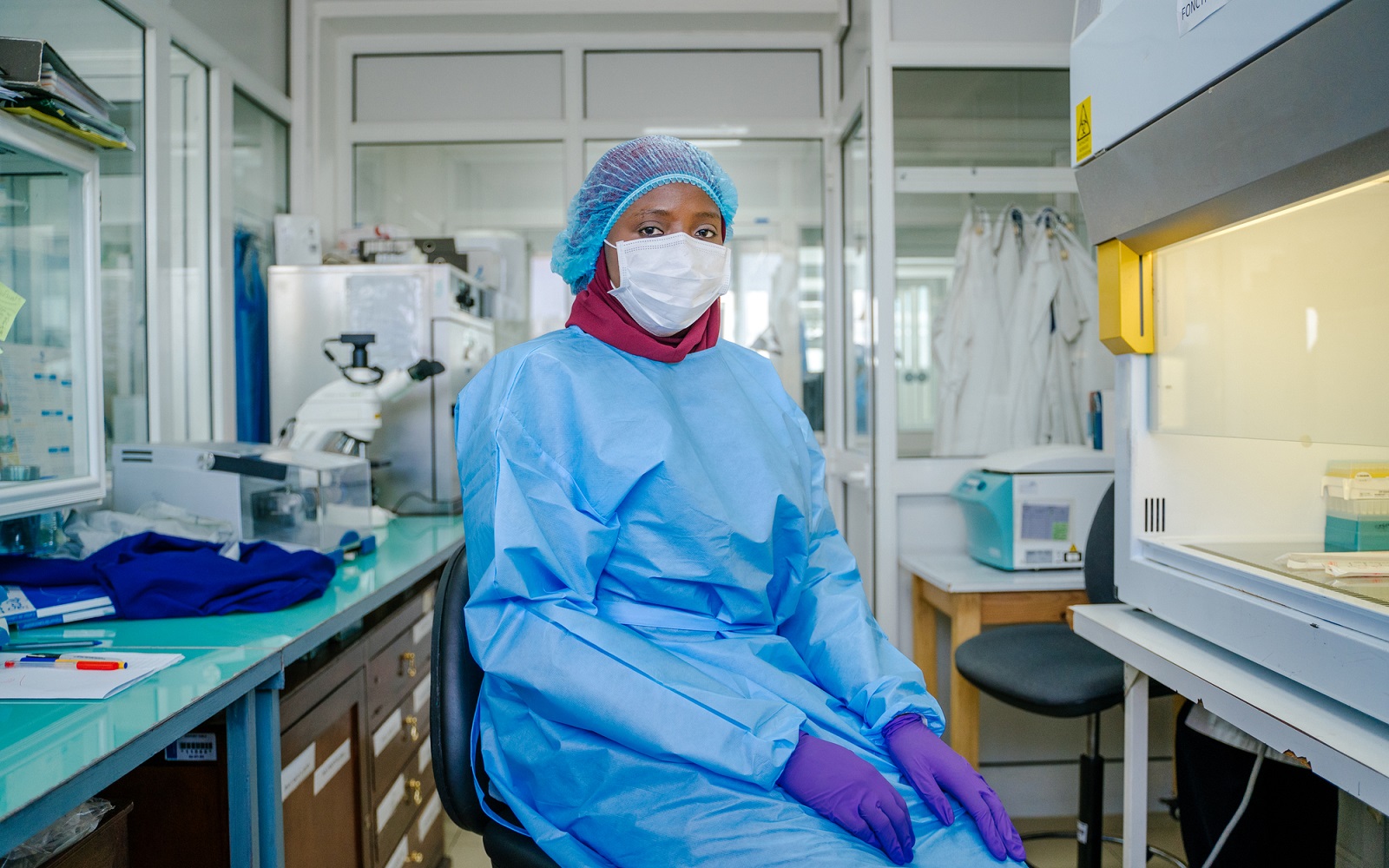
Under the bright lights of a lab at Institut Pasteur de Dakar (IPD) in Senegal, anticipation filled the air. Marie-Angélique Sène’s team was preparing to share a groundbreaking innovation—the groundwork for the first-ever mRNA vaccine developed in Senegal—with a group of global health leaders. The vaccine, which targets Rift Valley fever—a virus which can cause severe disease in both people and animals—represents a milestone in global health innovation by advancing vaccine design and manufacturing, laying the foundation for future breakthroughs.
As the Head of Advanced Vaccine Bioprocessing at IPD, Sène is leading all the work, from antigen design to manufacturing process development. Rather than take center stage herself, however, Sène let her team explain their trailblazing research to the visitors, including Bill Gates, as she beamed with pride. She had built this team of highly skilled scientists united by a mission to improve access to life-saving vaccines in Senegal and across Africa.
The road to this moment was anything but easy. Sène faced obstacles that could have ended her journey—but instead, they fueled her drive to lead her team to this major achievement.
The youngest of four siblings, Sène saw her own mother persevere in the face of challenges, working her way up from intern to headmistress of her daughters’ school. “People might expect my role model to be a scientist, but my mother was my role model,” Sène says. “She still is.” When she was growing up in Dakar, Sène attended a kindergarten owned by her mother, just a short distance from IPD. Sène carried her mother’s influence with her as she left Dakar to pursue her education in France.
When she arrived in Versailles for college, Sène felt out of place. Some of her classmates questioned her abilities and asked her questions rooted in stereotypes about Africans. “I was bombarded with questions like, ‘How did you hear about the school?’ or ‘Do you usually speak French [so well]?’” she recalls. Their questions, and the isolation of being so far from home, shook her confidence.
But in moments when she felt like giving up, her mother’s words helped keep her grounded: “When I wanted to quit science, she said to me, ‘Be grateful that people are trying to put obstacles in your path. That means you’re on the right track. You’re doing the right thing.’” Before long, Sène turned those obstacles into steppingstones on the path to a remarkable scientific career.
Fluent in four languages, Sène earned her M.S. in Mechanical engineering with a specialty in micro/nanotechnology at Seoul National University—one of South Korea’s top institutions—before completing a Ph.D. in biomedical sciences at McGill University, one of Canada’s leading research universities. By age 28, she was hired to lead the microbiology and analytical development lab at IPD.
In South Korea, Sène not only mastered complex nanotechnology coursework but also immersed herself in a new culture, even learning to speak Korean to collaborate effectively with her peers. These experiences shaped her adaptability and global perspective—qualities she now brings to her leadership at IPD.
At the start of her career, Sène often found her voice and expertise sidelined in male-dominated spaces. Determined to change this dynamic, she has worked to create leadership opportunities for others, especially women. As the head of Vaccine Research Center at IPD, Sène oversees a multigenerational team of scientists, most of them women.
Sène has learned that nurturing her team isn’t just about guiding their scientific work—it’s about helping shy, uncertain individuals blossom into leaders. “They come to me and say, ‘I didn’t know I could do this,’” she says. Now they are part of a team shaping the future of vaccine accessibility, developing manufacturing processes that could dramatically reduce disease rates across Africa and strengthen global health systems.
By submitting your email to subscribe, you agree to the Gates Foundation’s Privacy & Cookies Notice
Returning to Dakar as a leader at the Institut Pasteur de Dakar (IPD) felt like coming full circle for Sène—having attended her mother’s kindergarten just a short distance from the institute. For her, the journey home represents not only personal fulfillment but also a chance to empower the next generation of African scientists.
The mRNA vaccine her team is developing for Rift Valley fever has the potential to save countless lives across Africa, not only protecting people from severe disease but also safeguarding livestock that are essential to rural economies. By spearheading domestic vaccine production, Sène is helping Senegal reduce its reliance on external suppliers and positioning Africa as a leader in global health innovation. “The brains are here,” she says. “They just need the right tools and to be exposed to the right environment to thrive.”
Sène’s vision extends beyond her lab. For her, true leadership means creating opportunities for others to grow, even when that means ceding the spotlight to them. This philosophy of empowerment, rooted in her mother’s wisdom, is part of the legacy she is building. As she mentors young African scientists, she is helping build a future where Africa leads the way in global health innovation.
“We cannot build leaders by keeping them backstage,” she says. “We build them by letting them go out in the world and learn from their mistakes.”
By submitting your email to subscribe, you agree to the Gates Foundation’s Privacy & Cookies Notice
By submitting your email to subscribe, you agree to the Gates Foundation’s Privacy & Cookies Notice
About The Author

More Stories
Adaptability and Resilience: Q&A with New Board Chair Brian Haberman
Community Snapshot—July
Carrying the Light of the Internet Forward: A Farewell Message from Board Chair Ted Hardie