
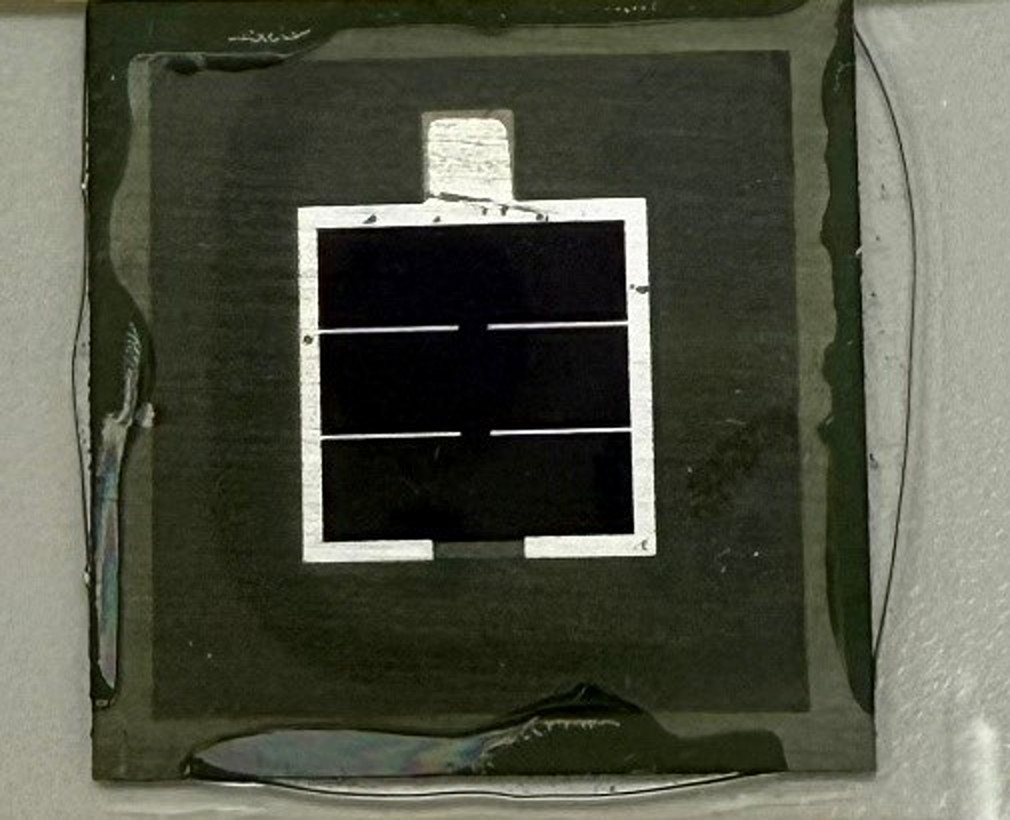
The cell utilizes a heterojunction device as the bottom cell and a perovskite top cell integrating a hole transport layer made of nickel(II) oxide and methyl-substituted carbazole.
Image: Academia Sinica
Taiwan’s Academia Sinica announced that a group of its researchers has developed a two-terminal (2T) perovskite-silicon tandem solar cell with a power conversion efficiency of 31.5%.
“In the future, the research team will further optimize the manufacturing process, enlarge the cell area, improve the stability of the stacked components, and develop a manufacturing method that is more suitable for mass production,” the research institute said in a statement. “We achieved a high efficiency by reducing interface losses.”
The research group utilized an unspecified heterojunction (HJT) crystalline solar cell technology for the bottom device.
Image: Academia Sinica
Furthermore, it used a top perovskite solar cell built with a substrate made of indium tin oxide (ITO), a hole transport layer (HTL) made of nickel(II) oxide (NiOx) and phosphonic acid called methyl-substituted carbazole (Me-4PACz), a perovskite absorber, a buckminsterfullerene (C60) electron transport layer (ETL), a tin oxide (SnOx) buffer layer, a transparent back contact made of indium zinc oxide (IZO), a silver (Ag) metal contact, and an anti-reflective coating based on magnesium fluoride (MgF2).
“We will continue to work closely with domestic academic research institutions and manufacturers to jointly develop this cell technology,” the research team, without revealing more technical details on the novel cell concept.
Chinese manufacturer Longi holds the world record for perovskite-tandem solar cell efficiency, achieving 34.6% efficiency in September. In 2023, Saudi Arabia’s King Abdullah University of Science and Technology (KAUST) announced a perovskite-silicon tandem device with an efficiency of 33.7%.
Researchers from Germany’s Fraunhofer Institute for Solar Energy Systems (Fraunhofer ISE) recently said that the practical power conversion efficiency potential of perovskite-silicon tandem solar cells could reach up to 39.5%. Researchers said exceeding this efficiency threshold requires a change in cell architecture, replacing buckminsterfullerene (C60) with a more transparent electron transport layer, and finding more transparent alternatives to indium tin oxide (ITO) layers.
This content is protected by copyright and may not be reused. If you want to cooperate with us and would like to reuse some of our content, please contact: editors@pv-magazine.com.
More articles from Emiliano Bellini
Please be mindful of our community standards.
Your email address will not be published.
By submitting this form you agree to pv magazine using your data for the purposes of publishing your comment.
Your personal data will only be disclosed or otherwise transmitted to third parties for the purposes of spam filtering or if this is necessary for technical maintenance of the website. Any other transfer to third parties will not take place unless this is justified on the basis of applicable data protection regulations or if pv magazine is legally obliged to do so.
You may revoke this consent at any time with effect for the future, in which case your personal data will be deleted immediately. Otherwise, your data will be deleted if pv magazine has processed your request or the purpose of data storage is fulfilled.
Further information on data privacy can be found in our Data Protection Policy.
Legal Notice Terms and Conditions Data Privacy © pv magazine 2025
This website uses cookies to anonymously count visitor numbers. View our privacy policy.
The cookie settings on this website are set to “allow cookies” to give you the best browsing experience possible. If you continue to use this website without changing your cookie settings or you click “Accept” below then you are consenting to this.
Close
About The Author


More Stories
Community Snapshot—June
New ITU Report Finds Community Networks Are Key to Reaching the Unconnected
Digital Coercion: How Inaccessible Design Strips Financial Privacy