
Thank you for visiting nature.com. You are using a browser version with limited support for CSS. To obtain the best experience, we recommend you use a more up to date browser (or turn off compatibility mode in Internet Explorer). In the meantime, to ensure continued support, we are displaying the site without styles and JavaScript.
Advertisement
Adele Waters is a freelance journalist based in London.
You can also search for this author in PubMed Google Scholar
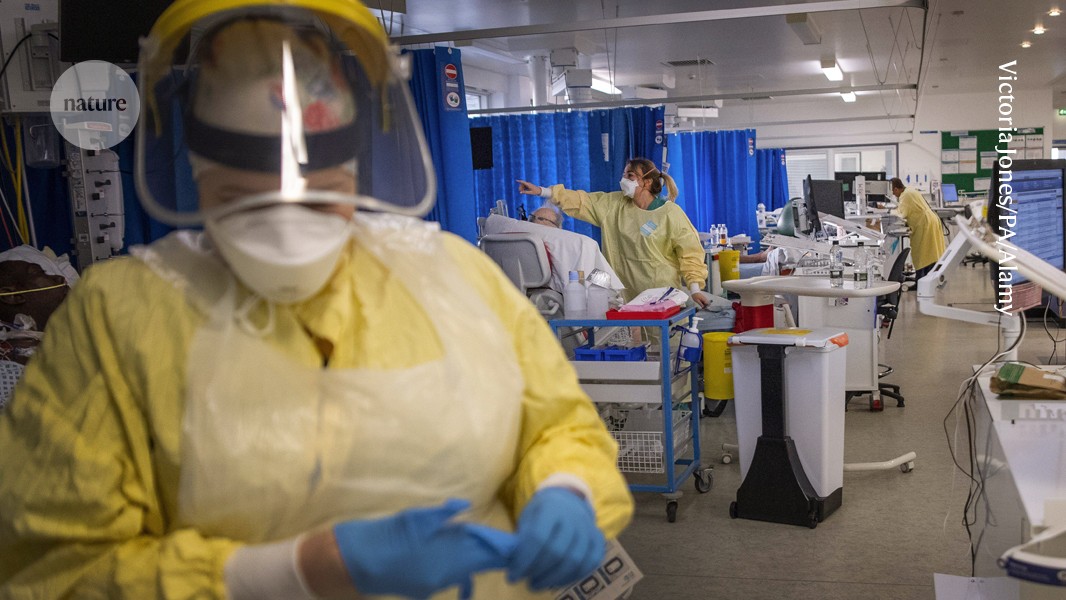
Health care, with all its complexities, is often wrongly modelled as if it were a service industry, says Alison Leary.Credit: Victoria Jones/PA/Alamy
Alison Leary’s career spans engineering, nursing and data science. In her current role as a workforce-modelling researcher at London’s South Bank University, she uses data-mining and pattern-recognition skills to model complex systems.
Leary also works for the World Health Organization, advising national agencies and governments on workforce modelling. Her work has contributed to global and national policy in various countries; in health care, she has studied more than 70 specialist workforces.
Before moving into academia, she worked for the commercial sector, doing mathematical modelling and data mining in fields including retail and pharmacy, and the aeronautical and space industries. Today, she provides that modelling expertise on a consultancy basis with a focus on complex systems, such as the United Kingdom’s National Health Service (NHS) workforce.
Leary tells Nature’s careers team about her mission to make under-recognized but crucial ‘pink collar’ work (service-oriented roles historically associated with women, such as nursing) more visible. Health care is often wrongly modelled as if it were a service industry, similar to grocery or hospitality, she argues. Instead, the focus should be on quality and safety, and on acknowledging its complexity.
Finally, she says, some lessons from health care can be applied to tackle the ‘leaky pipeline’ in academia, particularly as it affects women.
After completing an apprenticeship in electrical engineering, I did a degree in natural sciences and worked in industry and the NHS as an engineer for ten years. I retrained as a registered nurse, specializing in haematology and blood cancers. After a master’s degree in biomedical science, I did a PhD in thoracic oncology at University College London.
I became concerned about how poorly understood (and, to a certain extent, invisible) the contribution of specialist nurses was, so I developed an online tool to quantify their value to hospital board executives.
Bias in science: how to fight the good fight
Bias in science: how to fight the good fight
That was the start of my interest in interrogating workforces and examining their potential optimization. What interests me is the relationship between work, workforces and safety or outcomes. My particular focus is in modelling the demand for labour, particularly highly skilled labour, where work is complex.
The best endorsement I’ve ever received is that I “am not afraid to be unpopular”.I think this relates to my research, which tends to challenge the new and shiny ‘solutions’ that the health-care-policy world seems to favour. Health care has its own culture, which makes original evidence-based thinking a challenge to introduce or implement.
You collect data to build an accurate picture of the workforce, how it is structured and how it behaves. You also look at labour expenditure, as well as work done and work that is left undone, and look for points of improvement.
The basic steps are, first, understand the work and its purpose. Next, break down the work into component parts and count them. You can then start collecting data from which to build a model to explain how the workforce currently works; it will only ever be a representation of the real world. I spend a good proportion of my time understanding the work and the context in which it’s carried out, and checking any assumptions against that reality.
Finally, you can use the data to re-model the workforce to show how it might work better if adjustments were made, for example by altering workflows or the number of staff with particular qualifications. This can also reveal the risk that some work will not be done, and the consequences of that.
For example, my modelling for the inflammatory-bowel-disease specialist-nursing workforce recommended a staff-to-patient ratio of 2.5 full-time-equivalent specialist nurses per 250,000 patients. It has become the European standard.
No model is perfect, some are more useful than others, and we initially aim for roughly right, rather than precisely wrong. The models are iterative, too, so with more data over time, they refine and generate greater insights.
The structural inequality in society is reflected in scientific and academic careers. Whether it’s nursing, academia or clinical sciences, you see the scissor effect — where there are plenty of women in the lower ranks but their representation slides in higher ranks.
We lose women in science, engineering and technology (the ‘leaky pipeline’) for a number of reasons. Yes, women are more likely to take up caring responsibilities, but there are other factors, such as the authority gap — the lack of visible female leaders in the field. Plus, there’s an opportunity gap: it’s harder to access those opportunities when you are working part-time or have other responsibilities.
A lack of confidence can also be an obstacle. And factors such as ethnicity and social class have an impact: you might not have the same opportunities to network as those who hold more privilege or structural advantage.
or
doi: https://doi.org/10.1038/d41586-024-04243-y
 Hiring in science
 Women in science
Beyond black and white: an ecologist applies racial-justice principles to predators and their ecosystems
Career Feature
‘Publish or perish’ culture blamed for reproducibility crisis
Career News
How hosting Ukrainian scientists offers a template for supporting other scholars at risk
Career Feature
Beyond black and white: an ecologist applies racial-justice principles to predators and their ecosystems
Career Feature
Build a DNA database to help identify children stolen in conflicts
Comment
How hosting Ukrainian scientists offers a template for supporting other scholars at risk
Career Feature
Faced with funding cuts, collaborate to define research priorities
Correspondence
Why we still don’t know the mounting health risks of climate change
World View
What Trump’s flurry of executive orders means for science
News
New York City, New York (US)
NYU Grossman School of Medicine
Department of Biochemistry and Molecular Genetics at the University of Alabama at Birmingham and O’Neal Comprehensive Cancer Center
Birmingham, Alabama (US)
University of Alabama at Birmingham
Research into the synthesis of near-infrared emitting/absorbing functional soft materials and polymer composite materials.
Tsukuba, Ibaraki (JP)
National Institute for Materials Science (NIMS)
Four Excellence PhD positions with flexible research directions and sixteen focused PhD positions in the field of Nanoscience and Nanotechnology.
Gothenburg (Kommun), Västra Götaland (SE)
Chalmers Tekniska Högskola
Xiaoliang Sunney XIE’s Group is recruiting researchers specializing in Alzheimer's disease (AD).
Beijing, China
Changping Laboratory
Hiring in science
Women in science
An essential round-up of science news, opinion and analysis, delivered to your inbox every weekday.
Sign up for the Nature Briefing newsletter — what matters in science, free to your inbox daily.
© 2025 Springer Nature Limited
About The Author



More Stories
Global Encryption Day Summit 2026: Five Key Conversations on the Future of Digital Trust
What Global Data Tells Us About the Economics of IXPs
We Shouldn’t Have to Give Up Our Safety Online to Be Safe