
Click here to sign in with or
Forget Password?
Learn more
share this!
18
Twit
Share
Email
April 4, 2024
This article has been reviewed according to Science X’s editorial process and policies. Editors have highlighted the following attributes while ensuring the content’s credibility:
fact-checked
peer-reviewed publication
proofread
by Rachel Fritts, Eos
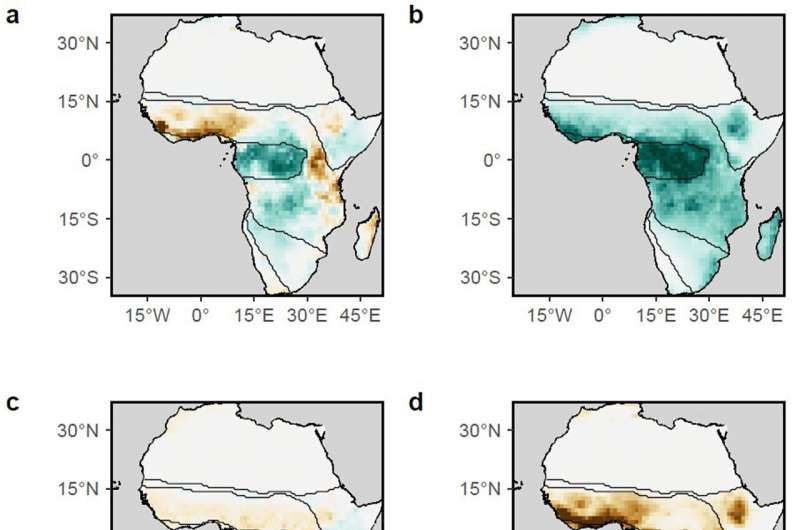
The population of Africa, the second-largest continent in the world, currently sits at about 1.4 billion, but is set to exceed 2 billion by 2040. This means greater swaths of land than ever before are being used for agriculture, and livestock numbers are increasing. A new estimate of Africa’s greenhouse gas budget between 2010 and 2019 quantifies just how much these changes in land use have affected Africa’s role in the global carbon cycle. The research is published in the journal Global Biogeochemical Cycles.
To make their estimates, Yolandi Ernst and colleagues followed the budget assessment protocol laid out by the Regional Carbon Cycle Assessment and Processes (RECCAP2) initiative. They took a comprehensive look at all major potential carbon sources, including human sources such as agriculture and fossil fuel emissions and natural sources such as termites and wildfires. They also considered natural sinks: the grasslands, savannas, and forests that still cover much of the continent.
The team found that between 2010 and 2019, Africa transitioned from being a slight net carbon sink to a slight net carbon source. Overall, they estimated that Africa was a source of 4.5 petagrams, or 4.5 billion metric tons, of carbon dioxide equivalents per year (a unit that represents the global warming potential of all greenhouse gases) during that period. And that number is likely to increase if current trends continue.
Key factors in the rise of greenhouse gases include fossil fuel burning, methane emissions from livestock, and soil carbon losses and nitrous oxide emissions as land is converted for agricultural use. Natural ecosystems continue to act as carbon sinks across the region and are absorbing about a third of what human activities are emitting to the atmosphere. The authors conclude that switching to carbon-neutral fuels could eliminate up to 30% of anthropogenic emissions. However, as demand for food production increases, this progress could be offset by the continued rise in converting land for agriculture.
The authors note that gathering more data on Africa and developing models specific to the continent are important to decrease the uncertainty of estimates. They also recommend a focus on climate-smart agricultural practices, as well as investments that address socioeconomic challenges while still preserving nature across Africa.
More information: Yolandi Ernst et al, The African Regional Greenhouse Gases Budget (2010–2019), Global Biogeochemical Cycles (2024). DOI: 10.1029/2023GB008016
Journal information: Global Biogeochemical Cycles
Journal information: Global Biogeochemical Cycles
Provided by Eos
Explore further
Feedback to editors
9 hours ago
0
Apr 5, 2024
0
Apr 5, 2024
0
Apr 5, 2024
0
Apr 4, 2024
0
3 hours ago
9 hours ago
11 hours ago
11 hours ago
11 hours ago
11 hours ago
11 hours ago
11 hours ago
Apr 5, 2024
Apr 5, 2024
54 minutes ago
8 hours ago
Apr 5, 2024
Apr 5, 2024
Mar 27, 2024
Mar 20, 2024
More from Earth Sciences
Jan 8, 2024
Jul 26, 2021
Dec 20, 2023
Mar 4, 2024
Feb 1, 2024
Jan 10, 2024
Apr 5, 2024
Apr 5, 2024
Apr 4, 2024
Apr 4, 2024
Apr 4, 2024
Apr 4, 2024
Use this form if you have come across a typo, inaccuracy or would like to send an edit request for the content on this page. For general inquiries, please use our contact form. For general feedback, use the public comments section below (please adhere to guidelines).
Please select the most appropriate category to facilitate processing of your request
Thank you for taking time to provide your feedback to the editors.
Your feedback is important to us. However, we do not guarantee individual replies due to the high volume of messages.
Your email address is used only to let the recipient know who sent the email. Neither your address nor the recipient’s address will be used for any other purpose. The information you enter will appear in your e-mail message and is not retained by Phys.org in any form.
Get weekly and/or daily updates delivered to your inbox. You can unsubscribe at any time and we’ll never share your details to third parties.
More information Privacy policy
We keep our content available to everyone. Consider supporting Science X’s mission by getting a premium account.
Medical research advances and health news
The latest engineering, electronics and technology advances
The most comprehensive sci-tech news coverage on the web
About The Author


More Stories
Introducing a New Chapter for the Internet Society Fellowship Program
Closing AI’s Language Gap: Why the Internet Society Is Joining a Global Commitment
What Happens When a Community Wires Itself: Lessons from Colville on the Power of Indigenous-Led Connectivity