
{{region_detail.text}}
{{person_detail.text}}
{{organization_detail.text}}
{{series.description | limitTo:140}}
The Salafi-Jihadi Movement Weekly Update was produced by the Critical Threats Project (CTP) at the American Enterprise Institute with support from the Institute for the Study of War (ISW).
The Africa File will provide weekly analysis and assessments of state and non-state actors’ activities in Africa that threaten US personnel and the numerous US national security interests on the continent. US national security interests in Africa include preventing adversaries from using Africa as a base to launch attacks or evade sanctions, ensuring access to strategic minerals and economic markets that are critical to US supply chains, working with partners to manage potentially destabilizing migration flows to Europe and the US, disrupting transnational crime networks that support illicit markets worldwide, and promoting democracy to prevent the spread of anti-Western authoritarianism. Prominent actors on the African continent threaten these interests, including state powers such as China, Iran, and Russia, as well as non-state groups like the Islamic State and al Qaeda. The product distills open-source information to assess these actors’ campaigns and related security and political issues in Africa that could impact their efforts. Irregular editions may be published based on current events.
To receive the Africa File via email, please subscribe here. Follow CTP on Twitter, LinkedIn, and Facebook.
Previous versions of static maps are available in our past publications. 
Additional maps specific to each region are available here.
The ongoing Senegalese election crisis is destabilizing a crucial democratic US ally in turbulent West Africa, which threatens to further weaken America’s position in the region. Disputed elections and a continued lack of economic prospects for Senegalese youth would likely erode democratic legitimacy in Senegal and increase political instability in the coming years. Russia has capitalized on the rise of authoritarian regimes emerging from democratic erosion and instability in other West African countries to gain a foothold in the region. Al Qaeda–affiliated militants in western Mali could also take advantage of instability to expand into Senegal, which would further destabilize the country and create more avenues for security cooperation with Russia. Senegal’s highly professional military is unlikely to launch a coup to take advantage of the unrest, but the spate of coups across Africa since 2020 underscores the risk of such an event.
The Somali Federal Government (SFG) is intensifying operations to clear al Shabaab’s remaining havens in central Somalia with support from international partners, including the United States, and said it will expand its offensive into southern Somalia in the coming months. Degrading al Shabaab’s capabilities is an important US national security interest, as the group has demonstrated its intent to attack the US homeland and its capability to conduct attacks beyond East Africa since 2019. The SFG faces several military and political obstacles to successfully concluding ongoing operations in central Somalia and expanding them south.
The US secretary of state met with key US partners in West Africa as Russia and Iran are bolstering their ties with authoritarian regimes in the region. Russia and Iran have capitalized on the rise of a bloc of anti-Western Sahelian juntas that overthrew Western partner states to advance their strategic aims of destabilizing Europe, mitigating Western sanctions, and diminishing Western influence worldwide. The growing Russo-Iranian partnerships with the authoritarian regimes have also enabled brutal and ineffective counterinsurgency strategies that have strengthened the regional Salafi-jihadi insurgency and undermined US regional counterterrorism interests.
The Nigerien junta is continuing to grow closer to the Kremlin and may deploy Russian mercenaries in Niger to respond to the deteriorating security situation in the country in the coming months. A significant number of Russian mercenaries would enable the junta to divert Nigerien troops away from the capital to counter al Qaeda–affiliated militants who are strengthening support zones in areas that are enabling attacks within 25 miles of the capital. Russian mercenaries are not effective at counterinsurgency operations and would likely be more focused on advancing the Kremlin’s strategic aims of regime security and resource plunder than counterterrorism operations. The junta could alternatively pursue a more traditional defense partnership with Russia and rely on civilian militias to augment its capacity outside the capital. The uses of Russian mercenaries and civilian militias are not mutually exclusive, but either option will likely exacerbate human rights abuses that push locals to ally with insurgents for protection.
IS affiliates across sub-Saharan Africa have claimed attacks as part of the new IS global campaign and could attempt to carry out high-visibility attacks against civilians and religious sites in their areas of operation to maximize the propaganda value of the global campaign. IS central media is branding the campaign as supportive of the Palestinian cause in response to the Israel-Hamas war and is also encouraging lone-wolf attacks against civilians in the West.
Horn of Africa. Ethiopia signed a memorandum of understanding with the de facto independent Somaliland Republic, a breakaway region of Somalia, to lease a naval port that will give it Red Sea access in exchange for formally recognizing Somaliland. The port deal has severely strained Somali-Ethiopian relations and increased anti-Ethiopian sentiment in southern Somalia, which will likely weaken regional counterterrorism cooperation and energize al Shabaab. Ethiopia’s African Red Sea neighbors in Djibouti, Egypt, and Eritrea will likely view an Ethiopian base as a threat, while the United Arab Emirates’ (UAE) strong ties with the Ethiopian government will strengthen the Emiratis’ position in its regional rivalry with other Gulf countries, such as Saudi Arabia and Qatar.
Sahel. Al Qaeda–linked militants have continued strengthening in central and southern Mali and across the border in northern Burkina Faso. Regional security forces likely lack the capacity to degrade the militants’ support zones, which allow the militants to continue launching attacks that temporarily overwhelm security force positions to delegitimize both countries’ governments and extend its support zones without establishing direct territorial control.
Ethiopia signed a memorandum of understanding with the de facto independent Somaliland Republic, a breakaway region of Somalia, to lease a naval port that will give it Red Sea access in exchange for formally recognizing Somaliland. The port deal has severely strained Somali-Ethiopian relations and increased anti-Ethiopian sentiment in southern Somalia, which will likely weaken regional counterterrorism cooperation and energize al Shabaab. Ethiopia’s African Red Sea neighbors in Djibouti, Egypt, and Eritrea will likely view an Ethiopian base as a threat, while the United Arab Emirates’ strong ties with the Ethiopian government will strengthen the Emiratis’ position in its regional rivalry with other Gulf countries, such as Saudi Arabia and Qatar.
Al Qaeda–linked militants are increasing their rate of attack in central Mali, likely to coerce civilians into submission to strengthen support zones and gain more resources to help the group isolate Malian forces in the area. Malian security forces and their Kremlin-funded Wagner Group auxiliaries will likely fail to protect civilians from the attacks because Malian forces cannot effectively contest insurgents in central Mali as they continue to give priority to fighting Tuareg rebels in northern Mali. UN forces that helped secure roads in the region are also no longer around to mitigate security gaps after withdrawing in early December. The insurgents will likely use strengthened support zones in central Mali to besiege major population centers and attack isolated security forces in Mali and Burkina Faso to delegitimize both countries’ governments.
Western counterterrorism efforts in the Sahel failed to degrade the Salafi-jihadi insurgency over the past decade, which contributed to governance collapse and the rise of military juntas in Burkina Faso, Mali, and Niger that have exacerbated the regional insurgency. Russia has taken advantage of this shift to entrench itself in the region, to the benefit of Salafi-jihadi insurgents and at the expense of US geostrategic and counterterrorism interests.
A potential localized truce between Islamic State and al Qaeda–linked militants near the Malian-Nigerien border is likely aiding both groups’ efforts to strengthen their support zones in the Sahel and increasing their transnational threat risk. The Islamic State’s Sahel Province (ISSP) has spread its governance efforts in northeastern Mali and expanded governance and military activity closer to the Nigerien capital since the July 2023 coup. Al Qaeda’s Sahelian affiliate has increased its military activity in northern Mali to exploit opportunities created by the end of the UN mission in Mali and renewed fighting between the Malian army and Tuareg rebels since July.
Malian and Kremlin-funded Wagner Group forces will likely attempt to capture the vacated UN base in the Kidal regional capital in the coming weeks. Malian and Wagner forces have the conventional capabilities to clear the base but almost certainly lack the popular support, strategy, and sufficient troop numbers needed to hold the base and degrade the insurgency. Tuareg rebels and al Qaeda–linked militants will likely give priority to preemptively attacking Malian and Wagner positions in the Kidal region in the coming weeks to degrade security forces’ ability to launch an offensive.
Mali. The Malian junta is hindering the ongoing UN withdrawal, which is making it easier for al Qaeda and Islamic State–affiliated militants to attack UN peacekeepers.
Somalia. Clan infighting in central Somalia will likely hinder the Somali Federal Government’s (SFG) plans to remove al Qaeda affiliate al Shabaab from central Somalia and pose an enduring risk to stability in central Somalia.
The Malian junta and its Wagner Group auxiliaries cannot backfill withdrawing UN forces in northern Mali while maintaining pressure across the country, which will likely create gaps for al Qaeda–affiliated militants to exploit in central Mali. Al Qaeda–affiliated militants and the Tuareg rebels are at least tacitly supporting each other operationally in northern Mali and may explicitly be coordinating some attacks, which will prolong the conflict and further strain the junta’s capacity issues.
Al Qaeda’s affiliates in sub-Saharan Africa may exploit the Israel-Hamas war to attack their regional or Western adversaries under the pretext of supporting Hamas. These attacks would simultaneously advance the affiliates’ transnational propaganda narratives while furthering their preexisting local campaigns. Al Qaeda’s Somali affiliate will likely increase the rate and scale of attacks in Kenya and against US and Kenyan forces in the Horn of Africa. The group’s Sahelian affiliate is unlikely to do the same against UN peacekeepers or foreigners because international disengagement from the region has removed many potential targets and incentives.
Niger. The Islamic State Sahel Province (ISSP) is isolating Nigerien forces and reducing Nigerien pressure on the group’s sanctuaries along the Malian-Nigerien border, which will enable the group to overrun Nigerien border posts to consolidate control over northwestern Niger. Strengthened ISSP control over northwestern Niger would destabilize the Nigerien junta and allow the group to target more politically sensitive areas, such as the capital.
Mali. The Malian army and Wagner Group are committing atrocities against civilians as they push into northern Mali to assume control over UN bases, which will likely strengthen al Qaeda–linked militants’ local support in the area. Al Qaeda’s local affiliate will likely leverage this support to further co-opt local leadership and implement shadow governance in rebel-controlled areas, which will increase the group’s transnational threat risk by giving it access to the sanctuaries and resources needed to stage external attacks.
Sahel. Worsening insurgencies are contributing to factionalism within the Burkinabe and Malian juntas, which could lead to additional coups. Factionalism in the military juntas will make them preoccupied with securing power, which will likely enable Salafi-jihadi insurgents to increase military pressure on politically sensitive areas, further eroding the juntas’ legitimacy.
Somalia. An al Shabaab offensive is setting conditions for the group to undo Somali Federal Government (SFG) gains made during its successful 2022 offensive. Al Shabaab will continue threatening to overturn SFG gains from the 2022 offensive as long as it retains havens in central Somalia.
The resumption of fighting between the Malian government and non-jihadist Tuareg rebels will likely enable al Qaeda–linked militants to further ingratiate themselves with communities in northern Mali, potentially establishing de facto control and shadow governance in some nominally rebel-controlled areas. Growing control in northern Mali will enable al Qaeda–linked militants to pose a greater transnational threat.
The Russian Ministry of Defense (MoD) is growing ties with Sahelian juntas as part of its efforts to subsume Wagner’s global operations. These efforts are increasing friction with Wagner fighters in the Sahel and creating opportunities for Salafi-jihadi and non-jihadist armed groups to exploit.
Al Qaeda–linked and IS-linked militants are continuing to expand in northern Mali and threatening to control major population centers. Al Qaeda–linked militants are exploiting the void left by withdrawing UN forces to besiege and coerce regional capitals in northern Mali, while IS-linked militants are setting conditions to control a regional capital they have encircled since April. Both groups’ growing control over northern Mali increases the risk that they could generate a transnational attack threat.
The Nigerien junta will likely expedite efforts to remove French forces from Niger due to France’s strong support for the Economic Community of West African States (ECOWAS). The Nigerien junta may allow the United States to continue operating in Niger because the United States has been less antagonistic toward the junta.
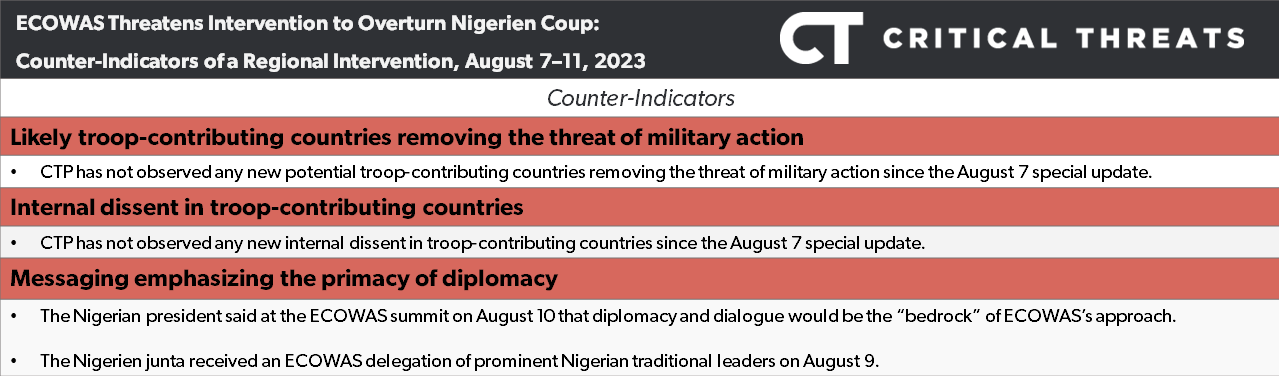
The Economic Community of West Africa States (ECOWAS) activated and ordered the deployment of a standby force on August 10 to reinstitute constitutional order in Niger, which increases the risk of a regional clash in the coming weeks. The junta’s refusal to cooperate is leaving little room for compromise, and ECOWAS risks undermining its stability by not confronting the junta, increasing the risk that neither side finds a suitable off-ramp to the looming military conflict.
ECOWAS will likely assemble the bulk of its standby force in the next month, and Nigeria remains the lynchpin for any potential military action and could follow through on the threat of military action if ECOWAS and the junta do not reach a compromise. Niger will pose significant operational challenges for the ESF that did not exist in the 2017 Gambian intervention, which strengthens CTP’s assessment that an ECOWAS intervention would be highly costly and destabilizing for Niger and West Africa.
Both sides could still reach a compromise during the weeks it takes the ESF to mobilize. ECOWAS continued diplomatic efforts during the buildup of the ESF in Gambia and is signaling it will do the same with Niger. Some ECOWAS partners may be willing to accept a compromise that secures the release of Nigerien President Mohamed Bazoum and a transitional government to avoid military conflict while securing a pathway to restore democracy. A similar road map failed in Mali due to the army’s heavy influence in the transition process, leading to a second coup that installed the country’s current junta.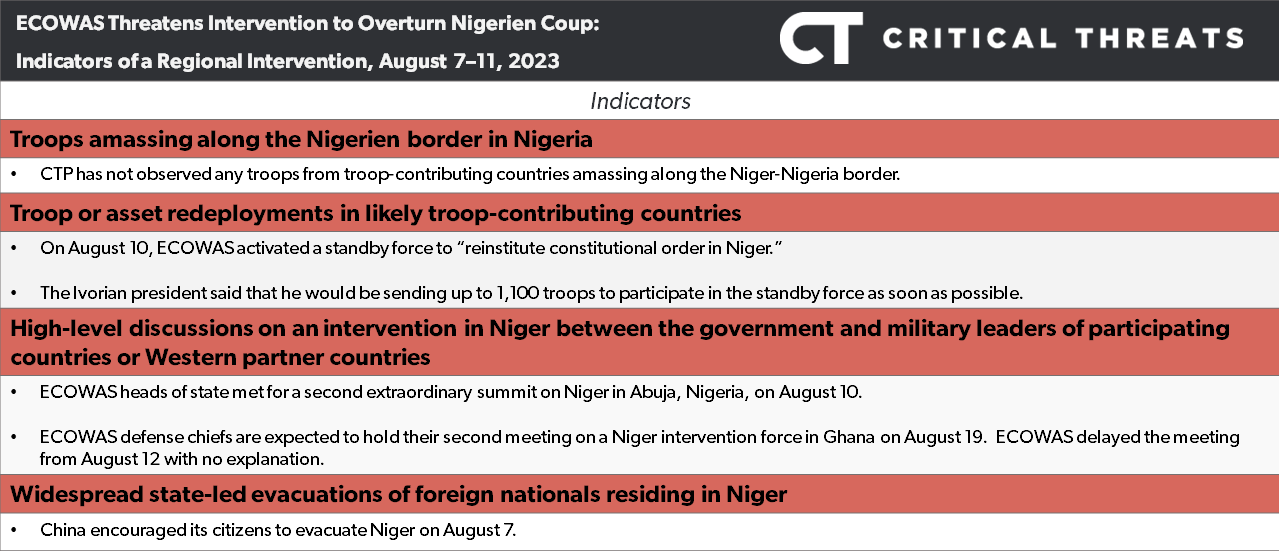
Niger. The Nigerien junta plans to use the Kremlin-funded Wagner Group and local volunteer militias to bolster security in the capital and may intend to use both against Salafi-jihadi insurgents after securing its hold on power. Relying on these auxiliary forces risks increasing human rights abuses and exacerbating communal tensions, which would create opportunities that Salafi-jihadi groups have historically exploited.
Mali. Al Qaeda–linked militants increased the rate and severity of their attacks in central Mali in July, indicating the group is strengthening in area despite Malian and Wagner Group counterterrorism operations. Al Qaeda associate Jama’at Nusrat al Islam wa al Muslimeen (JNIM) will likely use its growing support zones in central Mali to besiege larger towns in the area into submission and conduct more frequent and more severe attacks in southern Mali to challenge the junta’s legitimacy.
Somalia. The Somali Federal Government (SFG) will likely resume its offensive to capture the last al Shabaab–controlled district capital in north-central Somalia in the coming weeks. Al Shabaab will likely avoid conventional defensive engagements for complex suicide vehicle-borne improvised explosive device (SVBIED) counterattacks as it did during the initial phase of the offensive.
Salafi-Jihadi Movement Update Special Edition: Niger Coup—ECOWAS Invasion in Limbo
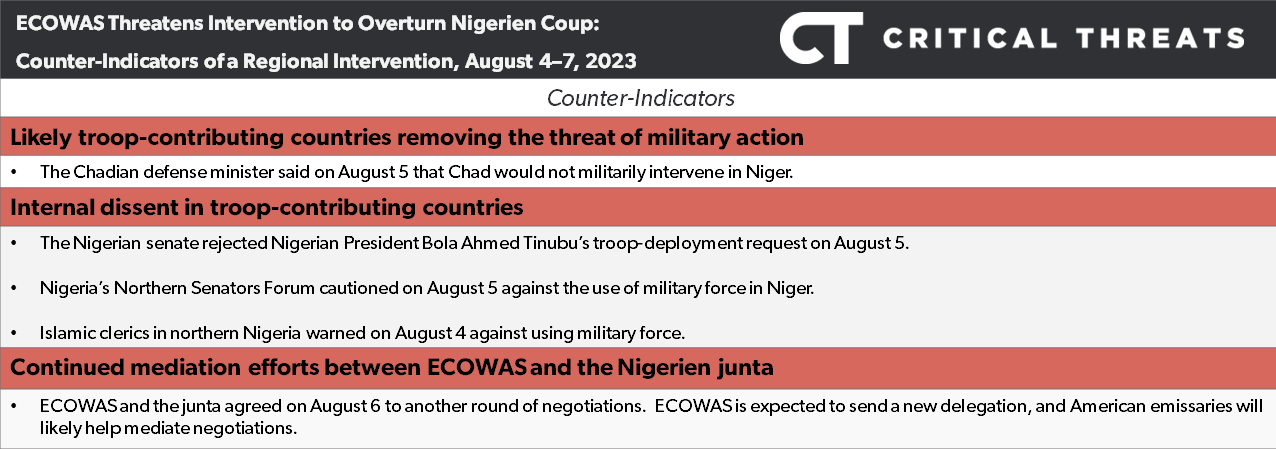
A regional intervention in Niger is unlikely in the next 72 hours, as the West African regional body buys itself time to reach a compromise and finalize military plans. The Economic Community of West African States (ECOWAS) has not yet followed through on its threat to use military force to reinstitute the democratically elected government of Niger, after its one-week ultimatum expired on August 6. ECOWAS and the Nigerien junta agreed to another round of talks on August 6, signaling the regional body is still seeking a negotiated solution. ECOWAS also announced that it would hold a second summit on Niger in Abuja, Nigeria, on August 10. This summit will provide ECOWAS leaders the chance to reassess all potential options and finalize invasion plans that the ECOWAS defense chiefs created during a summit from August 2 to 4.
Domestic Nigerian pushback to a military intervention could derail an ECOWAS intervention. Nigeria withdrawing its support for military action would end the chances of a regional invasion due to Nigeria’s crucial importance to an intervention. Nigeria is the largest of all troop-contributing countries and will presumably compromise the bulk of an intervention force. A regional intervention would also have to be staged from Nigeria. Algeria and Chad are against a regional intervention, and Burkina Faso and Mali have said they would support the junta.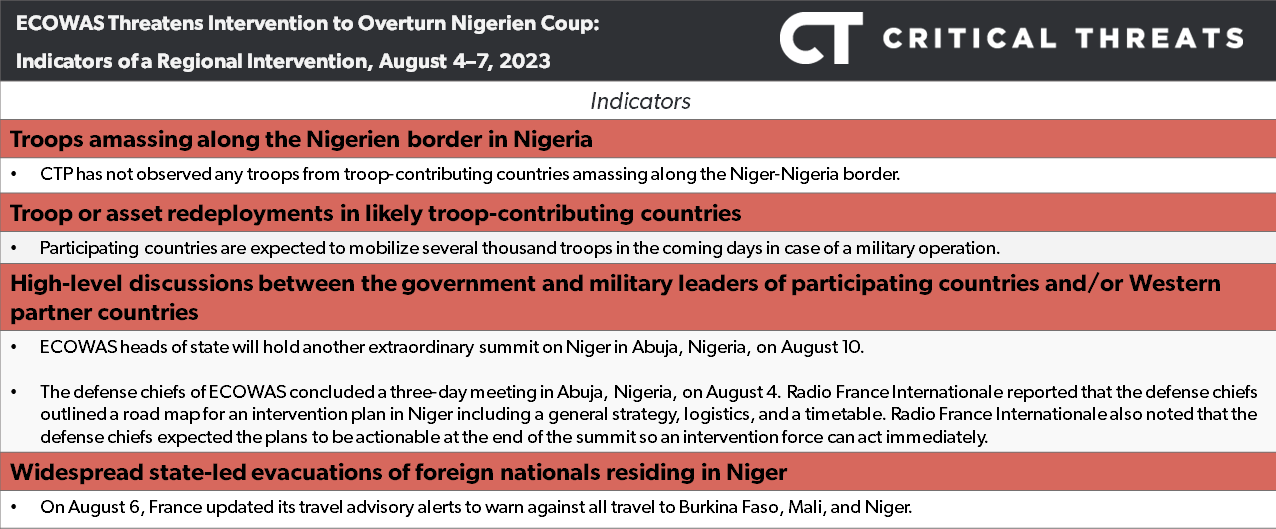
The Nigerien junta is unlikely to capitulate to international pressure to reverse its coup. The junta has doubled down on its coup by striking a deal with neighboring juntas to jointly defend against an ECOWAS intervention, arresting civilian officials, appointing military officers to lead government positions, and decreasing cooperation with Western partners.
The junta’s opposition to ceding authority back to civilians will result in its international isolation and force the junta to seek auxiliary forces. The EU and US have already cut military cooperation with Niger, and the deteriorating relationship between the West and the junta will make current French and US deployments in the country untenable. The Nigerien military would need to compensate for the loss of Western troops, supplies, and funding. The junta’s most likely options would be strengthening civilian militias, as Burkina Faso did, or hiring the Kremlin-funded Wagner Group, like Mali did. Supporting civilian militias or deploying the Wagner Group will almost certainly increase human rights abuses and exacerbate communal tensions, which Salafi-jihadi groups will use to expand.
An ECOWAS intervention into Niger could happen and would be a most-dangerous scenario. CTP is tracking the following indicators of a regional West African intervention into Niger:
An ECOWAS military intervention would create immediate opportunities for Salafi-jihadi groups to strengthen by significantly reducing counterterrorism pressure in West Africa as counterinsurgent forces prioritize each other over the insurgencies. An ECOWAS military intervention would likely worsen the security situation in Niger and the region in the long term, regardless of its outcome.
Niger and regional powers could also come to a compromise involving the release of President Bazoum and a road map to restoring civilian rule, although it is unlikely that a compromise deal would mitigate the fallout between Niger and its Western partners.
The Nigerien junta is unlikely to capitulate to international pressure to reverse its coup, which will result in its international isolation and could lead the junta to seek out the Wagner Group as a long-term replacement for Western support. The junta’s obstinacy may also prompt an Economic Community of West African States (ECOWAS) military intervention, which is a most-dangerous scenario that would likely create vacuums for Salafi-jihadi groups to fill and spread regional instability.
A successful coup in Niger would likely strengthen al Qaeda and the Islamic State by preoccupying Nigerien security forces and hindering international security cooperation as coups have elsewhere in the Sahel. A successful coup would almost certainly negatively impact Niger’s role as the last remaining Western partner in the tri-border area of Burkina Faso, Mali, and Niger and the largest recipient of US State Department military assistance in West Africa. Russia could also exploit an isolated junta government to evade Western sanctions.
The outcome of the attempted coup in Niger on July 26 is unclear. The Nigerien presidential guards besieged the presidential palace and surrounding ministries in Niamey on July 26, sealing President Mohamed Bazoum inside the palace and forcing negotiations. Jeune Afrique reported that President Bazoum had been considering sacking the presidential guards’ head in the days before the attempted coup.
Ghana. Al Qaeda’s regional associate may use abuses against Fulani refugees to begin conducting attacks in northern Ghana. The group has threatened to attack inside Ghana, has the capabilities to launch an attack should it choose to, and has repeatedly taken advantage of security force abuses and ethnic tensions to recruit and expand among marginalized Fulani communities in the Sahel. However, Burkinabe counterterrorism operations targeting Jama’at Nusrat al Islam wa al Muslimeen (JNIM) havens near the Ghanaian border may disincentivize JNIM from opening new attack zones in Ghana until at least after the pressure subsides.
Somalia. An al Shabaab blockade of a regional capital in southern Somalia will likely strengthen local support for an offensive against the group. While the Somali Federal Government (SFG) may attempt to break the blockade as a launching pad for a broader offensive against al Shabaab in southern Somalia, it likely does not have the capacity to sustain significant activity in the area in the coming months. This limited support will likely prevent the SFG from leveraging the increase in local discontent to counter al Shabaab.
Al Qaeda’s regional associate may use abuses against Fulani refugees to begin conducting attacks in northern Ghana. The UN said on July 13 that Ghana had illegally deported at least 250 Burkinabe refugees since July 11, which led to calls from the local media wing of al Qaeda’s regional associate to launch jihad against Ghana if the abuses continue. JNIM has not claimed an attack in northern Ghana, but it has the capabilities to launch an attack should it choose to and has repeatedly taken advantage of security force abuses and ethnic tensions to recruit and expand among marginalized Fulani communities in the Sahel. However, Burkinabe counterterrorism operations targeting JNIM havens near the Ghanaian border may disincentivize JNIM from opening new attack zones in Ghana until at least after the pressure subsides, as opening new attack zones in Ghana would invite pressure onto the group’s rear bases in Ghana that support the targeted havens in Burkina Faso.
The erosion of international counterterrorism pressure on Salafi-jihadi insurgents in Mali will likely enable al Qaeda’s regional associate to gradually rebuild transnational attack capabilities in its support zones to conduct external attacks. Al Qaeda–linked militants have historically carried out regional terror attacks and still aspire to build external attack capabilities targeting the West, despite prioritizing their locally focused insurgency in recent years. Jama’at Nusrat al Islam wa al Muslimeen (JNIM) would most likely target Western personnel in Africa or West African partners and could use West African human trafficking networks to target Europe, in the most dangerous scenario. JNIM’s expanding havens in the Sahel will increase the risk of external attacks even if JNIM leadership does not prioritize rebuilding transnational capabilities by giving internationally minded factions or individuals increased opportunities and resources to orchestrate such attacks.
The Wagner Group will continue operating in Africa following the group’s armed rebellion and is very unlikely to decrease its activity on the continent. Wagner’s continued presence in Africa is imperative to Russia’s foreign policy objectives on the continent, as it uses the group to gain access to natural resources that it uses to evade and mitigate Western sanctions and undermine Western influence on the continent. The group’s continued activity in Mali will almost certainly continue fueling the Sahel’s Salafi-jihadi insurgency.
The Wagner Group will continue operating in Africa following the group’s armed rebellion and is very unlikely to decrease its activity on the African continent. The Wagner Group launched an armed rebellion in Russia on June 23 aimed at forcing leadership changes in the Russian Ministry of Defense (MOD). The rebellion came to an end on June 24 after Wagner financier Yevgeny Prigozhin agreed to a deal on the fate of Wagner with Belarusian dictator Alexander Lukashenko.
Al Shabaab is increasing the rate and severity of its attacks in northeastern Kenya and against Ethiopian forces in Somalia, likely to boost recruitment and local support in Ethiopia, Kenya, and Somalia. Al Shabaab may also intend to undermine the ability of Ethiopia and Kenya to effectively participate in an offensive against the group in southern Somalia.
Al Shabaab is increasing the rate and severity of its attacks in northeastern Kenya and against Ethiopian forces in Somalia, likely to boost recruitment and local support in Ethiopia, Kenya, and Somalia. Al Shabaab may also intend to undermine the ability of Ethiopia and Kenya to effectively participate in an offensive against the group in southern Somalia.
Mali. The Malian junta requested the UN to end its peacekeeping mission in Mali, which is very likely to enable Salafi-jihadi groups to expand and pose greater domestic and transnational threats. The withdrawal of the UN mission will very likely end reconciliation efforts between the Malian government and non-jihadist former rebel groups with ties to al Qaeda–linked militants in Mali. The al Qaeda–linked group in Mali will very likely use these ties and the resulting security vacuum to assert itself as the primary power broker across northern Mali, which it can then leverage to carry out more-sophisticated attacks in central and southern Mali and spread its insurgency to neighboring states in West Africa. The UN withdrawal will also very likely embolden the regional IS affiliate to establish territorial control in northeastern Mali, increasing the group’s threat to US personnel and interests in West Africa.
Somalia. Clan-based disputes between regional and state governments are derailing Somali-led counterinsurgency offensives in central and southern Somalia. These disputes are not isolated, and clan infighting will undermine Somali security to a greater extent and present additional openings for al Shabaab to exploit as the Somali Federal Government (SFG) prepares to assume sole responsibility for Somali security by the end of 2024.
The Somali Federal Government (SFG) has to date failed to launch an offensive against al Shabaab in southern Somalia in 2023, which is likely enabling al Shabaab to increase the rate and severity of its attacks in Mogadishu. The group conducted its first suicide attack in Mogadishu in four months on June 9 and has increased car bomb attacks in Mogadishu since late May. The withdrawal of thousands of African Union soldiers by the end of June will likely create more security gaps for al Shabaab to exploit across the country in the coming months and will strain the Somali National Army’s (SNA) capacity as counterterrorism operations in central and southern Somalia remain stalled.
Burkina Faso. Burkinabe forces greatly increased their operations against al Qaeda–linked militants near Burkina Faso’s southern border in May, which has likely temporarily degraded the militants’ support zones in the area. The uptick in operations is in response to the growing presence of the al Qaeda–linked group in the area throughout 2023. The al Qaeda–linked militants will likely maintain their support zones in southeastern Burkina Faso and strengthen them as Burkinabe forces scale back counterterrorism pressure over time, using nearby havens along the borders with Benin, Ghana, and Togo.
Burkina Faso. Al Qaeda–linked militants increased the rate and lethality of their attacks in northwestern Burkina Faso in May 2023 to strengthen and expand their support zone along the border of central Mali and northwestern Burkina Faso. The al Qaeda–linked group is using these support zones in northwestern Burkina Faso to expand toward the Burkinabe capital. The group will also use these zones to expand south along the Burkina Faso–Mali border to threaten southern Mali and Burkina Faso’s second largest city and economic capital in southwestern Burkina Faso.
Somalia. Self-admitted poor troop performance likely enabled al Qaeda’s Somali affiliate al Shabaab to overrun a Ugandan African Union base in southern Somalia in late May. The Ugandan contingent’s intelligence gaps and lack of close air support likely also contributed to al Shabaab’s success. Al Shabaab also overran a Somali National Army (SNA) base in central Somalia in late May, underscoring the continued vulnerability of holding forces in recently liberated areas of Somalia.
Somalia. Somali-US drone strikes targeting al Shabaab leadership may temporarily weaken the group’s capabilities but will not disrupt al Shabaab’s regional threat. The al Shabaab network will continue organizing regional attacks from its havens in southern Somalia in the absence of effective Somali ground operations that degrade the group’s havens regardless of who is overseeing its activity. The lack of flood-prevention efforts in central Somalia despite international funds for such projects is a microcosm of how government mismanagement will continue to present al Shabaab opportunities to undo the few military setbacks it suffers.
Mali. Al Qaeda-affiliated militants have escalated its rate of attacks in western Mali since late 2022 to increase its revenue and support its campaign to degrade Malian lines of communication around the Malian capital. The militants may be trying to increase its ties with illicit networks in western Mali to strengthen its position in the area, which could create opportunities to spread its insurgency to neighboring countries in the future.
The recent increase in counterterrorism operations by regional forces in the Lake Chad Basin are unlikely to permanently weaken IS West Africa Province (ISWAP) because security forces cannot adequately sustain operations in the remote havens they are targeting. ISWAP is also fighting a rival Boko Haram faction, which will likely combine with the counterterrorism operations to temporarily weaken the group for several months. ISWAP will likely increase the rate and geographic scope of its attacks outside of northeastern Nigeria in response to the increased pressure. The resulting resource constraints and degraded support zones will likely proportionately degrade the regional IS support network in West Africa until ISWAP recovers.
Somalia. The Somali Federal Government (SFG) has improved security around Mogadishu since February. Al Shabaab has not conducted a mass casualty attack in the Somali capital since late February, after conducting three such attacks between November 2022 and February 2023. The SFG’s central Somalia offensive has likely degraded al Shabaab’s support zones and lines of communication north of Mogadishu that they previously used to support attacks in the city. The SFG has also deployed new Ugandan-trained soldiers in the capital that are degrading al Shabaab’s access to sensitive parts of Mogadishu. Al Shabaab is also likely giving priority to attacking Somali forces farther south to preempt the SFG’s planned offensive in southern Somalia, which is contributing to the decrease in attacks in the capital.
Sahel. The Islamic State affiliate in the Sahel is on course to eclipse its strength at its prior peak in 2020. The group has restrengthened across multiple fronts in the Burkina Faso, Mali, and Niger tri-border area since the French drawdown in northern Mali in 2022 and is a threat to US personnel and interests in West Africa. Al Qaeda–linked militants have also increased attacks targeting civilians farther south in the northern regions of Benin and Togo. The Beninese and Togolese governments have responded with increased security measures, which are necessary to degrade the Salafi-jihadi insurgents’ long-standing support zones in the area but risk exacerbating the grievances that drive local support for the insurgency.
The al Qaeda and Islamic State networks in Africa will likely seek to use the Sudan conflict to improve their position on the continent. Numerous inmates escaped from a prison in Khartoum city beginning on April 22 amid clashes between Sudan’s two warring factions. Al Qaeda and the Islamic State have previously used conflicts elsewhere in Africa to improve their position on the continent.
Sahel. Overstretched security forces cannot contain al Qaeda–linked and IS-affiliated militants across Mali. Al Qaeda–linked militants have very likely established new support zones in central Mali despite increased counterterrorism efforts. The group is likely using these havens to support attacks on security forces in central and southern Mali—including the region surrounding Mali’s capital. Security forces are also unlikely to disrupt IS-affiliated militants growing support zones in northeastern Mali as they give more priority to the challenges in more politically sensitive areas of central and southern Mali.
Somalia. Al Shabaab suicide vehicle-borne improvised explosive device (SVBIED) attacks are continuing to pose a significant long-term threat to Somali counterterrorism efforts in north-central Somalia. The SVBIED attacks are exacting unsustainable human costs on US-trained Somali special forces and will undermine crucial local support for the Somali government. Al Shabaab will continue to halt Somali forces and exact an unsustainable human cost, barring improved Somali tactics or a second front that diminishes al Shabaab’s ability to concentrate its resources.
Islamic State militants in the Sahel are strengthening their control over northeastern Mali. IS expansion in this area threatens US interests and personnel in neighboring Niger. IS core is likely using its global network to help its local affiliate appeal to civilians and set conditions to consolidate territorial control in northeastern Mali. Al Qaeda’s local affiliate, the Malian army, and Wagner Group are unlikely to undo IS’s gains in this area. The attempted coup in Sudan is also creating opportunities for the global Islamic State and al Qaeda networks to strengthen their influence in the region—and attack US personnel, in a worst-case scenario.
The Somali Federal Government’s (SFG) inability to escalate multiple fronts against al Shabaab could allow the group to repel renewed Somali offensive operations in central Somalia. Insufficient local support and the absence of expected regional troops are preventing or delaying the SFG from expanding additional fronts in central and southern Somalia, which will allow al Shabaab to concentrate its resources on the active Somali forces more effectively. Outreach to clans in central Somalia or the arrival of Kenyan or Djiboutian troops in Somalia could enable the SFG to increase operations on another front.
Burkina Faso. The Burkinabe junta has significantly increased drone strikes targeting al Qaeda and Islamic State–affiliated militants since late March 2023 to compensate for manpower capacity limitations and boost its popular support. The drone strikes may temporarily degrade the insurgents’ support zones and their ability to organize large-scale attacks on Burkinabe forces. However, both groups will likely adapt to continue attacks, and the junta’s use of drone strikes will not address the inherent manpower shortage that constrains Burkina Faso’s counterinsurgency operations.
Mali. Al Qaeda–linked militants have continued attacking Malian security forces in the region surrounding Mali’s capital since it launched an offensive in the area in January 2023. The campaign demonstrates the militants’ ability to sustain attacks in southern Mali and increases the likelihood that they have established support zones near the Malian capital. The group likely seeks to primarily discredit and undermine the junta’s legitimacy with this campaign and will likely focus on military targets over civilian targets to achieve this goal.
Somalia. Al Qaeda’s Somali affiliate al Shabaab has retained its vehicle-borne improvised explosive device (VBIED) capabilities in central Somalia, which could help it overturn recent counterterrorism gains. The group will likely continue manufacturing VBIEDs because Somali counterterrorism forces cannot adequately disrupt its supply chains and likely lack the capacity to degrade its havens in the area as the government gives more priority to opening a second front in southern Somalia. Al Shabaab will likely use VBIEDs to target and overrun vulnerable holding forces. Meanwhile, seasonal flooding in Somalia could affect the timeline and scope of the next phase of the Somali Federal Government’s (SFG) offensive in southern Somalia.
Mali. An al Qaeda–linked shadow governor in northern Mali indirectly threatened to attack the US, UK, and EU countries, underscoring the transnational Salafi-jihadi threat emanating from the Sahel. CTP continues to assess that the al Qaeda–linked group in the Sahel is unlikely to pursue transnational attack targets in the West in the near future, although there are signs and past patterns that indicate this could change. The group’s growing freedom in northern Mali increases its ability to host and support transnational attack cells, should it choose to pursue such aims.
The Islamic State has used its global network to rapidly grow its affiliate based in the Democratic Republic of the Congo (DRC). The group’s growth demonstrates the danger the IS global network poses by enabling terror groups across Africa, and its regional aims threaten nearby US counterterrorism partners, which could jeopardize counterterrorism missions elsewhere in Africa. Diverging interests between regional security forces likely will prevent Congolese and Ugandan forces from containing or defeating the group. The shortcomings of regional and US efforts to degrade the group and the global IS network increase the likelihood this group will continue to strengthen its threat to US and African interests in central and southern Africa.
Ongoing infighting between al Qaeda and Islamic State–affiliated militants in the Burkina Faso, Mali, and Niger tri-border area that has surged since the French withdrawal from Mali in 2022 will likely increase local support for both groups. Ethnic tensions have played into the clashes and worsened human rights abuses against civilians, forcing locals to support a side for protection. The al Qaeda–linked faction will likely remain the dominant group in the region but be unable to eliminate the Islamic State militants. The resulting stalemate will likely become a self-feeding conflict that will strengthen both sides in the coming months and years.
The Somali Federal Government (SFG) will begin a major offensive targeting al Shabaab–controlled areas of southern Somalia in the coming months. The SFG will likely be able to contest significant portions of southern Somalia’s Lower Jubba region during the offensive because it has competent and well-equipped clearing forces. It is highly unlikely that the SFG will penetrate the al Shabaab heartland in the neighboring Middle Jubba region, because of strong al Shabaab resistance. However, the offensive could still weaken al Shabaab and set conditions for future offensives by targeting al Shabaab logistical nodes in Lower Jubba. The SFG will likely struggle to hold newly contested areas in the long term because of a lack of adequate holding forces.
Jama’at Nusrat al Islam wa al Muslimeen (JNIM) is likely consolidating control over rural areas of southeastern Burkina Faso. The group is likely using these expanded havens to increase activity in neighboring regions of Burkina Faso and the littoral states. A Burkinese overemphasis on military solutions without successfully addressing underlying social issues risks backfiring, inflaming local tensions that feed JNIM recruitment in the area.
Somalia. Several large-scale al Shabaab attacks on military bases across Somalia highlight that Somali counterterrorism efforts have not weakened the group’s attack capabilities. Meanwhile, al Shabaab is also well positioned to take advantage of a festering clan-based conflict in northern Somalia’s disputed regions. A prolonged battle would reduce counterterrorism pressure on al Shabaab and Islamic State havens in northern Somalia.
Mali. The Malian junta appointed several pro-Russian figures to high-ranking military positions, indicating growing Russian influence over the Malian government. The junta could be planning to leverage Russian assistance in a northern Mali offensive in a highly unlikely but dangerous scenario. Any such offensive would likely increase links between militia groups and al Qaeda’s Sahelian branch without having long-term success.
Somalia. A decrease in al Shabaab bombings in central Somalia likely indicates a lull rather than the end of the group’s counteroffensive against the Somali government. Somali forces initiated an offensive to recapture al Shabaab–controlled areas in central Somalia’s Galgudud and Hirshabelle regions in January 2023. Al Shabaab surged explosive attacks in January and early February 2023 in response. The group tends to launch explosive attacks in clusters, so the current decline in attacks may indicate preparations for a larger counterattack.
Mali. Al Qaeda’s Sahel branch is taking advantage of the lack of counterterrorism pressure and state presence in northern Mali to position itself as the primary power broker in the area, including striking agreements with local groups that previously collaborated with French counterterrorism forces. Militants are simultaneously pressuring Mali’s junta with increased attacks in southern Mali. Meanwhile, Mali’s relationships with its foreign partners continue to deteriorate. The junta’s pressure on the United Nations mission in Mali will likely push major contingents to withdraw in the near term, worsening the security vacuum that Salafi-jihadi militants will fill in the country’s north.
The Islamic State is leveraging networks across multiple continents to sustain both new and established affiliates. A US military raid in northern Somalia killed a key ISIS facilitator in northern Somalia. This facilitator oversaw a sprawling financial and logistical support network from Somalia that coordinated trainers and funding to Islamic State affiliates in Afghanistan, the Democratic Republic of the Congo, and Mozambique. His death may temporarily disrupt these activities.
Somalia. Al Shabaab continued a wave of suicide attacks against Somali forces, including its first major tactical victory in central Somalia, where it overran a base used by US-trained special forces. These attacks are retaliation against a months-long Somali Federal Government (SFG)–led effort to oust al Shabaab from its positions in central Somalia. The SFG may open a second front against al Shabaab in southern Somalia, but this effort faces more hurdles than the central Somalia campaign.
Sahel. Malign actors are exploiting security vacuums left by the French withdrawal from Mali and Burkina Faso. Al Qaeda–affiliated Jama’a Nusrat al Islam wa al Muslimeen (JNIM) has emerged as the only viable security partner for Tuareg communities facing Islamic State violence in northeastern Mali. This situation forces communities to partner with JNIM in self-defense, solidifying the groups’ influence across northeastern Mali. JNIM is also active in Burkina Faso, where the country’s military leaders recently ended a military deal with France and are seeking partnership with the Russian Wagner Group. Wagner’s presence will increase violence against Burkinabe civilians, to the benefit of Salafi-jihadi groups—as it has in Mali since Wagner arrived in 2021.
Somalia. Anti–al Shabaab forces notched a significant victory in an ongoing offensive in central Somalia by capturing two logistical and financial hubs from al Shabaab. Al Shabaab has stepped up suicide attacks in response to the offensive, but its loss of these locations may harm its ability to sustain a counterattack over time. Al Shabaab’s withdrawal from the captured towns likely indicates that it withdrew in preparation for a future counterattack, though there are also limited indicators that the group is losing bandwidth and morale.
Mali. Al Qaeda’s Sahel branch increased attacks near the Malian capital in a likely effort to undermine the legitimacy of the Malian junta, which has promised to increase security in the country. The uptick in attacks indicates that Salafi-jihadi militants likely have access to enduring havens in southwestern Mali, signaling a shift in the militants’ ability to threaten Mali’s government and largest city.
Al Shabaab, al Qaeda’s affiliate in Somalia, is attempting to push back an effort by Somali government and local forces to oust the group from positions in central Somalia. Somali forces, with US support, have removed al Shabaab from several strongholds in central and south-central Somalia. Al Shabaab is retaliating with attacks intended to pin Somali forces in their positions and intimidate local militias. The group is likely not pursuing negotiations with the Somali government, despite media reports of talks.
Al Qaeda’s Sahel branch, Jama’at Nusrat al Islam wa al Muslimeen (JNIM), is filling the security vacuum in northern Mali following the French withdrawal in 2022. JNIM is establishing itself as the primary partner and power broker for former rebel groups and communities in the north, an area where the Malian government has historically lacked presence. These communities face rising violence from both the Islamic State and the Russian Wagner Group, which partners with the Malian government. This trend will likely lead to JNIM establishing de facto control over northern Mali, a takeover that will feed long-term instability in Mali and its neighbors and increase the resources and opportunities available to al Qaeda in Africa.
The Kremlin-linked Wagner Group will likely deploy to Burkina Faso in the coming months. Military juntas in Burkina Faso and neighboring Mali have sought to partner with Wagner to protect their regimes and mitigate the departure of Western counterterrorism forces. The Kremlin uses its partnerships with African countries to evade sanctions and advance strategic objectives such as countering Western influence and reestablishing Russia as a global power. Wagner’s priority is plunder, and it will likely stoke rather than suppress terror threats by increasing violence against vulnerable populations, thereby driving support to al Qaeda and Islamic State militants.
The Islamic State’s West Africa Province (ISWAP) likely attempted to assassinate the Nigerian president. The group claimed responsibility for a December 29 vehicle-borne improvised explosive device (VBIED) in central Nigeria. This attack marks ISWAP’s first documented attempt to assassinate Nigeria’s head of state and its first VBIED detonation outside of northeastern Nigeria. These inflections continue an expansion of ISWAP activity in central Nigeria, including its first attacks in the Federal Capital Territory in 2022. ISWAP poses a growing threat to central Nigeria and the country’s capital, Abuja, and will likely continue to escalate operations in early 2023—which could include pursuing international targets in Abuja and attempting to destabilize the country as the February 2023 general elections approach.
Burkina Faso’s latest coup on September 30 indicates that the governance and security crisis in West Africa’s Sahel region continues to deepen. Salafi-jihadi groups linked to al Qaeda and the Islamic State have exploited cyclical violence and anti-government grievances to root themselves in local communities and steadily expand in the Sahel over the past decade. The fallout from the Burkina Faso coup, like the 2020 and 2021 coups in Mali, will likely further reduce counterterrorism pressure and worsen the conditions that lead to Salafi-jihadi expansion.
Local tribes in central Somalia are increasingly mobilizing against al Shabaab. Several Hawiye subclans in central and south-central Somalia have mobilized local militias to fight al Shabaab after militants ambushed a humanitarian aid convoy on September 2. The Somali government may also attempt to reconcile with the Sufi militia Ahlu Sunna wa al Jama’a (ASWJ) to bring the group into the counter–al Shabaab fight. Al Shabaab will likely accept losses in central Somalia in the short term. Defeating al Shabaab in central Somalia in the long term will depend on local and federal Somali authorities’ ability to deliver tangible and sustained improvements in governance and security.
Al Shabaab conducted its longest-ever siege on a hotel in Somalia’s capital on August 19, marking a stepped-up effort to destabilize the country’s new administration and derail support for its counterterrorism agenda. This attack may have also aimed to disrupt Somali leaders’ responses to al Shabaab’s ongoing campaign along the Ethiopian border. The August 19 attack highlights the Somali government’s challenge in balancing its campaign against al Shabaab in central Somalia with the group’s attack capability in politically sensitive and strategically valuable areas of southern Somalia.
Al Shabaab conducted a multiday campaign inside Ethiopia for the first time. The cross-border offensive demonstrates al Shabaab’s strength inside Somalia and underscores its regional ambitions. Ethiopian security forces will likely contain the al Shabaab threat to Ethiopia in the near term, but domestic conditions in Ethiopia and Somalia may allow the group to wage a sustained cross-border insurgency over time.
The Islamic State’s West Africa Province (ISWA) freed dozens of Salafi-jihadi militants in an attack on a prison in Nigeria’s capital region on July 5. This incident is ISWA’s first claimed attack in the capital region and its most sophisticated attack outside of northeastern Nigeria. It likely required cooperation with other armed factions. The prison break indicates that the Salafi-jihadi threat is growing outside of northeastern Nigeria—jihadists’ main area of operations in recent years—and that Nigeria’s multifaceted security crisis is allowing Salafi-jihadi groups to expand.
Salafi-jihadi groups are beginning to intensify attacks in the northern border regions of several Gulf of Guinea states. These attacks may indicate that al Qaeda–linked militants intend to extend their territorial insurgency to these countries, continuing a multiyear southward expansion in West Africa.
The Malian Army launched a campaign of collective punishment in a bid to reimpose state control in central Mali. This approach, which Wagner Group is enabling, will strengthen al Qaeda’s Mali branch by forcing vulnerable civilian populations to rely on Salafi-jihadi militants for self-defense. Militants may conduct terror attacks in urban areas in retaliation for the central Mali campaign. This campaign also risks inflaming inter-ethnic conflict in central Mali that would inflict widespread harm on civilians.
The cease-fire agreement between the Ethiopian government and rebel forces in Tigray indicates that the Ethiopian government faces an even more pressing threat elsewhere. A multilayered conflict in Oromia—which surrounds the capital and is the country’s largest and most populous regional state—is worsening Ethiopia’s humanitarian crisis and may lead to its fragmentation or a change in national leadership.
French forces are accelerating their withdrawal from Mali following a breakdown in French-Malian relations. The withdrawal will remove necessary support to other local, regional, and international forces in Mali, leading to a drastic reduction in pressure on Salafi-jihadi groups in the Sahel. These groups, particularly al Qaeda’s Sahel branch, will capitalize on this opportunity to establish a secure haven in northern Mali.
The ongoing political crisis in Somalia will likely strengthen al Shabaab, an al Qaeda affiliate that is actively plotting transnational terror attacks. Al Shabaab surged suicide attacks in Somalia’s capital, Mogadishu, in January to further destabilize the Somali Federal Government (SFG) during a heated election period. The group will likely continue bursts of bombings in a bid to increase animosity between rival political factions and incentivize fighting among Somalia’s fragmented security forces. The most likely scenario will allow al Shabaab to expand its havens outside of Mogadishu during the political crisis. The worst-case scenario will lead to fighting for control of Mogadishu and could cause the disintegration of Somalia’s government.
The Wagner Group, a Russian private military company, has deployed to Mali. Wagner’s activities will likely worsen popular grievances and accelerate the deterioration of counterterrorism pressure in Mali, allowing Salafi-jihadi groups to strengthen.
Western policymakers neglect the Salafi-jihadi threat in Africa because of “political burnout, competing priorities, and policy hurdles,” argues AEI Research Fellow and CTP Research Manager Emily Estelle. She writes that the growth of Salafi-jihadi insurgencies undermines other policy goals, including public health and economic growth—in part because of the ballooning economic damage from terrorism in Africa. African Salafi-jihadi groups also pose a growing external attack threat as they develop local capabilities that can be repurposed transnationally.
CTP and the US Military Academy at West Point’s Combating Terrorism Center (CTC) hosted a debate series on the Islamic State and al Qaeda in Africa. The first debate examined the importance of African extremist groups’ affiliation with the Islamic State. The second debate focused on the external threat posed by Africa Salafi-jihadi groups. The third debate, hosted by AEI’s Katherine Zimmerman, examined the evolution of the global terrorist threat and the lessons learned from the past 20 years of counterterrorism efforts.
CTP provided leading analysis of the Islamic State’s new foothold in southern Africa. Estelle analyzes the rise of the Islamic State in Mozambique in Foreign Policy and an AEI-CTP report with Jessica Trisko Darden, published shortly before the militants’ surge grabbed international headlines. Estelle and Trisko Darden argue that the Mozambique insurgency “promises to spread into neighboring countries and deliver an enduring haven to extremist militants with regional and global ambitions while exacting a steep humanitarian toll.” They present several recommendations for defeating the insurgency and resolving underlying grievances.
{{currentView.title}}
{{nextView.title}}
About The Author


More Stories
From Curiosity to Confidence: CodificaKids Builds Digital Trust in Rural Brazil
Community Snapshot—August
Empowering Parents in Rwanda Through Digital Literacy Training