
https://arab.news/n3pa4
MIAMI: World leaders in business and finance are meeting in Miami this week to discuss potential solutions to the planet’s ongoing conflicts and climate change, as well as artificial intelligence.
The second edition of the Future Investment Initiative Priority Summit to be hosted in the city kicks off on Feb. 22, featuring a comprehensive agenda centered around the theme: “On the edge of a new frontier.”
According to FII, the summit offers an interactive program designed to showcase disruptive technology, connect ideas to investments, help changemakers align, and accelerate innovation for the betterment of business and society.
Running for two days at the Faena Forum, Miami Beach, FII Priority Miami 2024 will provide a platform for more than 800 global business and finance leaders, made up of CEOs, investors, academics, scientists, cultural icons, policymakers, entrepreneurs, media professionals, and members of the FII Institute.
This year’s program will explore how disruptive technologies and innovation can address humanity’s fundamental priorities and challenges.
“The world feels like an increasingly troubled place, with violent conflicts, cost of living crises, climate change, AI uncertainties, pandemic threats and other big problems,” Richard Attias, the CEO of the FII Institute, told Arab News.
“And so, it has never been more important to convene leaders from investment, business and government to address the root causes and come up with practical answers. The call for leadership and unity has never echoed more urgently.”
The organizers of FII Priority say the world stands at a crossroads where the interplay between investment, economic growth, and rapidly emerging technologies can either unlock extraordinary benefits or pose an ominous threat to humanity’s collective future.
The accelerating pace of technological advancements, from AI to biotechnology, holds immense promise in addressing global challenges, improving quality of life, and propelling economic growth to new heights.
However, experts are concerned that the unchecked pursuit of these innovations, devoid of ethical considerations and thoughtful governance, has the potential to lead societies down a perilous path.
The summit is committed to fostering positive change through effective solutions across various domains, including global connectivity, mining, AI, health-tech, sports, circular economy, food, economies of the future, art, culture, and other key areas.
Over the course of 36 sessions featuring some 85 speakers, attendees will explore how the latest breakthroughs in AI, robotics, healthcare, finance, and sustainability can be seamlessly incorporated into the international community’s response to collective challenges.
Topics the event will cover include how innovators can act to resolve citizen concerns at a global level, the role of vibrant cities — such as Miami — in bridging economic opportunities and promoting market growth, in addition to AI safety and regulation, human-centered macro-finance, supply chains, and climate solutions.
The three-part “AI Town Hall” discussion will bring together industry experts and thought leaders to delve into the multifaceted landscape of AI.
Speakers will engage in conversations on the efficient scaling of AI businesses, the substantial investment opportunities presented by AI, and establishing alignment among all sectors in AI governance issues, spanning ethics, data, and intellectual property rights.
The intersection of macroeconomic challenges and geopolitical tensions poses a threat to global prosperity and security. The FII Institute, which scrutinizes global citizen priorities, engaging leaders in finance, policymaking, business, and governance, will integrate its insights into the relevant strategic decisions.
This is considered an especially hot topic, as this year sees national elections involving nearly half the world’s population, making citizens’ attitudes an important consideration.
Building on conversations that took place in Hong Kong and Riyadh, the sessions will also discuss workable environmental, social and governance solutions in the Global South with the support of developed markets, driving global alignment on AI regulation and investment for more equitable access to education and healthcare.
The FII Miami Summit will feature a traditional one-hour “board of changemakers” session with leading financiers discussing the global macroeconomic picture. Speakers include Stephen Schwarzman of Blackstone, Jenny Johnson of Franklin Templeton, and Mary Callahan Erdoes of JP Morgan to name but a few.
Other distinguished speakers exploring global economic trends, financial markets, and policy dynamics include Yasir Al-Rumayyan, the governor of the Saudi Public Investment Fund and the chairman of FII Institute; Princess Reema bint Bandar Al-Saud, Saudi Arabia’s ambassador to the US; and Khalid A. Al-Falih, the Saudi minister of investment.
Moreover, the summit will explore the transformative power of sports, as new global sporting partnerships aim to leverage US sporting expertise and traditions to benefit societies where sports have not been a priority in the past.
“The FII Miami Summit is a call for action and for investing in humanity before opportunities slip away,” Attias said. “The clock is ticking, and there is no time like the present to make a difference.”
Last year’s FII Priority Summit in Miami built on the dialogue started after the results of a worldwide survey titled the “PRIORITY Report.”
In October 2023, Saudi Arabia hosted the seventh FII Summit in Riyadh, drawing more than 5,000 delegates. The summit showcased perspectives from an illustrious lineup of 500 speakers, delving into pivotal sectors aligned with the overarching theme, “The New Compass.”
It was during this summit that the findings of a global poll, titled “FII Priority Compass,” sampling 50,000 people from 23 countries, highlighted increasing discontent across a range of issues.
Commissioned by the FII Institute, in partnership with Accenture, the survey identified predominant issues of concern to citizens across the world. The data plays a role in shaping year-round discussions, policy advisory, and investment decisions at the FII Institute.
The annual research exercise, which polls individuals from a range of ages, backgrounds and countries, informs policy development and provides data for leaders, CEOs, policymakers, and organizations to identify with accuracy the sentiments of 60 percent of the world’s population.
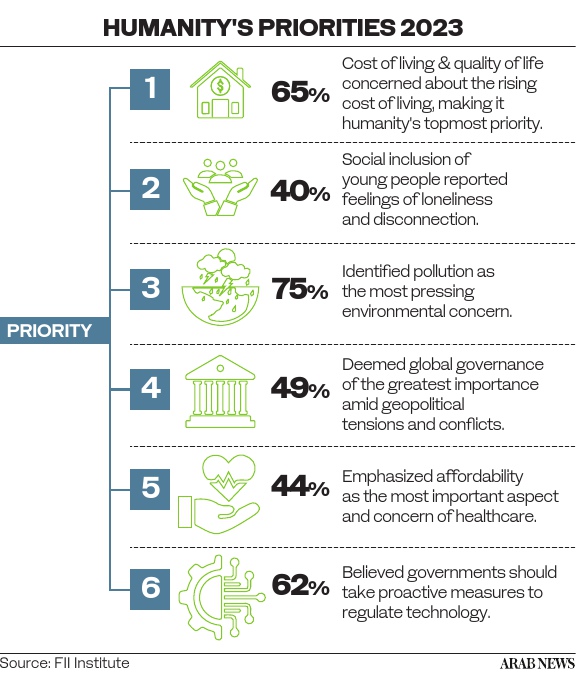
The October 2023 report found a 20 percent drop in people’s satisfaction with their personal lives compared to 2022. It found that 65 percent are distressed about the cost of living and quality of life.
It also discovered that 38 percent view social disconnection and lack of inclusion as a priority concern, that pollution is a concern for 75 percent, and that 44 percent globally are concerned about how to afford healthcare.
While 72 percent of those surveyed recognize that technology has democratized access to information, 47 percent of Africans worry about misleading information.
The findings of this survey will no doubt guide the discussions and policy solutions explored this week in Miami.
RIYADH: The UAE and Kenya have concluded negotiations on a trade deal that will boost investment flows in logistics, healthcare, and travel and tourism between the two countries.
The Comprehensive Economic Partnership Agreement will enhance market access for businesses on both sides, according to a press release.
Investments in the infrastructure and ICT sectors are also set to benefit, and the deal will also see a platform for small and medium enterprise cooperation and expansion on both sides.
Kenya’s economy experienced real annual GDP growth of 5 percent in 2023, up from 4.8 percent in the previous 12 months.
Its services sector, which accounts for 53.6 percent of Kenya’s economy, and agriculture sector, comprising around a quarter of national GDP, offer vast potential for UAE businesses looking to expand into the region, the release added.
The UAE’s Minister of Foreign Trade Thani bin Ahmed Al-Zeyoudi described the new agreement as marking a “significant milestone” in the country’s trade deal program.
He added: “It is a testament to our commitment to strengthening economic ties with the African continent and to creating new opportunities for businesses and investors in both of our countries.
“The UAE-Kenya CEPA will not only boost trade and investment, but also foster innovation and sustainable growth in key sectors such as agriculture, technology and tourism.
“We look forward to deepening our relationship with Kenya and to further expanding our presence in Africa as a trusted partner and investor.”
Kenya’s Cabinet Secretary for Investments, Trade and Industry Rebecca Miano said the agreement was testament to her government’s drive to use international commerce as “a key lever of economic growth and transformation.”
She added: “The Comprehensive Economic Partnership Agreement with the United Arab Emirates will play a key role in these efforts, enabling our exports to reach important markets in Asia and the Middle East, and also in stimulating the investment inflows that will further develop our national capabilities. We look forward to its implementation and the mutual benefits it will deliver.”
In 2023, the UAE’s non-oil trade in goods reached an all-time high of $710 billion, a 12.6 percent increase on 2022 – and 34.7 percent more than 2021.
The UAE has already concluded 10 CEPAs, including with India, Israel, and Indonesia, as well as Türkiye, Georgia, and South Korea.
SINGAPORE: Oil prices fell on Friday after a US Federal Reserve official said interest rate cuts should be delayed at least two more months, but indications of healthy demand and concerns over supplies could boost prices in the coming days, according to Reuters.
Brent crude futures were down 38 cents, or 0.5 percent, at $83.29 a barrel at 8:24 a.m. Saudi time, while US West Texas Intermediate crude futures were 40 cents, or 0.5 percent, lower at $78.21.
US Fed policymakers should delay interest rate cuts by at least another couple of months to see if a recent uptick in inflation signals stalling progress toward price stability or is just a bump in the road, Fed Gov. Christopher Waller said on Thursday.
Higher interest rates for longer slow economic growth, which could curb oil demand in the world’s largest oil consumer. But some analysts say demand has remained largely healthy, including in the US.
Analysts at ANZ research said US crude oil inventories rose at a less-than-expected rate last week, while run rates at refineries ended a streak of declines and may increase in coming weeks.
JPMorgan’s high frequency demand indicators are showing oil demand rising 1.7 million barrels per day month-over-month through Feb. 21, its analysts said in a note on Friday.
“This compares to 1.6 mbd increase observed during the prior week, likely benefitting from increased travel demand in China and Europe,” the analysts said.
Oil benchmarks pared some of their Thursday gains after Waller’s comments.
The US central bank has held its policy rate steady in the 5.25 percent-5.5 percent range since last July, and minutes of its policy meeting last month show most central bankers were worried about moving too quickly to ease policy.
Waller also pushed back on the idea that the Fed risks sending the economy into recession if it waits too long to cut rates, saying the Fed can afford to “wait a little longer.”
Oil futures had settled higher on Thursday as hostilities continued in the Red Sea, with Houthis stepping up attacks near Yemen to show support for Palestinians in the Gaza war.
Israel Prime Minister Benjamin Netanyahu’s war cabinet has approved sending negotiators to truce talks taking place in Paris on Friday as pressure mounts in the Middle East, according to a source briefed on the matter and Israeli media.
MIAMI: Artificial intelligence has the potential to bridge North-South divides, Accenture’s CEO told the Future Investment Initiative Priority summit in Miami on Thursday.
Julie Sweet explored the far-reaching impact of AI on addressing global challenges in a panel discussion titled “FII Priority Compass: What matters most to citizens?”
She said: “The question is how much AI can actually help the Global South and the countries that need help through precision farming, through telemedicine and better healthcare.”
Highlighting Saudi Arabia’s proactive stance in leveraging AI for societal advancement, Sweet stressed the importance of global collaboration in harnessing AI’s potential to tackle complex issues.
“One of the things that’s been great to see is Saudi Arabia taking the lead in many places to think through how can AI help and how can they be a leader.
“So I think it’s really important to always stay focused on what are the opportunities with AI to solve the world’s problems.”
However, Sweet acknowledged that the definitive solution to utilizing AI to close existing divides is not currently available.
Highlighting the vital efforts of organizations such as the UN, she emphasized the urgency of understanding how technology can be harnessed to avoid widening disparities.
Since the increased accessibility of AI in the public market and its “democratization,” experts have emphasized the need to regulate the technology.
“Regulation needs to be the outcome of a very strong public-private partnership, because most governments in the world don’t have the access or the talent inside to know it,” Sweet said, adding that there have been a few successful examples of governments balancing innovation and safety.
“That’s one of the most important things that governments need to do, particularly because the technology is changing rapidly. And I think the good news is that everyone has agreed that some regulation is needed.”
Regarding AI-related risks in the upcoming US election, Sweet cautioned against relying solely on government regulation. Instead, she advocated for increased collaboration among private entities.
“That’s as important as government regulation,” she said. “It’s responsible companies coming together in an agile fashion to solve the risks.”
Addressing concerns about job displacement due to AI, Sweet said while her role as a lawyer would persist, the nature of the job would evolve. She emphasized the need to reskill workforces and prepare the new generation to use AI.
Sweet highlighted Accenture’s annual investment of $1.1 billion in staff training, and stressed the importance of adapting school curricula to future-proof the younger generation through enhanced communication skills and basic technology education.
“All of us will have to continue to adapt and learn … because our skills have to constantly be improved and there’s so much change,” she concluded.
SAO PAULO: The Brazilian livestock sector is now authorized to export live cattle for slaughter and fattening to Oman.
The announcement was made after a meeting between Roberto Perosa, Brazil’s secretary for trade and international relations, and Ahmed Nasir Al-Bakri, undersecretary at Oman’s Agriculture Ministry. There were other members of the Omani government at the meeting.
“This new market adds to the other 14 opened this year, totaling 93 since the beginning of last year, during President Lula’s third term,” Perosa said.
“At the request of (Agriculture) Minister Carlos Favaro, we continue our mission in the Middle East, visiting countries aiming to expand Brazilian agricultural trade, opening new markets, obtaining approvals for plants through the pre-listing system (eliminating the need for local audits), and negotiating the import of nitrogen fertilizers.”
The Brazilian delegation visiting Oman also includes Julio Ramos, deputy secretary for trade and international relations, and Marcel Moreira, director of trade promotion and investments.
These new markets are the result of joint work by Brazil’s ministries of agriculture and livestock, and foreign affairs.
Representatives of both countries’ agriculture ministries emphasized their interest in expanding governmental cooperation and commercial partnerships.
They identified synergies between Oman’s Vision 2040 plan, which includes food security, and the Brazilian program to convert degraded pastures into agricultural areas.
They also discussed the possibility of partnerships in areas such as fertilizers, sugar, grains for animal feed, live animals, chicken meat and fish.
The Brazilian delegation also met with Ibtisam Ahmed Said Al-Farooji, undersecretary for investment promotion at Oman’s Ministry of Commerce, Industry and Investment.
She presented an Omani program that aims to increase investments in her country and abroad, focusing on food security and Oman’s interest in becoming a hub for the Gulf region.
Al-Farooji also underlined Oman’s neutrality and stability, adding that Brazil could be a great partner.
During the meeting, Perosa emphasized the good relations and complementarity between the two countries, saying Brazil could contribute even more to Oman’s food security and encourage Brazilian companies to process their products in Oman, as is the case with chicken and beef.
He added that the program to convert degraded pastures into agricultural areas represents a great opportunity to strengthen this partnership, including the possibility of acquiring nitrogen fertilizers from Oman.
The Omani side welcomed the idea and said that along with the Oman Investment Authority and Nitaj, the government arm for promoting food security, it will help build the partnership strategy between the two countries.
LONDON: It is important that investors understand the long-term structural changes to the Saudi economy that are taking place and the opportunities they offer, the head of the National Development Division at the Saudi Public Investment Fund said on Thursday.
Speaking at the Future Investment Initiative Priority forum in Miami, Jerry Todd said the three pillars of this transformation are industrialization of the economy, the development and expansion of service sectors, and the building-up of green energy capacity.
“Vision 2030 is the blueprint for this economic transformation, and it is a national project but it requires global resources, global talent, capital and operating capacity,” he said. “The attraction of those into the Kingdom is embedded into that blueprint.
“The question of what happens next is really a function of whether people in this room, and people in rooms like this, are learning more and trying to understand what’s happening (in the Kingdom). Personally, I’m optimistic, I think there’s a growing awareness of the opportunities being created.
“(Another thing that is changing) is the ability of the domestic economy to absorb longer-term investment, in large part through the industry-building that’s happening as part of Vision 2030. It’s creating chances for people to come in and capture asset-level opportunities.”
Former US Treasury Secretary Steven Mnuchin echoed that sentiment and said there are a lot of opportunities for investment in the wider Middle East region in relation to clean energy and energy transformation.
He warned, however, that if the region is to remain an attractive investment hub, the threat Iran poses to regional stability and security must be addressed, primarily through tougher and more rigidly enforced sanctions on the regime in Tehran.
About The Author


More Stories
Why Internet Infrastructure Decisions Rarely Stay Localized
A Safer Internet Starts with Taking Action: Introducing the Online Trust and Safety Hub
Introducing a New Chapter for the Internet Society Fellowship Program