
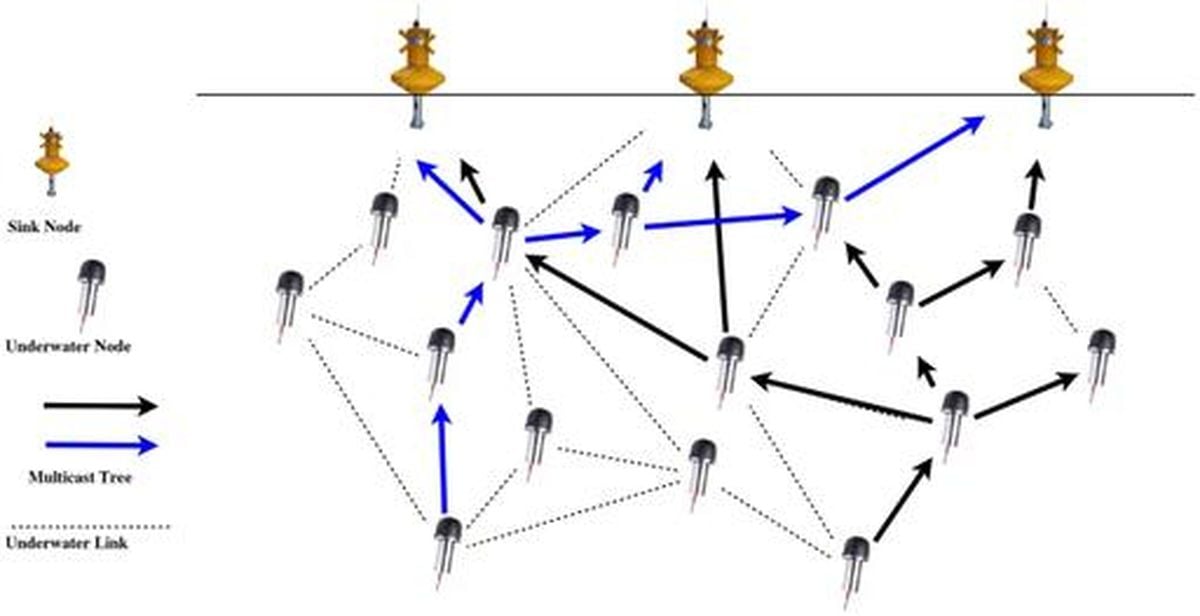
The advent of Underwater Internet of Things (IoUT) networks marks a groundbreaking shift in how we explore and monitor the vast, often mysterious environments beneath our oceans and seas. These technologies, leveraging the capabilities of the broader Internet of Things (IoT), promise significant advances for applications ranging from environmental monitoring to resource exploration and disaster prediction. Despite their potential, IoUT networks grapple with unique challenges, including dynamic underwater conditions, high propagation delays, and unreliable communication channels.
To tackle these challenges, researchers have developed innovative solutions. A recent study published on March 18, 2025, by R. Mohammadi and colleagues proposes the integration of Software-Defined Networking (SDN) with Fog Computing to bolster the reliability of underwater communications. This novel approach utilizes Integer Linear Programming (ILP) models to optimize multicast routing operations between underwater nodes and surface-level nodes.
Underwater environments are inherently varied and unpredictable, influenced by factors such as water currents, salinity, and temperature fluctuations. These variables complicate the communication efforts of IoUT networks, which are already hindered by low bandwidth and high bit error rates. Communication paths often suffer delays, as sound travels at approximately 1500 meters per second underwater. To alleviate these issues, the research team has developed a multicast routing tree aimed at minimizing delays and maximizing the reliability of data delivery.
“By leveraging Fog computing and SDN, we are addressing the unique challenges of underwater communication effectively,” wrote the authors of the article. The proposed architecture not only optimizes communication paths but also allows for dynamic network adjustments, enhancing the adaptability of the system as conditions change.
The methodology integrates SDN’s centralized control capabilities with Fog Computing, providing network resources closer to the IoUT nodes. This combination reduces latency inherent to conventional cloud infrastructures, enabling real-time data processing and decision-making directly at the edge of the network.
Simulation setups were conducted within three-dimensional underwater environments measuring 1000 m x 1000 m x 1000 m, where various scenarios were analyzed. Each underwater node periodically reported its location and energy levels, allowing for the establishment of the multicast routing tree based on up-to-date information about node viability. The traffic among nodes was modeled using Poisson distribution, which is common for network communications.
The results from these simulations illustrated significant advancements. Notably, the proposed multicast method yielded lower packet loss rates compared to traditional hop-count routing methods. While the multicast approach did incur higher energy consumption—which is expected due to the need for multiple packet distributions—it substantially outperformed standard techniques in terms of network reliability and lifetime.
“Simulation results confirm our method enhances performance and reliability significantly,” affirmed the authors of the article. With increased efficiency, the proposed architecture ensures effective data collection and analysis, maintaining operational continuity even under challenging conditions.
Although the multicast routing method tends to consume more energy overall, the longer network lifetime and reduced probability of packet loss present persuasive benefits. This work paves the way for more reliable underwater communications, with potential applications spanning environmental monitoring to military uses.
Overall, by leveraging cutting-edge SDN and Fog Computing technologies, this research not only presents solutions for immediate challenges but also opens avenues for future explorations of underwater environments. Further investigations could lead to even more advanced techniques, enhancing the effectiveness of IoUT networks and ensuring they can meet the pressing needs of their diverse applications.
We’ve launched what we proudly call the “Intelligent Journalism” era: a bold approach to journalism that prioritizes verifiable facts, eliminates unnecessary fluff, restores the rigor of classic journalistic principles, and delivers news in a clear, compelling format—all powered by our innovative AI algorithms.
Support Intelligent Journalism with a tip to help us understand the stories you love most, so we can bring you more of what matters!
We always aim for accuracy, but we recognize that errors can occasionally slip through. We value your feedback and are committed to making corrections whenever needed. If you spot a factual mistake in our stories, please let us know, and we’ll address it promptly.
Please use this feedback form solely for reporting factual errors, rather than for sharing personal opinions. We appreciate your help in keeping our content accurate and reliable.
We always strive for thorough and accurate reporting, and we value any verified information that can help us better understand the stories we cover. If you have relevant knowledge, insights, or evidence related to a news piece we’ve reported, we encourage you to share it with us. Please remember that we require credible proof or documentation to ensure the integrity of our journalism.
When submitting your tip, explain your connection to the case and provide verifiable evidence. This can include links to documents, photographs, recordings, or other supporting materials, as long as they are securely hosted on reputable cloud-based platforms like Google Drive or Dropbox. We cannot accept direct uploads. Please include your contact information (email and phone number) if you would like us to follow up with you regarding your tip. Our editorial team will review your submission, and if necessary, we will reach out for more information. Your help plays a crucial role in helping us deliver accurate, reliable news to the public.
THE PINNACLE GAZETTE, a platform established by Bayesian Tinkering Labs LLC, is your premier source for the latest news across a diverse array of topics. Our website offers comprehensive coverage on science, technology, current events, art, and sports, ensuring that you stay informed and gain fresh perspectives.
About The Author



More Stories
Global Encryption Day Summit 2026: Five Key Conversations on the Future of Digital Trust
What Global Data Tells Us About the Economics of IXPs
We Shouldn’t Have to Give Up Our Safety Online to Be Safe