
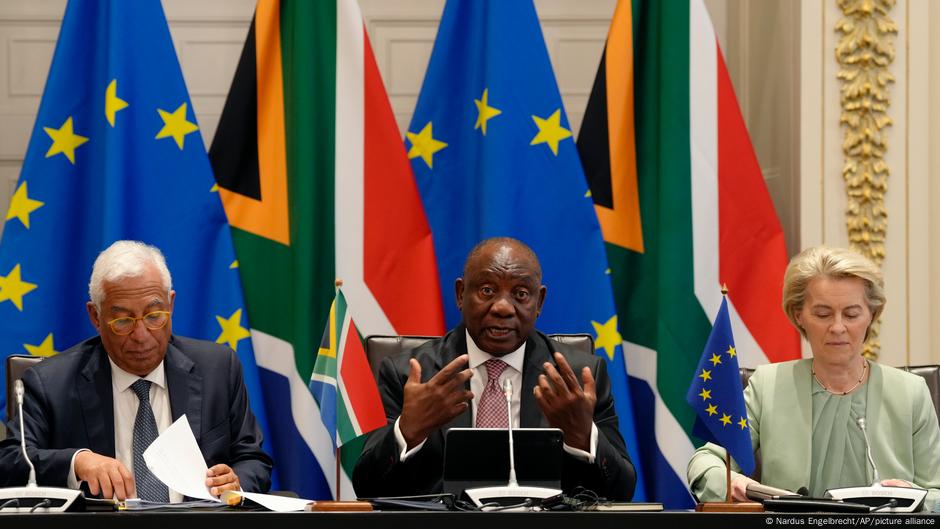
The EU and South Africa are forging stronger ties as they both grapple with aid and trade threats from the Trump administration in the United States.
The European Union on Thursday announced a €4.7 billion ($5 billion) investment package in South Africa to fund green energy projects and boost vaccine manufacturing.
The announcement came weeks after Washington pulled out of a climate funding deal, of which South Africa was one of the main beneficiaries.
The EU funding is linked to the bloc’s Global Gateway Initiative, which was announced in 2021 to mobilize €300 billion in sustainable investment by 2027, half of that in Africa.
The initiative is seen as a European effort to challenge China’s Belt and Road Initiative, a massive infrastructure plan that aims to smooth Chinese trade links with dozens of countries. Critics say Beijing’s plan traps recipients in debt.
Brussels’ financial backing announced on Thursday will pay for hydrogen energy projects and help South Africa achieve a just energy transition, which means that the country’s shift from fossil fuels to clean energy will not negatively impact its job market or communities dependent on products like coal.
Announcing the package in the South African city of Cape Town, European Commission President Ursula von der Leyen said the investment package would also support vaccine manufacturing, and digital and physical connectivity.
“We know that others are withdrawing,” Von der Leyen said in an apparent nod to Washington’s funding U-turn. “We want to be very clear with our message. We are here to stay.”
To view this video please enable JavaScript, and consider upgrading to a web browser that supports HTML5 video
South African President Cyril Ramaphosa, who met Von der Leyen and EU Council President Antonio Costa at the summit, said the cooperation would serve as a forum for regulatory cooperation between the European Union and South Africa.
“This partnership is expected, for example, to deliver short and long term solutions to enable Sasol [an energy company] to export sustainable fuel, especially aviation fuel, to the European Union,” he said.
South Africa is the EU’s largest sub-Saharan trading partner. Both pointed out that their relationship was fostered on mutual respect for multilateralism, support for human rights, and a shared world view.
“We are united by our democratic values. And our shared commitment to unity through diversity,” Von der Leyen said. “But we also share fundamental interests. From ensuring peace and stability on our continents, to boosting sustainable economic growth and strengthening our supply chains.”
Ramaphosa echoed her sentiments, noting that the summit “affirms our long-standing and close relationship, which is underpinned by the South Africa-European Union Strategic Partnership.”
“This is a partnership based on shared values and common interests,” the South African president said. “A partnership that seeks to create prosperity for our citizens and promote peace, safety and stability.”
To view this video please enable JavaScript, and consider upgrading to a web browser that supports HTML5 video
As the summit concluded on Thursday, US President Donald Trump threatened to impose a 200% tariff on European wine, champagne and spirits — on top of a 25% tariff on aluminum imports announced earlier in the week — if the European Union proceeds with plans to tax American whiskey imports.
South Africa’s relations with the US have also soured over allegations that white minority Afrikaners are being dispossessed of land, which prompted Trump to cut aid to South Africa and offer asylum in the US to Afrikaners.
Following the summit, Dr Ongama Mtimka, a political analyst who teaches Political Economy at the Nelson Mandela Bay University, said the solidarity messaging around the South Africa-EU summit is important.
“This is part of a strategy that seeks to emphasize the role of multilateralism at a time that the administration in Washington is waging a frontal attack on everybody,” Mtimka said, adding that the move seems to be “aimed at rattling the international political, economic system.”
“We have to appreciate their solidarity with South Africa at a time when South Africa faces a brutal attack from the Donald Trump-Elon Musk administration. Politically, that alliance is affirming for Pretoria,” he said.
Mtimka told DW that while the promise of funding from the EU might seem positive at face value, the South African government should be wary of “shackling future generations with mountains of debt” through loans.
“There are aspects of the energy transition that have neo-colonial tendencies. And these neo-colonial tendencies are evident in attempts to recolonize a country in the green energy grid,” he said.
To view this video please enable JavaScript, and consider upgrading to a web browser that supports HTML5 video
Oscar van Heerden, researcher at the Centre for African Diplomacy and Leadership at the University of Johannesburg, said the changing geopolitical conditions, pushed by Trump’s trade war and ongoing regional conflicts, would see the EU and South Africa coming closer together in the future.
Van Heerden said that South Africa wants to foster a healthy relationship with Washington, but there needs to be mutual respect between the two nations, however he suggested that the United States is “already playing games.”
He referred to a visit to the White House by AfriForum, a lobby group for South Africa’s Afrikaner community, and Afrikaner trade union Solidariteit, which translates as “Solidarity.”
“They are meeting with fringe right-wing conservative groups such as AfriForum and Solidarity, which sends a clear message. They don’t want to meet with us, and there’s only so much that [South Africa’s Foreign Minister, Ronald] Lamola can do to try and meet with the Americans.”
Van Heerden also noted that the EU has a long-standing relationship and trust with South Africa, one which has the potential of strengthening beyond business.
“South Africa and the EU need to begin to forge better relations and greater relations on all levels, politically and economically,” Van Heerden said.
“And of course, both need to begin to look to the east, because China is a phenomenon that just cannot be ignored, even if America has decided that it’s their enemy, and that’s the future.”
Edited by: Keith Walker
About The Author





More Stories
Advancing the Safer Internet Initiative for Everyone
Youth in Action: Contributing to a More Connected and Inclusive Digital Future
Advancing a Connected Future for Indigenous Communities