
Register for a free basic membership to enjoy up to 5 free articles per month.
Or
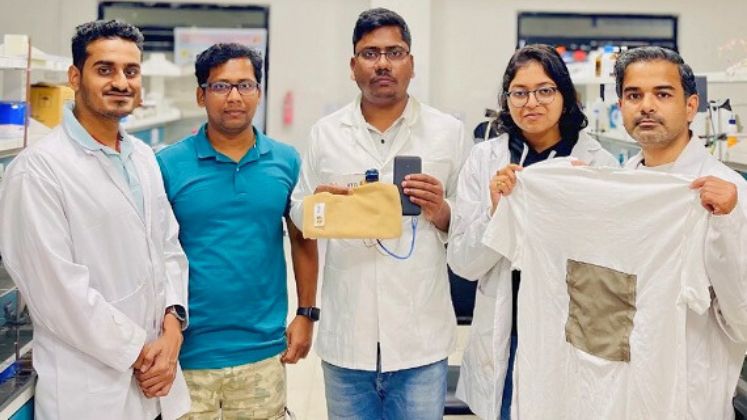
Researchers at IIT Guwahati have developed an innovative water-repellent and conductive textile capable of converting both electricity and sunlight into heat. This new material is designed to provide warmth in cold climates, addressing the health risks associated with prolonged exposure to low temperatures, such as blood clotting, respiratory issues, and weakened immunity.
Existing conductive textiles often suffer from durability problems, high power consumption, and water vulnerability. The IIT Guwahati team’s solution involves spraying ultra-thin silver nanowires onto cotton fabric. These nanowires, significantly thinner than human hair, allow for electrical conductivity, enabling the fabric to generate heat while maintaining softness and flexibility.
Professor Uttam Manna from the Department of Chemistry at IIT Guwahati highlighted the textile’s self-cleaning, breathable, flexible, and scalable nature, emphasising its durability and long-lasting performance for various controlled heating applications.
The use of silver nanowires is crucial due to their high electrical conductivity and ability to convert both electricity and sunlight into heat. The low electrical resistance of silver ensures efficient electrothermal conversion at low voltages, minimizing the risk of electrocution.
To address the issue of silver nanowire tarnishing, the researchers applied a water-repellent coating. This coating, inspired by the lotus leaf, features a microscopically rough texture that repels water, preventing it from soaking into the fabric. This keeps the textile dry, ensuring long-lasting conductivity and effective heating even in damp conditions. The coating also protects against sweat, rain, and spills, making the textile suitable for outdoor and everyday use, as detailed in their paper published in ‘Nano-Micro-Small’.
The textile can be powered by a small rechargeable battery or solar energy and can maintain a temperature between 40°C and 60°C for over 10 hours. The researchers successfully tested the textile in wearable knee and elbow bands, demonstrating its potential for providing sustained warmth to individuals working in cold environments and for therapeutic heat application for conditions like arthritis.
Your email address will not be published. Required fields are marked *
Stay updated on your topics of interest with our handpicked news and articles
Copyright © 2025 Apparel Resources
Feb 13, 2025 | 38 mins ago
Feb 12, 2025 | 1 day ago
Feb 11, 2025 | 2 days ago
Feb 11, 2025 | 2 days ago
Feb 10, 2025 | 3 days ago
Feb 08, 2025 | 5 days ago
About The Author




More Stories
What Happens When a Community Wires Itself: Lessons from Colville on the Power of Indigenous-Led Connectivity
From Curiosity to Confidence: CodificaKids Builds Digital Trust in Rural Brazil
Community Snapshot—August