
February 6, 2025
Source: NSIDC
In 2024, annual average global air temperatures surpassed 1.5 degrees Celsius above pre-industrial levels for the first time, triggering extreme weather events like record-breaking rainfall and flooding events in the Sahara Desert and extreme summer heat waves across the planet.
Based on the current pledges of countries for limiting their emissions of greenhouse gases, global temperatures are projected to reach 2.7 degrees Celsius beyond pre-industrial levels by the end of this century.
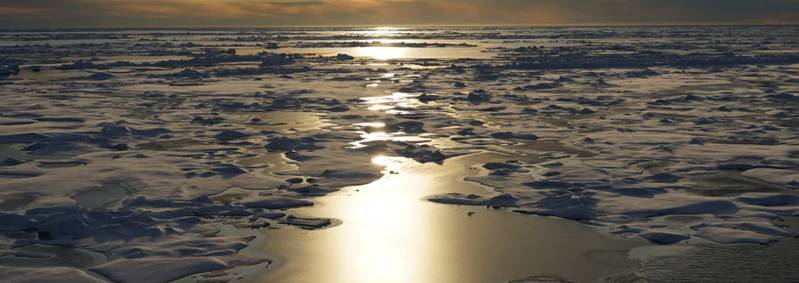
A new review paper, published in Science on February 6, 2025, highlights the expected changes to the Arctic, the fastest-warming region on Earth. The paper, “Disappearing landscapes: The Arctic at +2.7°C global warming,” was led by Julienne Stroeve, senior research scientist at the National Snow and Ice Data Center (NSIDC) and professor at the Centre for Earth Observation Science at the University of Manitoba.
“The Arctic is warming at four times the rate of the rest of the planet,” said Stroeve. “At 2.7 degrees Celsius of global warming, we will see more extreme and cascading impacts in this region than elsewhere, including sea-ice-free Arctic summers, accelerated melting of the Greenland Ice Sheet, widespread permafrost loss and more extreme air temperatures. These changes will devastate infrastructure, ecosystems, vulnerable communities and wildlife.”
Under 2.7 degrees Celsius of warming, the Arctic region is likely to experience the following effects:
• Virtually every day of the year will have air temperatures exceeding pre-industrial temperature extremes.
• The Arctic Ocean will be free of sea ice for several months each summer.
• The area of the Greenland Ice Sheet that experiences more than a month of surface temperatures above 0 degrees Celsius will quadruple compared with pre-industrial conditions, causing global sea levels to rise faster.
• Surface-level permafrost will decrease by 50 percent of pre-industrial levels.
“Our paper shows that, already today, mankind has the power to wipe out entire landscapes from the surface of our planet,” said Dirk Notz, professor for polar research at the University of Hamburg and co-author of the study. “It’d be amazing if we could become more aware of this power and the responsibility that goes with it, as the future of the Arctic truly lies in our hands.”
Other co-authors on the paper included Jackie Dawson of the University of Ottawa, Edward A.G. Schuur of Northern Arizona University, Dorthe Dahl-Jensen of the University of Manitoba and University of Copenhagen, and Céline Giesse of the University of Hamburg.
University of California, Irvine researchers have reported evidence that marine nutrient cycles – essential for sustaining…
Engineering firm Kystdesign has a contract with the Royal Netherlands Institute for Sea Research (NIOZ) for the construction…
Speaking on Marine Technology TV this week, Dr Tim Gallaudet, Rear Admiral, U.S. Navy (ret) and CEO of Ocean STL Consulting…
As directed by the President, the US Department of Interior (DOI) has announced that Gulf of Mexico (GoM) will officially…
An undersea fibre optic cable between Latvia and Sweden was damaged on Sunday, likely as a result of external influence, Latvia said…
Teledyne Marine to announced the integration of ClearSignal, a leading biofouling protection coating, into its SeaBat and…
Marine Technology Reporter is the world’s largest audited subsea industry publication serving the offshore energy, subsea defense and scientific communities.
Marine Technology ENews is the subsea industry’s largest circulation and most authoritative ENews Service, delivered to your Email three times per week
Subscribe for MTR E-news
About The Author





More Stories
Advancing the Safer Internet Initiative for Everyone
Youth in Action: Contributing to a More Connected and Inclusive Digital Future
Advancing a Connected Future for Indigenous Communities