
Let Agriculture Dive’s free newsletter keep you informed, straight from your inbox.
Also in this week’s farm technology news: Deere & Co. will partner with six agtech startups in 2025, and Google makes two biochar carbon credit deals.
Editor’s note: Agtech Seedlings is a weekly roundup of the latest in agriculture technology news, digging into venture funding, product announcements and other innovation milestones. Have news to share? Email us here.
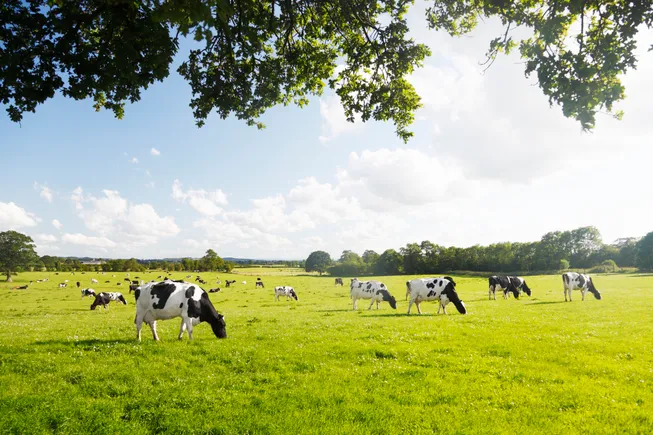
CH4 Global is expanding its methane-reducing cattle feed supplements across Asia-Pacific markets with help from Mitsubishi Corporation, the companies said Tuesday.
The strategic partnership will focus on growing sales of CH4’s Methane Tamer in Australia, according to a release. The companies also plan to develop new forms of the product and eventually enter Japanese markets.
As part of the partnership, the companies will explore opportunities to scale production of Asparagopsis seaweed to supply Asia markets, according to a release. The seaweed is a key ingredient in Methane Tamer, which has the potential to reduce enteric emissions from cattle by up to 90%.
The collaboration advances CH4’s goal to achieve gigaton-scale emissions reductions by 2035, Steve Meller, CH4’s co-founder and CEO, said in a statement.
“Mitsubishi’s deep experience in agricultural products and services and strong presence across Asian markets makes them an ideal partner,” Meller said.
Tractor giant Deere & Co. said it will collaborate with a cohort of startups that specialize in digital twins and other technologies that could advance the future of farming.
The manufacturer named six companies for its annual startup collaborator program, which began in 2019. Participating startups will work closely with Deere to explore new technologies that could potentially benefit customers in the future, according to a release.
Startups in this year’s program include Landscan, a digital twin company that uses soil and remote sensing signals to help optimize land management. Also participating is Array Labs, a space technology company designed for frequent 3D imaging of the Earth’s surface.
Companies focused on artificial intelligence were also prominent in this year’s cohort. Presien, an AI company, aims to improve worksite safety and productivity with on-machine technology. ReSim, another AI-centric firm, operates as a testing ground for automated hardware, simulations and replay evaluations.
“Each startup in this cohort brings unique technologies aimed at tackling real challenges in agriculture and construction. By working together and learning from one another, we will explore new technologies that can benefit our customers,” Colton Salyards, principal of corporate development at John Deere, said in a statement.
Other participating firms include advanced chip-developer Lidwave and Witricity, a developer of wireless charging technology.
Google LLC has agreed to buy 200,000 tons of biochar carbon removal credits to support its net zero emissions goal over the next five years.
The tech giant said it will partner with Varaha and Charm to purchase 100,000 tons of biochar carbon removal from each company by 2030, making them “the largest biochar carbon removal deals to date.”
Biochar occurs following the decomposition of food scraps, wood chips and animal waste in the absence of oxygen. The black carbon mineralized substance can then be mixed with soil to help store carbon dioxide from the atmosphere.
Google said these deals will help spur biochar production to a meaningful scale as companies look to mitigate climate change. In addition to biochar, the Silicon Valley company is supporting offtake deals such as enhanced rock weathering and direct air capture.
A majority of people feel positively about the use of new genomic techniques in agriculture if the changes are used to make crops more climate resilient, according to a recent survey from Leaps, the impact investing arm of Bayer AG.
About 56% of respondents globally supported the use of such breeding techniques, which can change the genetic makeup of organisms, if that meant crops could be more resistant to climate change.
According to the survey, about 47% of European respondents felt positively about NGTs, 34% were neutral and 12% had a negative view. Bayer said results were compelling in that NGT usage is heavily restricted in the EU.
Get the free daily newsletter read by industry experts
While prices of feed, fertilizer and pesticides are expected to decline, farmers are forecast to spend more on labor and taxes.
Herbicide bans and new application restrictions aimed at protecting farmworkers and the environment have also made it more difficult for farmers to manage crops.
Keep up with the story. Subscribe to the Agriculture Dive free daily newsletter
Subscribe to Agriculture Dive for top news, trends & analysis
Get the free daily newsletter read by industry experts
While prices of feed, fertilizer and pesticides are expected to decline, farmers are forecast to spend more on labor and taxes.
Herbicide bans and new application restrictions aimed at protecting farmworkers and the environment have also made it more difficult for farmers to manage crops.
The free newsletter covering the top industry headlines
About The Author





More Stories
Advancing the Safer Internet Initiative for Everyone
Youth in Action: Contributing to a More Connected and Inclusive Digital Future
Advancing a Connected Future for Indigenous Communities