
Wendy Laursen has 20 years of experience as a journalist….
January 23, 2025
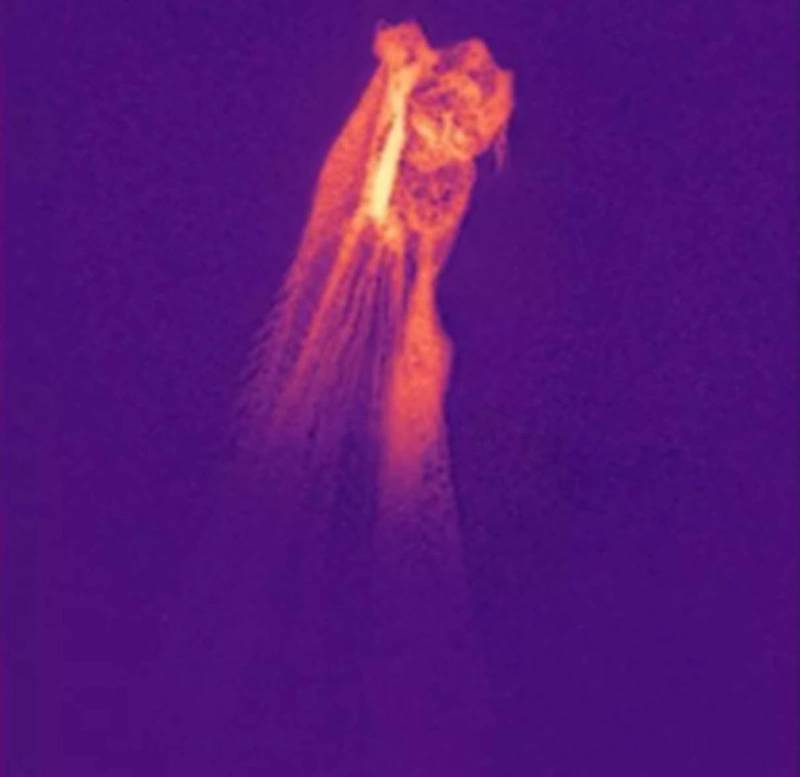
Image of a mosquito wing created with the quantum optical microscope. (Shabir Barzanjeh / University of Calgary)
This week at Marine Technology News…
The quantum economy is not just a distant dream – it's unfolding right now, offering unprecedented opportunities for those ready to seize them.
That’s how the World Economic Forum introduced its new report “Embracing the Quantum Economy – A Pathway for Business Leaders” last week.
Prepared in collaboration with Accenture, the report explores advancements in quantum computing, quantum sensing and quantum communication and outlines strategic steps for businesses to get started with them.
Quantum sensors offer dramatically increased sensitivity compared to traditional sensors, and the World Economic Forum report says the technology is potentially disruptive for land and sea monitoring activities.
This week Marine Technology News reported on the agreement between ADNOC, the Technology Innovation Institute and ASPIRE to develop quantum sensing technology for carbon storage monitoring. It will be capable of detecting subtle environmental changes, such as shifts in magnetic or electrical properties, to help enhance safety and prevent leaks.
Also this week, Marine Technology News spoke to Georgios Salavasidis, a senior robotics researcher and delivery lead at NOC in the UK. He sees promising advances in quantum magnetometers and gravimeters.
“Their potential for use on underwater vehicles is immense, potentially revolutionizing key applications, such as high-resolution subsurface mapping, detecting leaks from carbon capture and storage sites and locating buried pipelines, cables or unexploded ordnance beneath the seabed.”
While quantum gravimeters are still under development, requiring significant miniaturization to integrate seamlessly into AUVs, quantum magnetometers have already been successfully used for years in various detection and monitoring applications.
They are now also being explored for their potential as navigation aids by using the Earth’s natural magnetic field to determine position in GPS-denied environments. “This concept, while promising, requires accurate magnetic anomaly maps, advanced estimation and inference techniques and often necessitates towing the sensor behind the vehicle to minimize interference from onboard electronics, power systems and other magnetic materials,” says Salavasidis.
“For us, the potential of quantum sensing in GPS-denied navigation is particularly exciting, as this has always been a fundamental challenge for underwater vehicles, which, by definition, operate without access to GPS. Most navigational sensors we currently rely on are prone to drift, meaning navigation systems require external support or frequent surfacing to acquire GPS fixes, especially during science missions that demand high navigational accuracy. The promising aspect of quantum sensing lies in its ability to deliver high precision without the issue of drift.”
It will likely take several years before these technologies become available for practical applications, says Salavasidis.
Meanwhile, the world's first quantum optical microscope was unveiled in Canada this week. Developed by a team of researchers from the National Research Council, University of Calgary, University of Ottawa and beyond, the microscope uses entangled photons to provide ultra-low intensity illumination. By harnessing the power of correlations between single photons, the technology speeds the process and reduces the risk of photo damage while delivering high-resolution images.
New developments such as this demonstrate the vast commercial potential of quantum sensing as it transitions from experimentation to widespread deployment. This emerging market is expected to reach $2.2 billion by 2045, according to IDTechEx's new report "Quantum Sensors Market 2025-2045: Technology, Trends, Players, Forecasts."
The Korea Institute of Ocean Science & Technology (KIOST) accepted delivery of the Klein Marine System’s 5900 ultra-high-resolution sonar…
Australia has a reputation for naming animals based on their color: the red belly black snake, the red necked wallaby. More…
Teledyne Impulse-PDM supplied its Omicron optical fiber connectors to BBC Studios for use in its upcoming underwater natural history series…
A new UK National Oceanography Centre (NOC)-led study has put a major question mark over the role a unique group of tiny…
Ocean Scientific International Ltd (OSIL) have manufactured a oceanographic data buoy system, the first of its kind in the…
The Scythian philosopher Anacharsis (6th century B.C.) said: “There are three sorts of people: those who are alive, those…
Marine Technology Reporter is the world’s largest audited subsea industry publication serving the offshore energy, subsea defense and scientific communities.
Marine Technology ENews is the subsea industry’s largest circulation and most authoritative ENews Service, delivered to your Email three times per week
Subscribe for MTR E-news
About The Author




More Stories
Internet Governance: Empowering Communities to Shape the Future of the Internet
Global Encryption Day Summit 2026: Five Key Conversations on the Future of Digital Trust
What Global Data Tells Us About the Economics of IXPs