
Thank you for visiting nature.com. You are using a browser version with limited support for CSS. To obtain the best experience, we recommend you use a more up to date browser (or turn off compatibility mode in Internet Explorer). In the meantime, to ensure continued support, we are displaying the site without styles and JavaScript.
Advertisement
You have full access to this article via your institution.
Model PI? Leonardo DiCaprio plays astronomer Randall Mindy, with Jennifer Lawrence as his graduate student Kate Dibiasky, in the disaster satire Don’t Look Up.Credit: Bluegrass Films/Entertainment Pictures/Alamy
It’s a well-trodden path for most people who aspire to a career in academic research: you first earn a PhD, then take a succession of fixed-term contract jobs. For a small minority, this eventually leads to the coveted role of principal investigator (PI) and the chance to set up your own research group. Many of the postdoctoral researchers you hire will harbour the same ambition. An increasing supply of talent chasing a relatively static number of permanent positions inevitably results in a tortuous route to professional status.
The process of becoming a PI is stressful and precarious, and, in many ways, not reflective of the increasingly collaborative nature of science today. Nor is it healthy for the long-term interests of the research enterprise, which, according to some scientists, is struggling to produce disruptive discoveries and innovations1.
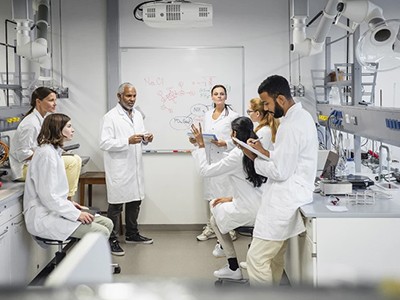
What’s the state of hiring researchers in science? Share your insights with Nature
What’s the state of hiring researchers in science? Share your insights with Nature
These observations are hardly new. Researchers at all career stages have described them in Nature’s pages. This week, our careers team has launched its first global survey of hiring managers and research leaders, hoping to capture their experiences of the recruitment process.
Research leaders have previously proposed solutions (see, for example, ref. 2), but these have had little success. Could at least part of the answer lie outside academia? In January, a team of researchers at the Tony Blair Institute for Global Change (TBI), a London-based think tank established by the former UK prime minister, came up with a proposal that some academics might call radical.
The team delved into the structure and outputs of academic research. To their horror, the researchers uncovered a system that, in their words, “ends up rewarding administrators and empire-builders, not creative scientists actively engaged in research and mentoring”. They have much more to say in their report, A New National Purpose: Leading the Biotech Revolution (see go.nature.com/3vvnpy5), but this quote demonstrates their shock over how academia is structured and how it operates.

‘Disruptive’ science has declined — and no one knows why
‘Disruptive’ science has declined — and no one knows why
The structure of academia is also attracting attention from high-level policymakers because science is increasingly seen as a way to boost economic growth. Growth is barely above 1% in many countries that are home to some of the world’s leading universities and science-based industries, such as aerospace and pharmaceuticals. Political leaders want to know how better partnerships between academia and industry, coupled with the potential of artificial intelligence, can accelerate growth. To reliably answer their questions, advisers need an understanding of how universities work and what the impediments to improvement might be.
One of the suggestions in the TBI report is to organize research and development (R&D) in some parts of academia similarly to how it is structured in some R&D-intensive corporations. Instead of distributing funding through a single PI, money and decision-making would be shared between senior leaders. According to this vision, pay and conditions would be better than in the current model, and there might also be more permanent roles available. A similar approach, called the Focused Research Organization, was described earlier this year in a commentary in Cell by Samuel Rodriques, a researcher at the Francis Crick Institute in London3.
Such models are not exclusive to corporations; they also exist in some government-funded national laboratories. These are devoted mainly to applied research, and their scientists’ employment status is similar to that of civil-service workers. However, this makes external collaboration harder.
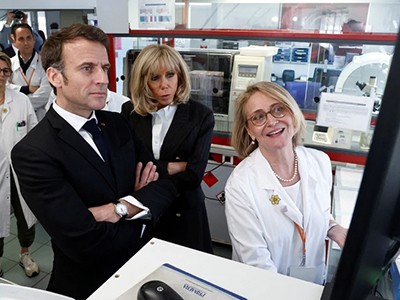
A DARPA-like agency could boost EU innovation — but cannot come at the expense of existing schemes
A DARPA-like agency could boost EU innovation — but cannot come at the expense of existing schemes
Another model is seen in the US Defense Advanced Research Projects Agency (DARPA) and its increasing number of counterparts around the world. In this system, grant managers — picked from a pool of some of the most successful PIs — wield considerable power and influence. It could, therefore, be argued that this offers no real improvement over the PI model.
There are other models, too, and many associated issues to unpick. The current system, in which funders award large grants to one individual, who then employs 5, 10, 20 or more people, all with the ambition of becoming a PI, has served academia well, but will inevitably lead to an oversupply of researchers. Some might say that creating more highly qualified people is a good thing, regardless of whether they choose research careers, because their knowledge and skills will benefit them regardless of their occupation. Others might disagree, arguing that research should be subject to the kinds of recruitment limitations that exist in professions such as medicine. Another argument is that society would be better off taking resources that are going into research training and investing them in programmes, such as apprenticeships, that help people to develop more targeted skills.
We would like to hear your thoughts. Take part in our survey of hiring managers (see go.nature.com/3zq1x2z) or participate in our poll (see go.nature.com/linkedin). Do you agree that the PI model is broken? If so, what would you change and why? If you disagree, or can see downsides to the alternatives, what are you reservations? Your thoughts will inform our future coverage of this issue.
Nature 630, 793 (2024)
doi: https://doi.org/10.1038/d41586-024-02080-7
Park, M., Leahey, E. & Funk, R. J. Nature 613, 138–144 (2023).
Article PubMed Google Scholar
Alberts, B., Kirschner, M. W., Tilghman, S. & Varmus, H. Proc. Natl Acad. Sci. USA 111, 5773–5777 (2014).
Article PubMed Google Scholar
Rodriques, S. G. Cell 187, 3–7 (2024).
Article PubMed Google Scholar
Download references
Reprints and permissions
 What’s the state of hiring researchers in science? Share your insights with Nature
 Bring PhD assessment into the twenty-first century
 A DARPA-like agency could boost EU innovation — but cannot come at the expense of existing schemes
 ‘Disruptive’ science has declined — and no one knows why
The geneticist who uses science to free parents wrongly convicted of killing their children
Career Feature
Science on the edge: how extreme outdoor skills enhanced our fieldwork
Career Feature
Maggie Aderin-Pocock on diversity: ‘It’s hard to find an argument against it’
Career Q&A
Your reagent is past its use-by date. Should you bin it?
Technology Feature
Is your research a trade secret? South Korean data-sharing case is a wake-up call
World View
To regain lost public trust, incorporate research ethics into graduate training
Correspondence
A Trojan horse for thirsty tumours
Outlook
A light-touch approach to intracellular delivery
Outlook
Infrared spectrometry guides cancer treatment
Outlook
To study how a population of skeletal stem cells mediate bone regeneration and orchestrate a composite tissue regeneration program using mouse models.
Hospital for Special Surgery, New York City, New York (US)
Hospital for Special Surgery
Lecturer / Associate Professor in Advanced Cell Models Cell and Developmental Biology Location: Highfield Campus Salary: £44,263 to £72,018 per ann…
Southampton, Hampshire (GB)
University of Southampton
Lecturer / Associate Professor in Biological Sciences School of Biological Sciences Location: Highfield Campus Salary: £44,263 to £72,018 per annum…
Southampton, Hampshire (GB)
University of Southampton
Associate Professor / Professor in Microbial Biofilms Microbiology Location: Highfield Campus Salary: Associate Professor Level 6 – £57,696 to £72,…
Southampton, Hampshire (GB)
University of Southampton
Lecturer / Associate Professor in Computational Biology School of Biological Sciences Location: Highfield Campus Salary: £44,263 to £72,018 per ann…
Southampton, Hampshire (GB)
University of Southampton
You have full access to this article via your institution.
What’s the state of hiring researchers in science? Share your insights with Nature
Bring PhD assessment into the twenty-first century
A DARPA-like agency could boost EU innovation — but cannot come at the expense of existing schemes
‘Disruptive’ science has declined — and no one knows why
An essential round-up of science news, opinion and analysis, delivered to your inbox every weekday.
Sign up for the Nature Briefing newsletter — what matters in science, free to your inbox daily.
© 2024 Springer Nature Limited
About The Author





More Stories
Advancing the Safer Internet Initiative for Everyone
Youth in Action: Contributing to a More Connected and Inclusive Digital Future
Advancing a Connected Future for Indigenous Communities