
Domain Name Wire | Domain Name News
Domain Name Industry News
Leave a Comment
How much of ICANN’s time is spent dealing with compliance?
ICANN 73 Prep Week is underway, and on Tuesday, ICANN’s Contractual Compliance and Consumer Safeguards department gave an update on its activity.
The department enforces ICANN’s contracts with registries and registrars. They handle complaints from registrants and end users, conduct audits, and monitor the domain name industry.
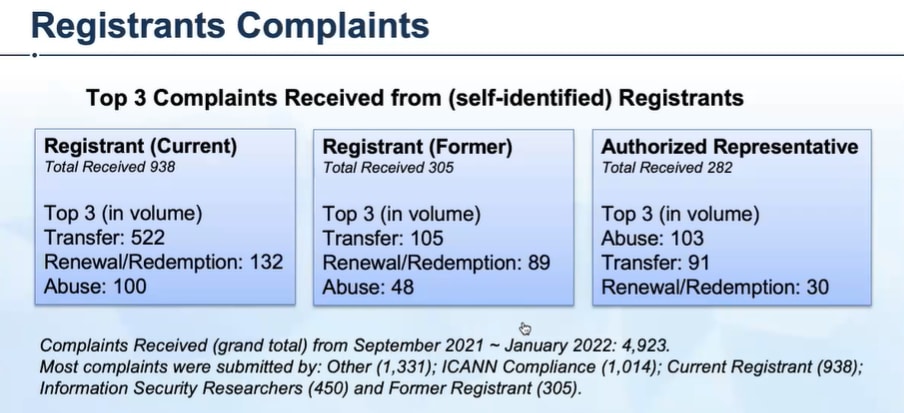
During the presentation (login required), the compliance team announced that its adoption of Salesforce has allowed it to slice and dice its data regarding complaint volumes, compliance actions, and other more granular details. It said transfer and renewal issues continue to be the most common sources of complaints (see image above).
Every upheaval in the domain industry has impacted compliance activity within ICANN. Events in the domain space and community pressure typically result in increased compliance efforts.
For example, in 2007, the RegisterFly meltdown spurred Contractual Compliance to initiate audits and led to changes in the Registrar Accreditation Agreement that took effect in 2009. The New gTLD Program led to the creation of a base Registry Agreement with additional audit rights. While growing community concern over DNS abuse has not granted ICANN the power to directly address either maliciously registered or compromised domains, Contractual Compliance seems to be spending more resources on demonstrating that it ensures that registrars and registries post (and follow) procedures and policies for abuse reporting.
GDPR, which has caused most Whois data to be redacted, has had a significant impact on complaints. Since 2018, policy changes focused on personal data protection have reduced the overall number of registration data complaints and raised the rejection rate of the remaining attempts to garner information.
The complaint process is reasonably straightforward for registrants experiencing issues with their registrars. That doesn’t mean the complainant will be successful. Contractual Compliance simply rejects the vast majority of complaints as out of scope, moot, or otherwise invalid. As with ICANN’s DIDP process, submissions can miss the mark for a variety of reasons:
There were a couple of takeaways from the presentation on Tuesday. First, report as much information as possible and respond promptly to any follow-up questions. Second, Contractual Compliance generally tries to resolve complaints before issuing a formal notice. So even though ICANN only publishes a handful of formal compliance actions per month, valid complaints are acted upon in other ways.
Categories: Policy & Law
Andrew Allemann has been registering domains for over 25 years and publishing Domain Name Wire since 2005. He has been quoted about his expertise in domain names by The Wall Street Journal, New York Times, and NPR. Connect with Andrew: LinkedIn – Twitter/X – Facebook
Stay up-to-date with the latest analysis and news about the domain name industry by joining our mailing list.
No spam, unsubscribe anytime.
Domain Name Wire is a trade publication for the domain name industry covering topics relevant to domain investors, brand owners, policy makers, domain registrars and registries, and more. Founded in 2005, Domain Name Wire has been cited by Wall Street Journal, New York Times, NPR, and Washington Post. Read More About DNW.
Stay up-to-date with the latest analysis and news about the domain name industry by joining our mailing list.
No spam, unsubscribe anytime.
© 2005–2025 Domain Name Wire · DNW and Domain Name Wire are trademarks of Brainstorm Labs, LLC
About The Author


More Stories
From Curiosity to Confidence: CodificaKids Builds Digital Trust in Rural Brazil
Community Snapshot—August
Empowering Parents in Rwanda Through Digital Literacy Training