
Your browser appears to be unsupported. Because of this, portions of the site may not function as intended.
Please install a current version of Chrome, Firefox, Edge, or Safari for a better experience.
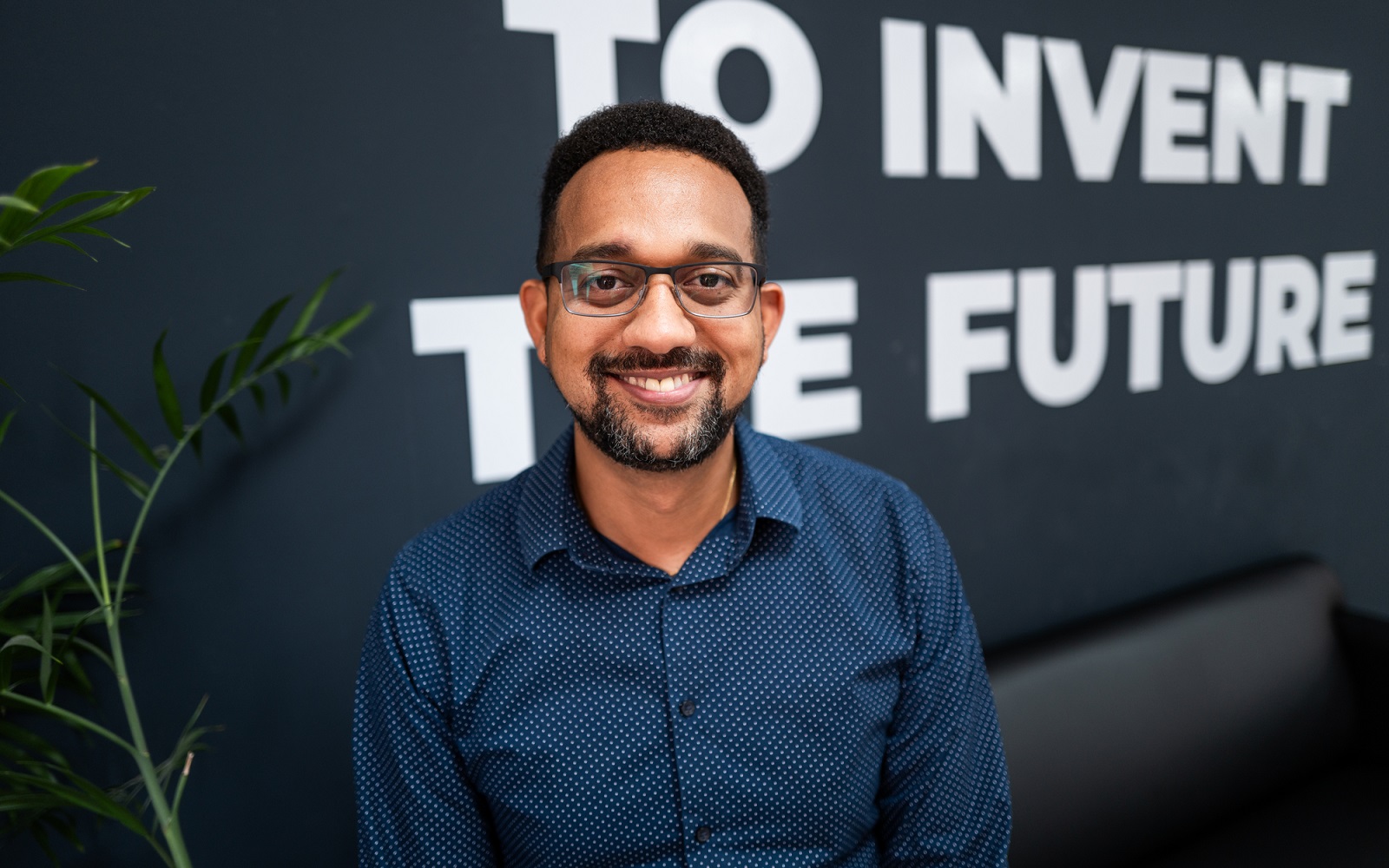
After a grueling year of applications, interviews, and anxiety, immunologist Yaw Bediako was thrilled to learn in 2021 that he’d won a prestigious two-year fellowship from the London-based Royal Society. In the hypercompetitive world of academic research, this was a huge triumph for Yaw after years of hard work and dedication. He’d have two years of funding to dive deeply into the connections between immunity and cancer, particularly among people of African descent.
A few months later, Yaw sat down at his desk to read devastating news: The fellowship was canceled. His funding had disappeared overnight.
Yaw began to seek answers about his vanished fellowship. In the course of doing so, he’d begin a life-changing pivot.
Yaw grew up in Ghana, the son of a British mother and a Ghanaian father, both academics. Yaw and his younger brother attended schools in both the UK and Ghana. His mother, Gillian Mary Bediako, often assigned him and his brother two sets of homework.
“I always tell people I was homeschooled and school-schooled. That’s probably why I am where I am today—because of that extra effort my mom put in to give us a firm foundation,” he says.
Like his parents, Yaw was drawn to academia. “My goal was to become a professor before I turned 45,” he says. When it came time to apply to college, Yaw found that there weren’t many research opportunities in Ghana, so he attended Calvin University in Grand Rapids, Michigan, in the United States, where he majored in biology and began doing research the summer after his first year. He spent a year after graduation working at a cancer research institute and went on to earn a Ph.D. in microbiology and immunology at Northwestern University in Chicago, Illinois.
As he neared graduation, Yaw became determined to return home and spend his most productive years contributing to Africa. When he was a child, his father, Kwame Bediako, established the Akrofi-Christaller Institute for Theology, Mission, and Culture—a university dedicated to the study and documentation of Christian history, thought, and life in Ghana. It was the first of its kind.
“I grew up watching my father turn down job offers abroad to build something locally. That’s something that’s motivated me to try and build something in Ghana,” he says.
Yaw secured a postdoctoral position with the KEMRI-Wellcome Trust Research Programme in Kenya, a leading African research center. “I thought it was a great place to cut my teeth and do science on the continent,” he says.
After two years, Yaw followed his next funding opportunity and left for London, where he began a postdoc at the Francis Crick Institute, one of the world’s top research institutes. “I was a little bit disappointed that I was leaving the continent, but in hindsight, it’s exactly what I needed because I was still green as a researcher,” he says.
Yaw matured in a world-class environment, with access to top-tier equipment and a fully developed research ecosystem. Eventually he returned home, joining the faculty at the University of Ghana. But the need to secure research funding continued to put pressure on his path forward. It’s why he was so thrilled about the Royal Society fellowship.
Ironically, the source of funding he perceived to be the most reliable turned out to be anything but. Because of the COVID-19 pandemic’s impact on the economy, roughly 70% of funding to grant holders like Yaw was cut. When he sat at his desk, reading the shocking news, he almost couldn’t believe it. “It was a year of applications, interviews, and anguish, only to win the race and find there’s no prize,” he says.
For Yaw, this news spurred curiosity. It led Yaw to ask: Why were he and so many of his peers dependent on someone else’s government? And what would it look like if he created his own research jobs and infrastructure? The answer involved stepping away from academia and creating a company of his own in Africa.
Leaving academia was not something Yaw took lightly. “It was a huge gamble,” he says. “Anybody who’s an academic knows it’s a bit of a rat race. The moment you take your foot off the gas, things pass you by, you don’t publish as much, and everything slows down.”
But he took the leap, launching Yemaachi Biotech, an immunogenomics research company, with guidance from a university mentor who shared his long-term vision. “We want to be the first of many, we want to clear the path for many more to come and stand on our shoulders,” Yaw says. His goal in starting the company was to do globally competitive work while training and retaining local talent.
Being a startup founder gave Yaw access to new funding streams. Though it wasn’t a cure-all—as Yaw notes, “Ghana doesn’t have an NIH structure like the US, so it sets up a huge competition for externally generated funds because of so many people applying for a limited number of spots,”—it was an entree into the world of venture capital.
He applied to Y Combinator, one of the most prestigious Silicon Valley startup accelerators. Each year thousands of companies around the world apply for funding. “We tried without expecting to get in, which is probably why we got in. We were loose about it. We presented ourselves as who we were and didn’t get caught up in the moment.” Yaw says.
Yemaachi was the only Ghanaian-based startup to be awarded funds from a pool of about 15,000 applicants. Winning opened many doors from an investment standpoint.
Yaw Bediako was one of 14 recipients of the 2021 Calestous Juma Science Leadership Fellowship, funded by the Bill & Melinda Gates Foundation to support the next generation of science leaders across Africa.
Yemaachi now employs 40 people with an impressive range of academic experience and business acumen. Together, they work to understand immune function among African populations, with a primary focus on diversifying cancer research.
In 2008, Yaw’s father passed away from liver cancer. “Black people bear a disproportionate burden of cancer mortality around the world,” Yaw says. “Black men have more aggressive prostate cancer than white men, and we don’t know why. No one is really doing research on this disease in our population. And what better way to do that than to center that in Africa?”
When medical research is diverse, scientists can ensure that their findings are generalizable across a large population. Yaw points out that most human research trials rely disproportionately on European participants, who are more genetically homogenous than Africans. “With the current skewing of databases, many precision tools are least effective for African people and people of African descent,” he says. “It’s not a Black and white thing—it’s about diversity. Africa is central to the human experience—the continent that homo sapiens evolved from and the most genetically diverse continent on the planet,” Yaw says.
Earlier this year, Yaw assembled a group of researchers from around the world, including his team at Yemaachi, to apply for another long-shot source of funding—the Cancer Grand Challenges, founded by Cancer Research UK and the U.S. National Cancer Institute. “Team SAMBAI,” as they called it, led by Melissa Davis of the Morehouse School of Medicine in the United States, was awarded US$25 million—the largest grant in history for research on cancer inequities.
“We’re looking at trying to understand cancer in the African diaspora—African American, Black British, and continental Africans—the first initiative of its scale,” says Yaw. “You can’t say you’re studying a disease if you don’t include the most diverse population on the planet, which is the Black population.”
Through Yemaachi, Yaw is changing the narrative about Africa’s role in biomedical research and paving the way for increasing scientific excellence, local investment, and retention of local talent.
“The boldest thing I’ve done in my life is to start this company,” says Yaw. “It’s a huge deviation from what I thought was my life’s trajectory. And we’re working together to build this. I may be the one who people interview, but it’s really a team effort.”
By submitting your email to subscribe, you agree to the Gates Foundation’s Privacy & Cookies Notice
By submitting your email to subscribe, you agree to the Gates Foundation’s Privacy & Cookies Notice
About The Author

More Stories
Introducing a New Chapter for the Internet Society Fellowship Program
Closing AI’s Language Gap: Why the Internet Society Is Joining a Global Commitment
What Happens When a Community Wires Itself: Lessons from Colville on the Power of Indigenous-Led Connectivity