
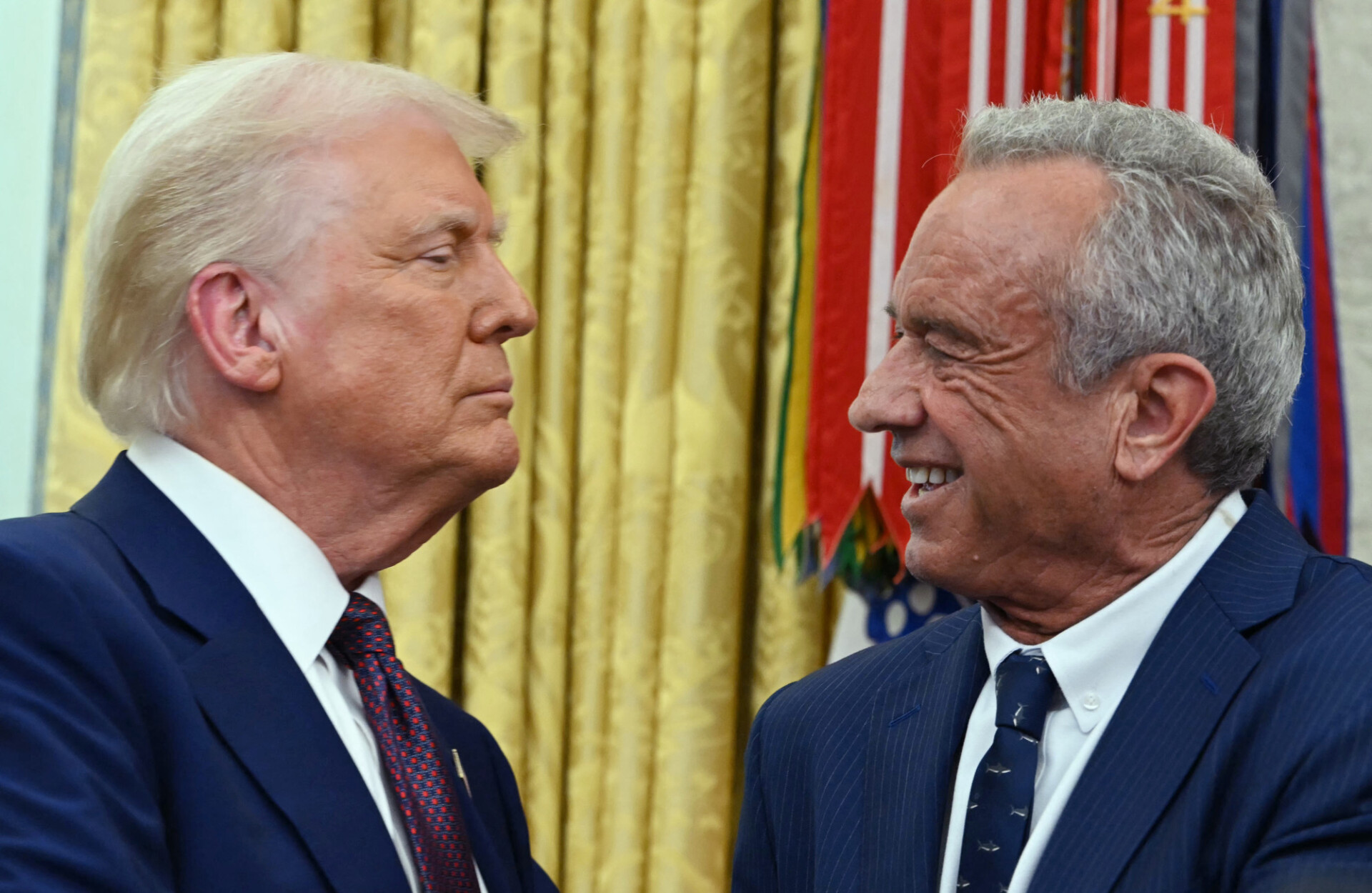
RFK Jr. has said he wants to clean house at federal health agencies. Credit: Getty
18:00
18:00
18:00
Federal research funding in the United States is facing significant cuts under the Trump administration. National Institutes of Health (NIH) and National Science Foundation (NSF), the nation’s two largest sponsors of academic research, have started to see reductions that many scientists find alarming. Senator Ted Cruz has led an effort to scrutinise NSF grants, identifying over 3,400 projects allegedly promoting Diversity, Equity, and Inclusion (DEI) or “neo-Marxist class warfare propaganda.” While a review by the blog Astral Codex Ten found that only 40% of the sampled projects could reasonably be categorised as “woke science,” the effort signals a broader trend: conservatives are using their political power to push back against an academic establishment they view as ideologically hostile.
Criticism of the cuts has been swift. Harvard professor Joe Henrich and education policy expert Stuart Buck have pointed out that some defunded research projects are rigorous, valuable, and unrelated to ideological activism. Buck, in particular, lamented that Elon Musk’s influence over the Department of Education led to the cancellation of important national surveys and education research. Yet while these concerns are valid, they overlook a crucial point: academia’s lack of ideological diversity and embrace of political activism made this backlash inevitable.
For years, dissenting academics have warned of the dangers of turning universities into ideological monocultures. Rutgers psychology professor Lee Jussim recently published a blog post titled “We Tried to Warn You,” cataloging decades of contributions from heterodox scholars about the risks of ideological overreach. The list includes over 80 books, essays, or other studies that predicted the loss of public trust in higher education.
In 2023, when Florida removed sociology from its general education curriculum, I argued it is time we start listening to our critics and “view the Florida decision as a wake-up call and an invitation to introspection.” The result? Denial and hostility by the academic mainstream. We are now witnessing the predictable consequences of having nurtured entire fields of inquiry that have managed to alienate half the country with their one-sided political advocacy in the name of science.
The Trump administration’s efforts to curb DEI initiatives was only the beginning. Republicans are moving beyond bureaucratic bloat and striking at the core of academic infrastructure. Some of these cuts will undoubtedly damage valuable scientific research, but the ultimate responsibility does not lie with conservative lawmakers. Academia has long treated conservatives as enemies rather than as a legitimate part of the intellectual community. It is unsurprising that those same conservatives, now in power, are treating professors as enemies rather than as impartial scholars deserving of public trust and taxpayer dollars. Had professors and university administrators done an acceptable job policing our troubled turf, I suspect we could have avoided having our babies thrown out with the bathwater.
If academics want to preserve federal funding, they must first restore credibility. That means recommitting to intellectual diversity, resisting ideological conformity, and acknowledging our role in fostering the polarisation that led to this crisis of confidence. Until then, no amount of protesting will stop the political forces now reshaping higher education.
Folks, we did this to ourselves. It is up to us to fix it.
Jukka Savolainen is a Writing Fellow at Heterodox Academy and Professor of Sociology at Wayne State University in Detroit, Michigan.
My original career was in chemistry/biochemistry and I spent a few years in academia a long time ago. The universities were left-leaning but not nearly so politicized as today. My strong impression of academic STEM research, however, is not that it’s strongly politicized but that so much of it is mediocre at best.
The academic research community has expanded massively over the past thirty or forty years, but the quality of the research has not improved. Many people are dotting i’s and crossing t’s and trying to make their work sound like the days of Bohr, Pauli, Heisenberg, Einstein revolutionizing our understanding of how the universe works. At least in my field, half the primary literature could disappear and we’d lose little of real value.
From a purely return-on-investment point of view, it’s time federal funding for research is subject to a thorough review.
In citing those scientific luminaries of yesteryear, a question springs to mind: how were they funded during the years of their most vital and ground-breaking research?
I don’t know enough to attempt to answer that question, but others might. I have my doubts though, as to whether the answers might be anything like “federal funding” (or the equivalent in their respective communities).
Einstein famously did much of his ground-breaking work while a clerk at the Swiss patent office. More typically, however, these luminaries made their most significant discoveries as Ph.D students or junior faculty members. Like you, I don’t know the details of their funding but I strongly suspect it came directly or indirectly from the government.
I am certainly not arguing governments have no role in research funding. I am arguing, however, that research in Western universities has adopted many of the characteristics of a bureaucracy, especially the tendency of all bureaucracies to expand and make that expansion their primary goal. Modern university departments don’t ask, “Which research deserves funding?” They ask, “How can we secure more research dollars?” Those two questions are not the same.
At least in a number of cases these scientists had far wider intellectual interests than would be common today. Perhaps a key to innovation is ideas and frames of reference making the jump from one area to another. Narrow specialisation works against this.
Quite likely a lot of research is indeed mediocre. It is a sad fact that most scientists (engineers, politicians, lawyers, …) are mediocre and only a very small proportion are outstanding. Trouble is (as they said about advertising) even if you know half the money is being wasted, ho do you determine which half? Anyway, how sure are you that messrs. Trump, Kennedy et al. know how to distinguish good science from bad?
The ease at identifying Political propaganda in scientific journals isn’t difficult. Certain subjective words are a dead giveaway.
“how sure are you that messrs. Trump, Kennedy et al. know how to distinguish good science from bad?”
My views on this subject are based on personal experience where it was very easy to spot the third-rate research which was often linked to pork barrel funding. No doubt there is an intermediate quality of research which might or might not produce something of value, but we simply cannot provide limitless funding for research. Choices have to be made.
I believe the quickest and cleanest way to address this problem is to significantly cut research funding, especially in the less critical aspects of STEM–the strongest case can be made for funding IT-related projects, imo.
The research community will be left to sort the wheat from the chaff. Sure, there will be favoritism and politics within the research community, but eventually the most significant research will attract the most funding. Moreover, much federal money currently goes to what is, in fact, applied research rather than basic research. I would argue that if industry wants to research certain projects it should pay for that research.
The process of down-sizing the federally-funded research community will not be painless or neat. There will be some mistakes, but it’s a necessary project and, as the saying goes, don’t let the perfect stand in the way of the good.
I bought a Scientific American in April. There is an incredible article about Indigenous “Ways of Knowing” with a bunch of pie charts and graphs for reorganizing all of society.
I want the entire world to read this nonsense.
I believe that a number of scientists feel that there has been little truly original thinking in science for around 50 years. This seems to be the case regardless of the maturity of the subject. It’s not quite clear why this should be though – and of course some deny it.
My experience is that a lot of time and money is wasted on managerial bureaucracy. Like everywhere, market fundamentalism became a thing, which means many researchers focus on meeting all kinds of targets and on auditing. For example, publishing as much as you can: quantity over quality. Also lot of researchers waste more and more time on grant proposals, which is also an incredibly bureaucratic process. Finally a lot of talent checks out of academia because endless unstable temporary (postdoc) positions for low wages are not worth it at some point.
“What a vision may offer, and what the prevailing vision of our time emphatically does offer, is a special state of grace for those who believe in it. Those who accept this vision are deemed to be not merely factually correct but morally on a higher plane. Put differently, those who disagree with the prevailing vision are seen as being not merely in error, but in sin. For those who have this vision of the world, the anointed and the benighted do not argue on the same moral plane or play by the same cold rules of logic and evidence.”
Thomas Sowell
The author says “we tried to warn them” but as Sowell points out, warnings don’t register with people that know they are right. These are not academics they are disciples. There will not come a time when they realize the jig is up so the only option is to remove them and their programs. It’s no surprise that some healthy tissue will get excised along with the rotten but that’s the price to be paid to save the patient.
The trouble is that your quote applies just as exactly lo the Trumpists as to the woke. You are not improving anything, just replacing one self-righteous tribe with another.
I like how you’re an expert on American politics now that you’re at a risk of having money for social programs redirected to national defense.
Keep trashing America. Keep it up.
I see that the weird and unwelcoming redesign of the comments section that ‘greeted’ me on Unherd this morning has been scrapped – permanently I hope. I was set to cancel my subscription later this evening and move to the Daily Sceptic for conversations with more edge (for better or worse).
The result? Denial and hostility by the academic mainstream.
Because they believe their own nonsense, and are convinced they are on the side of the good.
Some more cynical souls have been shoehorning DEI into research proposals where it didn’t really fit in order to secure funding – sometimes with the aid of consultants. I wonder if that has come back to bite any of them?
Hopefully those scientists who are researching in a scientific manner important scientific questions will retain their funding while those who have allowed ideology to intrude into trivial and unscientific studies will become defunded. Clearly a necessary cleansing of the Augean Stables.
Good thinking. Donald Trump is clearly the man to determine what the “important scientific questions” are! He’s known for his rigorous adherence to the facts in all cases and strictly following the data to their logical conclusion.
Oh wait, my mistake! He’s a bigoted buffoon who wouldn’t know scientific research if it slapped him in his fat mug!
In other words: Anyone who was not smart enough to support the revolution up front has only himself to blame when his work gets trashed.
Are you planning to become one of the komissars, Mr. Savolainen?
We welcome applications to contribute to UnHerd – please fill out the form below including examples of your previously published work.
Please click here to submit your pitch.
Please click here to view our media pack for more information on advertising and partnership opportunities with UnHerd.
About The Author


More Stories
Why Internet Infrastructure Decisions Rarely Stay Localized
A Safer Internet Starts with Taking Action: Introducing the Online Trust and Safety Hub
Introducing a New Chapter for the Internet Society Fellowship Program