
Thank you for visiting nature.com. You are using a browser version with limited support for CSS. To obtain the best experience, we recommend you use a more up to date browser (or turn off compatibility mode in Internet Explorer). In the meantime, to ensure continued support, we are displaying the site without styles and JavaScript.
Advertisement
Nature volume 469, pages 491–497 (2011)
8908
91
Metrics details
This article has been updated
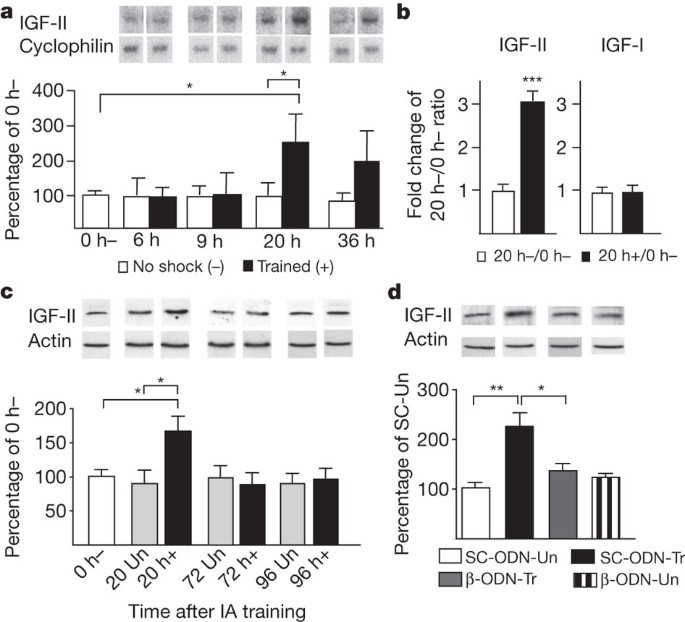
We report that, in the rat, administering insulin-like growth factor II (IGF-II, also known as IGF2) significantly enhances memory retention and prevents forgetting. Inhibitory avoidance learning leads to an increase in hippocampal expression of IGF-II, which requires the transcription factor CCAAT enhancer binding protein β and is essential for memory consolidation. Furthermore, injections of recombinant IGF-II into the hippocampus after either training or memory retrieval significantly enhance memory retention and prevent forgetting. To be effective, IGF-II needs to be administered within a sensitive period of memory consolidation. IGF-II-dependent memory enhancement requires IGF-II receptors, new protein synthesis, the function of activity-regulated cytoskeletal-associated protein and glycogen-synthase kinase 3 (GSK3). Moreover, it correlates with a significant activation of synaptic GSK3β and increased expression of GluR1 (also known as GRIA1) α-amino-3-hydroxy-5-methyl-4-isoxasolepropionic acid receptor subunits. In hippocampal slices, IGF-II promotes IGF-II receptor-dependent, persistent long-term potentiation after weak synaptic stimulation. Thus, IGF-II may represent a novel target for cognitive enhancement therapies.
This is a preview of subscription content, access via your institution
Subscribe to this journal
Receive 51 print issues and online access
£199.00 per year
only £3.90 per issue
Buy this article
Prices may be subject to local taxes which are calculated during checkout
In Supplementary Fig. 2 of this Article, the same western blot representative was inadvertently used for rows 1 and 3 of the left panel.
McGaugh, J. L. Memory–a century of consolidation. Science 287, 248–251 (2000)
Article ADS CAS Google Scholar
Alberini, C. M. Transcription factors in long-term memory and synaptic plasticity. Physiol. Rev. 89, 121–145 (2009)
Article CAS Google Scholar
Kandel, E. R. The molecular biology of memory storage: a dialog between genes and synapses. Biosci. Rep. 21, 565–611 (2001)
Article CAS Google Scholar
Silva, A. J., Kogan, J. H., Frankland, P. W. & Kida, S. CREB and memory. Annu. Rev. Neurosci. 21, 127–148 (1998)
Article CAS Google Scholar
Bailey, C. H. & Kandel, E. R. Structural changes accompanying memory storage. Annu. Rev. Physiol. 55, 397–426 (1993)
Article CAS Google Scholar
Kida, S. et al. CREB required for the stability of new and reactivated fear memories. Nature Neurosci. 5, 348–355 (2002)
Article CAS Google Scholar
Milekic, M. H., Pollonini, G. & Alberini, C. M. Temporal requirement of C/EBPβ in the amygdala following reactivation but not acquisition of inhibitory avoidance. Learn. Mem. 14, 504–511 (2007)
Article CAS Google Scholar
Nader, K., Schafe, G. E. & Le Doux, J. E. Fear memories require protein synthesis in the amygdala for reconsolidation after retrieval. Nature 406, 722–726 (2000)
Article ADS CAS Google Scholar
Shamblott, M. J., Leung, S., Greene, M. W. & Chen, T. T. Characterization of a teleost insulin-like growth factor II (IGF-II) gene: evidence for promoter CCAAT/enhancer-binding protein (C/EBP) sites, and the presence of hepatic C/EBP. Mol. Mar. Biol. Biotechnol. 7, 181–190 (1998)
CAS PubMed Google Scholar
Russo, V. C., Gluckman, P. D., Feldman, E. L. & Werther, G. A. The insulin-like growth factor system and its pleiotropic functions in brain. Endocr. Rev. 26, 916–943 (2005)
Article CAS Google Scholar
Hawkes, C. & Kar, S. The insulin-like growth factor-II/mannose-6-phosphate receptor: structure, distribution and function in the central nervous system. Brain Res. Brain Res. Rev. 44, 117–140 (2004)
Article CAS Google Scholar
Kitraki, E., Bozas, E., Philippidis, H. & Stylianopoulou, F. Aging-related changes in IGF-II and c-fos gene expression in the rat brain. Int. J. Dev. Neurosci. 11, 1–9 (1993)
Article CAS Google Scholar
Kar, S., Chabot, J. G. & Quirion, R. Quantitative autoradiographic localization of [125I]insulin-like growth factor I, [125I]insulin-like growth factor II, and [125I]insulin receptor binding sites in developing and adult rat brain. J. Comp. Neurol. 333, 375–397 (1993)
Article CAS Google Scholar
Taubenfeld, S. M. et al. Fornix-dependent induction of hippocampal CCAAT enhancer-binding protein β and δ co-localizes with phosphorylated cAMP response element-binding protein and accompanies long-term memory consolidation. J. Neurosci. 21, 84–91 (2001)
Article CAS Google Scholar
Taubenfeld, S. M., Milekic, M. H., Monti, B. & Alberini, C. M. The consolidation of new but not reactivated memory requires hippocampal C/EBPβ. Nature Neurosci. 4, 813–818 (2001)
Article CAS Google Scholar
Liang, K. C. et al. Post-training amygdaloid lesions impair retention of an inhibitory avoidance response. Behav. Brain Res. 4, 237–249 (1982)
Article CAS Google Scholar
Alberini, C. M. Mechanisms of memory stabilization: are consolidation and reconsolidation similar or distinct processes? Trends Neurosci. 28, 51–56 (2005)
Article CAS Google Scholar
Nader, K., Schafe, G. E. & LeDoux, J. E. The labile nature of consolidation theory. Nature Rev. Neurosci. 1, 216–219 (2000)
Article CAS Google Scholar
Eisenberg, M. & Dudai, Y. Reconsolidation of fresh, remote, and extinguished fear memory in medaka: old fears don’t die. Eur. J. Neurosci. 20, 3397–3403 (2004)
Article Google Scholar
Milekic, M. H. & Alberini, C. M. Temporally graded requirement for protein synthesis following memory reactivation. Neuron 36, 521–525 (2002)
Article CAS Google Scholar
Suzuki, A. et al. Memory reconsolidation and extinction have distinct temporal and biochemical signatures. J. Neurosci. 24, 4787–4795 (2004)
Article CAS Google Scholar
Litvin, O. O. & Anokhin, K. V. Mechanisms of memory reorganization during retrieval of acquired behavioral experience in chicks: the effects of protein synthesis inhibition in the brain. Neurosci. Behav. Physiol. 30, 671–678 (2000)
Article CAS Google Scholar
Debiec, J., LeDoux, J. E. & Nader, K. Cellular and systems reconsolidation in the hippocampus. Neuron 36, 527–538 (2002)
Article CAS Google Scholar
Nissley, S. P. & Rechler, M. M. Somatomedin/insulin-like growth factor tissue receptors. Clin. Endocrinol. Metab. 13, 43–67 (1984)
Article CAS Google Scholar
Bramham, C. R., Worley, P. F., Moore, M. J. & Guzowski, J. F. The immediate early gene Arc/Arg3. 1: regulation, mechanisms, and function. J. Neurosci. 28, 11760–11767 (2008)
Article CAS Google Scholar
Whitlock, J. R., Heynen, A. J., Shuler, M. G. & Bear, M. F. Learning induces long-term potentiation in the hippocampus. Science 313, 1093–1097 (2006)
Article ADS CAS Google Scholar
Slipczuk, L. et al. BDNF activates mTOR to regulate GluR1 expression required for memory formation. PLoS ONE 4, e6007 (2009)
Article ADS Google Scholar
Kessels, H. W. & Malinow, R. Synaptic AMPA receptor plasticity and behavior. Neuron 61, 340–350 (2009)
Article CAS Google Scholar
Wei, J., Liu, W. & Yan, Z. Regulation of AMPA receptor trafficking and function by glycogen synthase kinase 3. J. Biol. Chem. 285, 26369–26376 (2010)
Article CAS Google Scholar
Scalia, P. et al. Regulation of the Akt/glycogen synthase kinase-3 axis by insulin-like growth factor-II via activation of the human insulin receptor isoform-A. J. Cell. Biochem. 82, 610–618 (2001)
Article CAS Google Scholar
Dajani, R. et al. Crystal structure of glycogen synthase kinase 3β: structural basis for phosphate-primed substrate specificity and autoinhibition. Cell 105, 721–732 (2001)
Article CAS Google Scholar
Cooke, S. F. & Bliss, T. V. Plasticity in the human central nervous system. Brain 129, 1659–1673 (2006)
Article CAS Google Scholar
Alberini, C. M., Milekic, M. H. & Tronel, S. Mechanisms of memory stabilization and de-stabilization. Cell. Mol. Life Sci. 63, 999–1008 (2006)
Article CAS Google Scholar
Milner, B., Squire, L. R. & Kandel, E. R. Cognitive neuroscience and the study of memory. Neuron 20, 445–468 (1998)
Article CAS Google Scholar
Maviel, T., Durkin, T. P., Menzaghi, F. & Bontempi, B. Sites of neocortical reorganization critical for remote spatial memory. Science 305, 96–99 (2004)
Article ADS CAS Google Scholar
Nadel, L. & Land, C. Memory traces revisited. Nature Rev. Neurosci. 1, 209–212 (2000)
Article CAS Google Scholar
Garcia-Osta, A. et al. Musk expressed in the brain mediates cholinergic responses, synaptic plasticity, and memory formation. J. Neurosci. 26, 7919–7932 (2006)
Article CAS Google Scholar
Muravieva, E. V. & Alberini, C. M. Limited efficacy of propranolol on the reconsolidation of fear memories. Learn. Mem. 17, 306–313 (2010)
Article CAS Google Scholar
Tronel, S. & Alberini, C. M. Persistent disruption of a traumatic memory by postretrieval inactivation of glucocorticoid receptors in the amygdala. Biol. Psychiatry 62, 33–39 (2007)
Article CAS Google Scholar
Tsankova, N. M., Kumar, A. & Nestler, E. J. Histone modifications at gene promoter regions in rat hippocampus after acute and chronic electroconvulsive seizures. J. Neurosci. 24, 5603–5610 (2004)
Article CAS Google Scholar
Tsokas, P. et al. Local protein synthesis mediates a rapid increase in dendritic elongation factor 1A after induction of late long-term potentiation. J. Neurosci. 25, 5833–5843 (2005)
Article CAS Google Scholar
Elizalde, P. V. et al. Involvement of insulin-like growth factors-I and -II and their receptors in medroxyprogesterone acetate-induced growth of mouse mammary adenocarcinomas. J. Steroid Biochem. Mol. Biol. 67, 305–317 (1998)
Article CAS Google Scholar
Guzowski, J. F. et al. Inhibition of activity-dependent Arc protein expression in the rat hippocampus impairs the maintenance of long-term potentiation and the consolidation of long-term memory. J. Neurosci. 20, 3993–4001 (2000)
Article CAS Google Scholar
Pietrzkowski, Z. et al. Inhibition of cellular proliferation by peptide analogues of insulin-like growth factor 1. Cancer Res. 52, 6447–6451 (1992)
CAS PubMed Google Scholar
Quesada, A. & Micevych, P. E. Estrogen interacts with the IGF-1 system to protect nigrostriatal dopamine and maintain motoric behavior after 6-hydroxdopamine lesions. J. Neurosci. Res. 75, 107–116 (2004)
Article CAS Google Scholar
Milekic, M. H., Brown, S. D., Castellini, C. & Alberini, C. M. Persistent disruption of an established morphine conditioned place preference. J. Neurosci. 26, 3010–3020 (2006)
Article CAS Google Scholar
Xu, C. M. et al. Glycogen synthase kinase 3β in the nucleus accumbens core mediates cocaine-induced behavioral sensitization. J. Neurochem. 111, 1357–1368 (2009)
Article CAS Google Scholar
Elkobi, A. et al. ERK-dependent PSD-95 induction in the gustatory cortex is necessary for taste learning, but not retrieval. Nature Neurosci. 11, 1149–1151 (2008)
Article CAS Google Scholar
Lo, J. H. & Chen, T. T. CCAAT/enhancer binding protein β2 is involved in growth hormone-regulated insulin-like growth factor-II gene expression in the liver of rainbow trout (Oncorhynchus mykiss). Endocrinology 151, 2128–2139 (2001)
Article Google Scholar
van Dijk, M. A., Rodenburg, R. J., Holthuizen, P. & Sussenbach, J. S. The liver-specific promoter of the human insulin-like growth factor II gene is activated by CCAAT/enhancer binding protein (C/EBP). Nucleic Acids Res. 20, 3099–3104 (1992)
Article CAS Google Scholar
Download references
Acknowledgments This work was supported by grants R01-MH065635, R01-MH074736, NARSAD, the Hirschl Foundation and Philoctetes Foundation awarded to C.M.A., F31-MH816213 to D.Y.C., and T32-MH087004 to S.A.S.; R21-DA29298 and R01-GM054508 to R.D.B. We thank M. Baxter for assistance with statistical analyses. We thank J. Feng, J.-W. Koo and C.-Y. Lu for technical assistance. We thank A. Suzuki and A. Arguello for comments on the manuscript. We thank R. Miller and the Center for Comparative Medicine and Surgery Facility at Mount Sinai School of Medicine for technical support.
Ana Garcia-Osta
Present address: Present address: CIMA, University of Navarra, CIBERNED, Pamplona 31008, Spain.,
Department of Neuroscience, Mount Sinai School of Medicine, New York, 10029, New York, USA
Dillon Y. Chen, Sarah A. Stern, Ana Garcia-Osta, Gabriella Pollonini, Dhananjay Bambah-Mukku & Cristina M. Alberini
Department of Pharmacology and Systems Therapeutics, Mount Sinai School of Medicine, New York, 10029, New York, USA
Bernadette Saunier-Rebori & Robert D. Blitzer
Department of Psychiatry, Mount Sinai School of Medicine, New York, 10029, New York, USA
Robert D. Blitzer & Cristina M. Alberini
You can also search for this author in PubMed Google Scholar
You can also search for this author in PubMed Google Scholar
You can also search for this author in PubMed Google Scholar
You can also search for this author in PubMed Google Scholar
You can also search for this author in PubMed Google Scholar
You can also search for this author in PubMed Google Scholar
You can also search for this author in PubMed Google Scholar
You can also search for this author in PubMed Google Scholar
D.Y.C., A.G.-O. and C.M.A. designed and developed this study. D.Y.C., S.A.S. and A.G.-O. carried out the behavioural studies. D.Y.C., A.G.-O., G.P. and D.B.-M. carried out the biochemical studies and analyses. R.D.B. and B.S.-R. designed and conducted the electrophysiology experiments. D.Y.C. and C.M.A. wrote the manuscript.
Correspondence to Cristina M. Alberini.
Patent pending on IGF-II as a strategy to enhance memory.
The file contains Supplementary Figures 1-12 with legends and Supplementary Tables 1-6. This file was replaced on 17 October 2011. (PDF 612 kb)
Reprints and permissions
Chen, D., Stern, S., Garcia-Osta, A. et al. A critical role for IGF-II in memory consolidation and enhancement. Nature 469, 491–497 (2011). https://doi.org/10.1038/nature09667
Download citation
Received:
Accepted:
Published:
Issue Date:
DOI: https://doi.org/10.1038/nature09667
Anyone you share the following link with will be able to read this content:
Sorry, a shareable link is not currently available for this article.
Provided by the Springer Nature SharedIt content-sharing initiative
An understanding of the mechanisms of memory enhancement is vital for broadening our knowledge of memory processes, as well as for potential clinical applications. Yet very little is known about it. Experiments in rats now show that the administration of insulin-like growth factor II (IGF-II), a protein typically implicated in somatic tissue growth and repair, significantly enhances memory retention, promotes the memory proxy known as long-term potentiation and prevents forgetting. IGF-II acts by initiating a network of signalling cascades that can lead to synaptic potentiation and are most effective within a short time frame immediately following learning. IGF-II is therefore a potential target for modulating cognitive enhancement.
Advertisement
© 2025 Springer Nature Limited
Sign up for the Nature Briefing newsletter — what matters in science, free to your inbox daily.
About The Author

More Stories
Community-Centered Connectivity Initiatives Earn Viddy Awards Recognition
Zombie IXPs: The Four Types of Exchanges That Refuse to Die, but Fail to Live
The Shift in Peering Threatening the Internet’s Foundations