
February 5, 2025
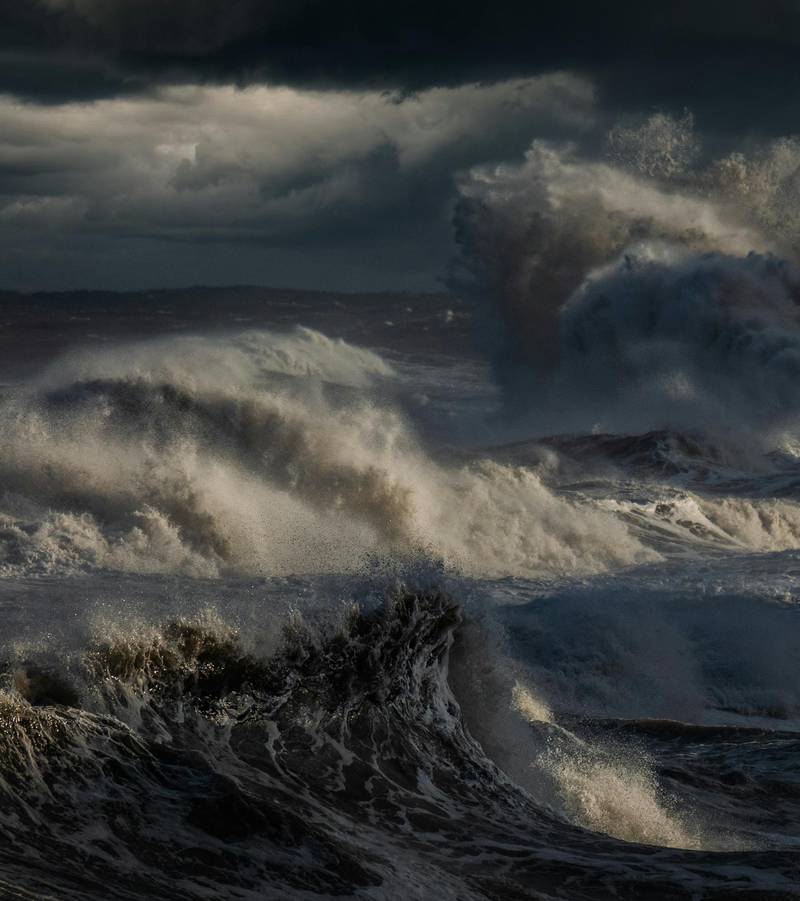
(Credit: Ray Bilcliff)
Scientists from the University College London (UCL), the National Oceanography Centre (NOC), and the École Normale Supérieure (ENS) Paris-Saclay have joined forces to shed more light on the role of coastal wave breaking in global climate modeling.
Under the WAVECLIM project, scientists from UCL, NOC and ENS will use novel observations of coastal wave breaking, advanced modeling, and machine learning to determine the importance of the coastal wave breaking, deemed notoriously complex and challenging-to-measure phenomenon.
Specifically, the WAVECLIM project will look to fill a gap in understanding the role these often dramatic coastal processes play in global climate modeling.
The project will use advanced sensor technology and machine learning to capture and integrate coastal wave-breaking dynamics into predictive models. State-of-the-art monitoring equipment, including LIDAR, drones, and stereoscopic cameras, will be deployed to provide unprecedented data on coastal wave breaking under diverse conditions.
Machine learning models trained on these observations will be integrated into climate models, addressing biases and enhancing the accuracy of future climate predictions.
Through this collaboration, the partners aim to address critical knowledge gaps, paving the way for improved representation of coastal seas complexities in the next generation of climate models.
The innovative project is one of the first opportunity seeds in the UK's Advanced Research and Invention Agency's (ARIA) Scoping Our Planet opportunity space, announced in October 2024. ARIA’s seed funding supports ambitious research that can challenge assumptions, open up new research paths, and provide steps toward new capabilities.
UC San Diego’s Scripps Institution of Oceanography issued a request for proposals (RFP) to select a shipyard for the final…
As directed by the President, the US Department of Interior (DOI) has announced that Gulf of Mexico (GoM) will officially…
An undersea fibre optic cable between Latvia and Sweden was damaged on Sunday, likely as a result of external influence, Latvia said…
This week at Marine Technology News…The quantum economy is not just a distant dream – it's unfolding right now, offering…
Australia has a reputation for naming animals based on their color: the red belly black snake, the red necked wallaby. More…
This week at Marine Technology News…One of the earliest documented examples of biomimicry is attributed to Leonardo da…
Marine Technology Reporter is the world’s largest audited subsea industry publication serving the offshore energy, subsea defense and scientific communities.
Marine Technology ENews is the subsea industry’s largest circulation and most authoritative ENews Service, delivered to your Email three times per week
Subscribe for MTR E-news
About The Author


More Stories
Anatomy of a Scam
Climate and Environmental Sustainability Within the IETF and IRTF
From Commitments to Practice: Internet Society’s Priorities for WSIS+20 Implementation