
Sustainability and climate issues can only be understood and resolved through interdisciplinary collaboration across various disciplines. Technological solutions are system-oriented, necessitating extensive collaboration between stakeholders from academia and society. As a result, it is critical that engineering students gain experience and knowledge of cross-disciplinary collaboration. However, interdisciplinary collaboration across disciplinary boundaries is extremely difficult.
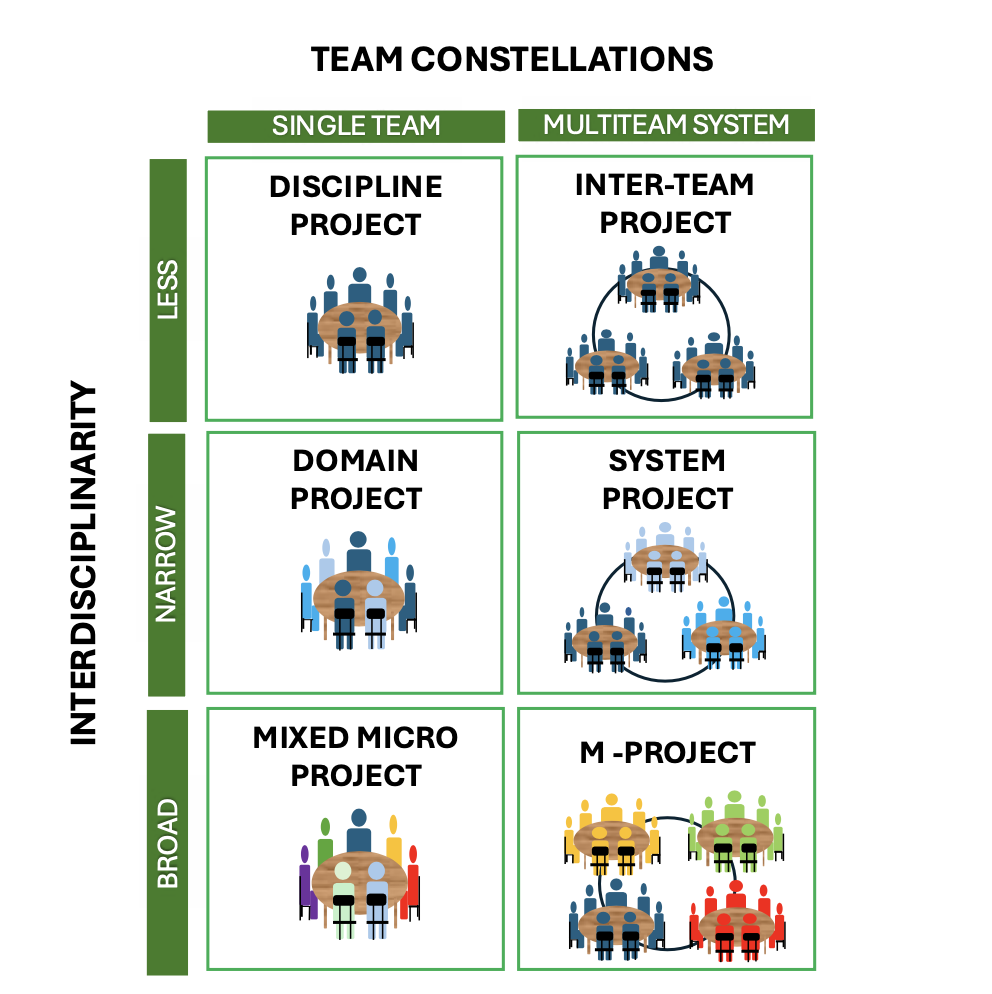
InterPBL, a research project at Aalborg University funded by the Grundfos Foundation, seeks to improve interdisciplinary collaboration in engineering education. In the InterPBL project, we discovered that the approach to interdisciplinary projects was overly simplistic due to a lack of understanding of the various forms that interdisciplinary projects can take. A framework was created based on empirical data, with six categories of disciplinary and interdisciplinary problem-based projects. These are defined by two dimensions: the type of knowledge, which ranges from disciplines to narrow and broad interdisciplinary problems. Figure 1 illustrates the project collaboration pattern, which ranges from single project teams to multi-teams with multiple student teams working together.
This framework indicates different project constellations; however, the interdisciplinary collaboration is much more varied in practice. The main contribution is that we distinguish between narrow and broad interdisciplinary approaches, as greater distance between disciplines creates more challenges in understanding scientific knowledge, not to mention cultural and pedagogical differences.
Our data, gathered through interdisciplinary system projects, has taught us that there is a story that needs to be retold. Interdisciplinary collaboration does not imply that you lack disciplinary knowledge. On the contrary, interdisciplinary collaboration allows for a better understanding of one’s own field (Routhe et al., 2023). Therefore, the students gain and do NOT lose disciplinary knowledge. They learn about the limitations and opportunities for knowledge collaboration.
We also learned that in the multi-team system projects, it was not enough to apply project management tools. To frame and enhance progression in system projects, students must develop common visions, knowledge bases, and approaches to learning. The students advanced from using project management tools to leadership (Routhe et al., 2024).
Understanding the factors influencing collaboration is essential for both narrow and broad interdisciplinary collaboration. Academics must understand what factors to consider when designing and facilitating interdisciplinary projects. As a result, the InterPBL project focused on discipline understanding. We identified three major dimensions in the literature: knowledge, learning, and culture. This made sense based on our findings, as different students and student project teams approached problems and project organization in different ways. Students learn to collaborate in a variety of ways across disciplines, including understanding what a problem is and structuring project phases. We discovered that generic skills and competencies are contextually understood and that collaborative skills, for example, must be reflected and adjusted during any transition from a disciplinary to an interdisciplinary project.
Generic skills/competencies are essential for interdisciplinary teams, and they are typically taught in the engineering curriculum to supplement disciplinary learning. However, in interdisciplinary projects, disciplinary knowledge serves as a means of learning generic skills and competencies. Depending on the learning objectives, the designs of interdisciplinary projects are very different, and hopefully these models can help in the planning phase.
License: CC BY-NC-ND 4.0
This work is licensed under Creative Commons Attribution-NonCommercial-NoDerivatives 4.0 International.
What does this mean?
Share – Copy and redistribute the material in any medium or format.
The licensor cannot revoke these freedoms as long as you follow the license terms.
Academic articles from a similar field of interest
Open Access Government produces compelling and informative news, publications, eBooks, and academic research articles for the public and private sector looking at health, diseases & conditions, workplace, research & innovation, digital transformation, government policy, environment, agriculture, energy, transport and more.
As a Crossref Sponsored Member we are able to connect your content with a global network of online scholarly research, currently over 20,000 other organizational members from 160 countries. Crossref drive metadata exchange and support nearly 2 billion monthly API queries, facilitating global research communication.
© Adjacent Digital Politics Ltd
About The Author



More Stories
Closing AI’s Language Gap: Why the Internet Society Is Joining a Global Commitment
What Happens When a Community Wires Itself: Lessons from Colville on the Power of Indigenous-Led Connectivity
From Curiosity to Confidence: CodificaKids Builds Digital Trust in Rural Brazil