
Thank you for visiting nature.com. You are using a browser version with limited support for CSS. To obtain the best experience, we recommend you use a more up to date browser (or turn off compatibility mode in Internet Explorer). In the meantime, to ensure continued support, we are displaying the site without styles and JavaScript.
Advertisement
You can also search for this author in PubMed Google Scholar
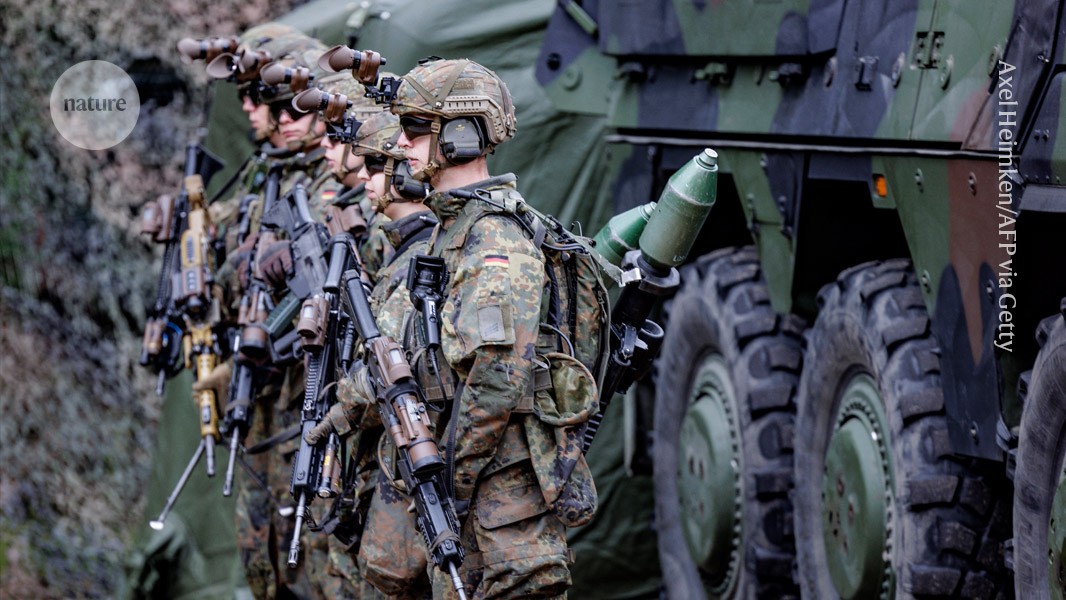
The German military received an extra €100 billion of investment after Russia invaded Ukraine in 2022. Credit: Axel Heimken/AFP via Getty
A drive to increase university participation in military research is gaining pace across Europe — and meeting resistance.
The European Commission is proposing ways to boost dual-use research — that with both civilian and military uses — including by bringing such studies into its flagship multibillion-euro research programme, from which they have historically been excluded. In Germany, the government is encouraging institutions to overturn decades-old policies that restrict research to peaceful purposes.
“There is a lot of pressure at the moment on research institutions and universities to change their long tradition in peaceful and civilian research, towards a more politically oriented policy,” says Hannes Jung, a particle physicist at the German Electron Synchrotron (DESY) in Hamburg and a member of the Science4Peace Forum, which campaigns to use science to promote peace. “I find that extremely worrying.”

The UK’s $1-billion bet to create technologies that change the world
The UK’s $1-billion bet to create technologies that change the world
The push comes amid increasing militarization of European research, which began after Russia’s incursions into Ukraine in 2014 and ramped up following the full-scale invasion in 2022. Boosting dual-use research is part of the European Union’s response to a “more threatening geopolitical context”, commission president Ursula von der Leyen has said.
Unlike after the Second World War, when government-backed military laboratories were major research hubs that often spun out civilian applications, today the military must “spin in” innovation from universities and industry, says James Black, who studies defence policy at RAND Europe, a research consultancy in Cambridge, UK.
The EU is in a different situation from the United States and China, which spend vastly more on military research and where academia and defence typically have closer ties. In China, researchers are often incentivized to engage with the military, says Fiona Quimbre, a senior analyst at RAND. Chinese military and academic centres are often located together, and many of their leaders have spent time working in both domains, she says. “The networks they’ve created are something that takes years to gain,” she says.
Meanwhile, Japan — which since the Second World War has been a pacifist nation — has over the past decade begun investing in research with possible military applications.

What Japan’s election means for controversial defence research
What Japan’s election means for controversial defence research
How involved European universities are in defence varies. Some institutions in western Europe have long-standing defence ties, but connections are more common in nations with a history of being invaded, for example in eastern Europe, as well as Nordic nations. Other nations have avoided such work.
The push to increase military research comes amid rising defence spending by EU countries. Investment grew by 10% from 2022 to 2023, to €279 billion (US$287 billion,) according to the European Defence Agency. Spending on research by the European Defence Fund (EDF), the EU’s main funder of military research and development, will rise to €2.7 billion for the 2021–27 period.
But the EDF has struggled with academic engagement. The bulk of its funding awards go to semi-governmental research, technology organizations, large defence industries and smaller companies.
Some researchers might ethically object to doing military research, but many don’t engage because of a lack of access or incentive, says Black. Military research can restrict collaboration and prevent publication, and there might be only a small market for products.
Now, the European Commission’s new commissioners, who began their terms in December, will explore how the bloc might better harness the potential of dual-use research, says a commission spokesperson.
A white paper published last year proposed introducing dual-use research into the EU’s main civilian-research programme1, potentially in the next ‘framework programme’ known as FP10, which begins in 2028. Universities largely rejected this idea during consultation. Instead, academic groups preferred one of the commission’s alternative suggestions, to improve existing separate civilian- and military-funding schemes.
Merging the streams in the framework programme risks increasing bureaucracy and reducing international cooperation and resources for civilian research, says Walter Rosenthal, president of the Bonn-based German Rectors’ Conference, an association of 269 universities.
DESY, Germany’s largest particle-physics lab, is consulting staff on whether dual-use research can be conducted at its facilities.Credit: Patrick Pleul/dpa via Alamy
or
doi: https://doi.org/10.1038/d41586-025-00117-z
European Commission. Report No. COM(2024) 27 final (European Commission, 2024).
Download references
Reprints and permissions
 Far-right governments seek to cut billions of euros from research in Europe
 A science mega-programme is taking shape in the EU: what it means for researchers
 How climate change is hitting Europe: three graphics reveal health impacts
 The UK’s $1-billion bet to create technologies that change the world
 Will war in Ukraine mark a new era for European defence research?
 What Japan’s election means for controversial defence research
Menopause research is globally underfunded. It’s time to change that
Editorial
Faced with funding cuts, collaborate to define research priorities
Correspondence
How often do unexpected scientific discoveries occur? More often than you might think
News
What Trump’s flurry of executive orders means for science
News
Trump’s science advisers: how they could influence his second presidency
News
Trump will weaken climate action — the rest of the US must not follow suit
World View
Regional and institutional trends in assessment for academic promotion
Article
Faced with funding cuts, collaborate to define research priorities
Correspondence
How I use data to highlight complex and overlooked work in health-care systems
Career Q&A
Assistant or Associate on Term Professor (Tenure-Track) Yale Center for Molecular and Systems Metabolism Yale University School of Medicine The Yal…
New Haven, Connecticut
Yale Medical School
UNIL (University of Lausanne) is a leading international teaching and research institution, with over 5,000 employees and 15,500 students spread ac…
Lausanne, Canton of Vaud (CH)
University of Lausanne (UNIL)
APPLICATION CLOSING DATE: February 9th, 2025 Human Technopole (HT) is an interdisciplinary life science research institute, created and supported …
Milan (IT)
Human Technopole
Bringing Global Minds, Shaping TJU’s Timeless Tides.
Tianjin (Province), China
Tianjin University (TJU)
New York City, New York (US)
NYU Grossman School of Medicine
Far-right governments seek to cut billions of euros from research in Europe
A science mega-programme is taking shape in the EU: what it means for researchers
How climate change is hitting Europe: three graphics reveal health impacts
The UK’s $1-billion bet to create technologies that change the world
Will war in Ukraine mark a new era for European defence research?
What Japan’s election means for controversial defence research
An essential round-up of science news, opinion and analysis, delivered to your inbox every weekday.
Sign up for the Nature Briefing newsletter — what matters in science, free to your inbox daily.
© 2025 Springer Nature Limited
About The Author



More Stories
Global Encryption Day Summit 2026: Five Key Conversations on the Future of Digital Trust
What Global Data Tells Us About the Economics of IXPs
We Shouldn’t Have to Give Up Our Safety Online to Be Safe