
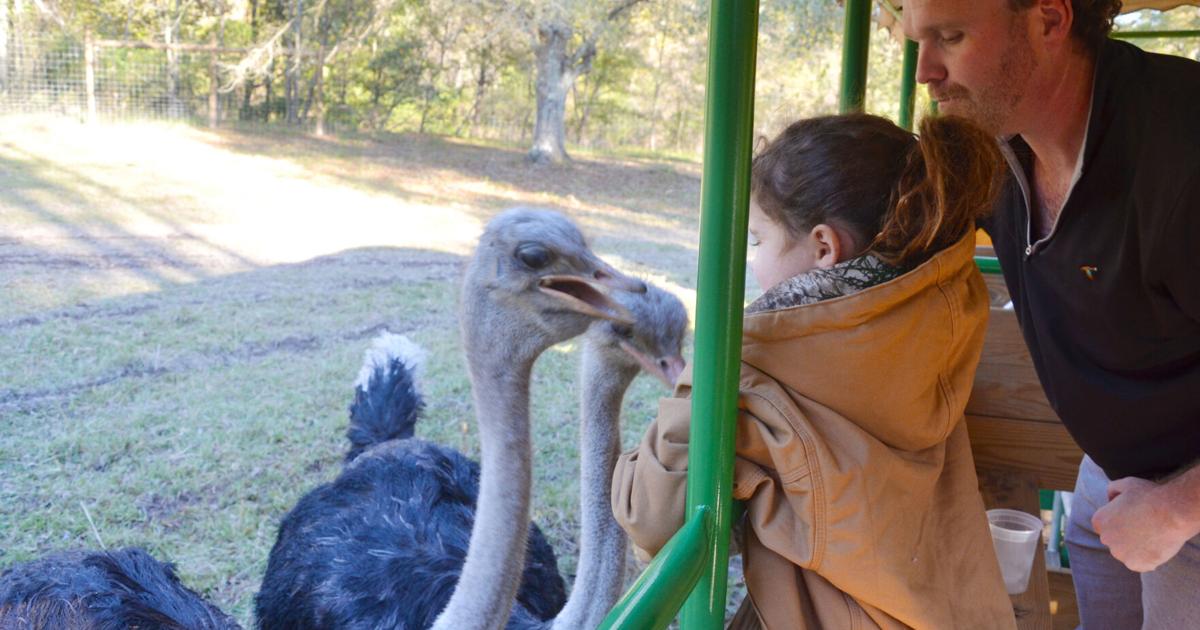
Gabe Ligon and his daughter, Molly, feed the ostriches drawn to the Magnolia Wild Safari tram driving through the facility Friday, Dec. 6, 2024.
A range of animals native to the African Plains gather Friday, Dec. 6, 2024, along the Comite River on the grounds of Magnolia Wilds Safari. These species include ostriches, Watusi cattle, zebras and wildebeests.
A marabou stork leads the pack as Magnolia Wilds Safari animals follow a passenger tram away from their gathering area.
Two marabou storks play tug-of-war over a rat Friday, Dec. 6, 2024, during feeding time at Magnolia Wilds Safari.
For more than a decade, Clyde the camel welcomed visitors to the Barn Hill Preserve in East Feliciana Parish. Clyde earns a snack Friday, Dec. 6, 2024, in his new home at Magnolia Wilds Safari just right down the road from its sister facility.
An African Crown Crane, one of a couple living at Magnolia Wilds, puts on a show for visitors Friday, Dec. 6, 2024.
An emu vies for snacks Friday, Dec. 6, 2024, at Magnolia Wilds Safari. The emu, the largest bird native to Australia, occupies a different habitat from the ostriches who are also large flightless birds, but native to Africa.
Magnolia Wilds Animal Director Hunter Osbourne and Safari Property Manager Abraham ‘Ab’ Gonzalez offer fresh rats during a feeding of marabou storks at Magnolia Wilds Safari.
Molly Ligon displays her knowledge of the hatching process of emu eggs Friday, Dec. 6, 2024, in his new home at Magnolia Wilds Safari. The eggs laid at the safari are placed in an incubator to help the survival of the birds native to the Australian climate.
A friendly alpaca approaches a tram Friday, Dec. 6, 2024, at Magnolia Wilds Safari.
Safari Property Manager Abraham ‘Ab’ Gonzalez shows the miles of protective fencing Friday, Dec. 6, 2024, that protects the animals living at Magnolia Wilds Safari. Gonzalez, over the last three years, built and oversaw the massive fencing project.
Barn Hill Preserve CEO and Safari founder Gabe Ligon explains his plan Friday, Dec. 6, 2024, to put a primate exhibit on an island located at the East Feliciana Parish facility.
A member of the Watusi cattle herd grazes Friday, Dec. 6, 2024, near the Comite River on the grounds of Magnolia Wilds Safari. The long-horned cattle are native to the African Plains.
A member of the zebra herd mingles Friday, Dec. 6, 2024, near the Comite River on the grounds of Magnolia Wilds Safari. The zebra is one of many species at the safari native to the African Plains.
Gabe Ligon and his daughter, Molly, feed the ostriches drawn to the Magnolia Wild Safari tram driving through the facility Friday, Dec. 6, 2024.
A range of animals native to the African Plains gather Friday, Dec. 6, 2024, along the Comite River on the grounds of Magnolia Wilds Safari. These species include ostriches, Watusi cattle, zebras and wildebeests.
A marabou stork leads the pack as Magnolia Wilds Safari animals follow a passenger tram away from their gathering area.
Two marabou storks play tug-of-war over a rat Friday, Dec. 6, 2024, during feeding time at Magnolia Wilds Safari.
For more than a decade, Clyde the camel welcomed visitors to the Barn Hill Preserve in East Feliciana Parish. Clyde earns a snack Friday, Dec. 6, 2024, in his new home at Magnolia Wilds Safari just right down the road from its sister facility.
An African Crown Crane, one of a couple living at Magnolia Wilds, puts on a show for visitors Friday, Dec. 6, 2024.
An emu vies for snacks Friday, Dec. 6, 2024, at Magnolia Wilds Safari. The emu, the largest bird native to Australia, occupies a different habitat from the ostriches who are also large flightless birds, but native to Africa.
Magnolia Wilds Animal Director Hunter Osbourne and Safari Property Manager Abraham ‘Ab’ Gonzalez offer fresh rats during a feeding of marabou storks at Magnolia Wilds Safari.
Molly Ligon displays her knowledge of the hatching process of emu eggs Friday, Dec. 6, 2024, in his new home at Magnolia Wilds Safari. The eggs laid at the safari are placed in an incubator to help the survival of the birds native to the Australian climate.
A friendly alpaca approaches a tram Friday, Dec. 6, 2024, at Magnolia Wilds Safari.
Safari Property Manager Abraham ‘Ab’ Gonzalez shows the miles of protective fencing Friday, Dec. 6, 2024, that protects the animals living at Magnolia Wilds Safari. Gonzalez, over the last three years, built and oversaw the massive fencing project.
Barn Hill Preserve CEO and Safari founder Gabe Ligon explains his plan Friday, Dec. 6, 2024, to put a primate exhibit on an island located at the East Feliciana Parish facility.
A member of the Watusi cattle herd grazes Friday, Dec. 6, 2024, near the Comite River on the grounds of Magnolia Wilds Safari. The long-horned cattle are native to the African Plains.
A member of the zebra herd mingles Friday, Dec. 6, 2024, near the Comite River on the grounds of Magnolia Wilds Safari. The zebra is one of many species at the safari native to the African Plains.
A bridge capable of joining the wonders of distant continents now exists in the heart of the Felicianas where a short journey offers species native to Africa, Australia and the Americas in one home near the banks of the Comite River.
Gabe Ligon, the animal enthusiast and conservationist who brought the area Barn Hill Animal Preserve more than a decade ago, has recently expanded the glimpse into the animal world to a new vision that includes a giraffe, zebras, emus, wildebeest and Clyde the camel in an up-close-and-personal safari tour.
Ligon’s East Feliciana operation already includes a 98-acre animal preserve and ziplining at nearby Magnolia Ridge Adventure Park. The safari park has been in development for three years and opened its doors for a soft launch in October. Next, Ligon plans a rebranding of all three attractions under the name Magnolia Wilds.
Magnolia Wilds Safari encompasses about 60 acres on the Comite River in East Feliciana Parish, Ligon said. It’s a mixture of grasslands and native trees, and the focus isn’t just on animal conservation.
“We try to eradicate as many invasive trees and species as we can,” he said. “That includes the fire ants and the tallow tree. And we have a mixture of species that eat both grass and leaves from trees.”
Visitors to the safari will be greeted by more than 100 animals representing more than 20 domestic and wild species. “Our domestic species are animals that cannot survive in the wild without human care,” Ligon said. “And some of the wild species like the Neoga — a species of Antelope — living here have actually escaped from hunting ranches in Texas and actually live out in the wild in the U.S. now.
Visitors loading up on the facility tram will immediately see a mix of farm and wild species co-existing. The Scottish Highlander cows, a current viral craze, are productive, docile cows that also happen to have long coats.
The journey allows visitors to experience animals native to specific parts of the world interacting and those who will find themselves at home anywhere food and friends mix. Two marabou storks often make a grand feeding display fighting over a freshly killed rat.
“They’re known as the Grim Reaper Bird, and they follow around dead or dying animals to eat carcasses,” Ligon said. “They have evolved to have light or no feathers on their head so they can stick their head into the carcass.”
The drive continues through some thicker brush and opens to a wide plain of African species including zebras, wildebeests and the grand Watusi cattle with large, impressive horns. On a recent visit, reminiscent of the “Circle of Life” scene from the Lion King, one herd of many species surround the tram in a breathtaking display.
Conservation of the land and the creatures who inhabit it is pushed to the forefront as Ligon explained the labor of love need to restore the area damaged in the 2016 floods. The Comite riverbank is a recipient of the care and effort to reduce invasive species. The wall of almost four miles of fencing protects the animals and the land as it keeps out predators.
Guided tours continue the earlier mission of Barn Hill Preserve to educate school children about the animal kingdom and foster both appreciation and animal conservation.
The crew has grown to about 20 full and part-time employees across the three sister properties.
“We’ve really evolved over the years, and we hope to do it anymore and bring people cool opportunities,” Ligon said. “This safari park is only $19 so it’s something everyone will be able to afford. And we even have a membership program now where families can come and just a nice outdoor activity to do with the kids all year round.”
{{description}}
Email notifications are only sent once a day, and only if there are new matching items.
News Tips:
newstips@theadvocate.com
Other questions:
subscriberservices@theadvocate.com
Need help?
Your browser is out of date and potentially vulnerable to security risks.
We recommend switching to one of the following browsers:
About The Author

More Stories
The EU KIDS Act Should Make Services Safer, Not Create an Internet Badge
Community Snapshot—September
Why Internet Infrastructure Decisions Rarely Stay Localized