
As the archaeological discoveries at Kansala, located in present-day Guinea-Bissau, reveal the tangible remnants of the once-mighty Kaabu Kingdom, the echoes of griots’ songs remind us that the rich tapestry of oral tradition holds the key to understanding a history that has long been shrouded in mystery.
The captivating history of the West African kingdom of Kaabu, which flourished from the mid-1500s to the 1800s, has long been woven into the fabric of oral tradition, where griots—skilled storytellers—have kept alive the tales of its rulers and the kingdom’s remarkable legacy, awaiting the day when archaeology would unveil the truths behind these age-old narratives. This kingdom, at its zenith, encompassed regions that are now part of Guinea-Bissau, Senegal, and Gambia.
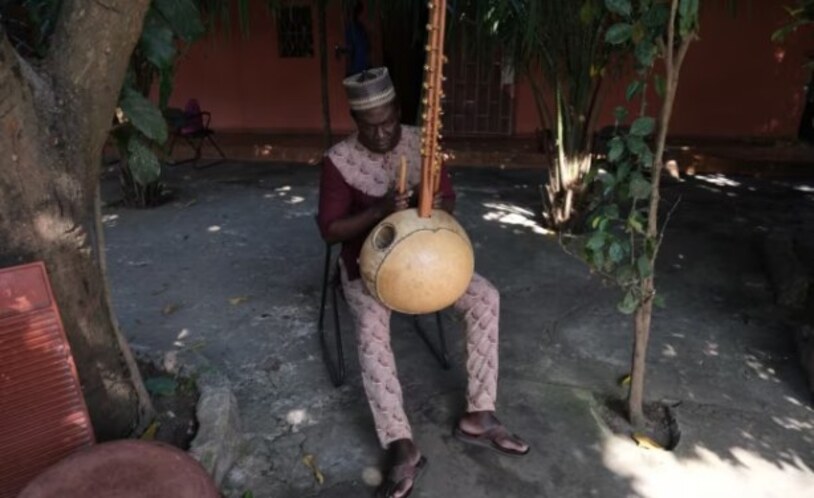
The stories of Kaabu were often passed down from generation to generation, sometimes from father to son, but more frequently through griots—West African oral historians renowned for their songs about the kingdom’s rulers. Nino Galissa, a musician and direct descendant of the griots who once performed for Kaabu’s last emperor, encapsulates this connection in a recent song inspired by archaeological discoveries at Kansala, the former capital of the kingdom.
“The griots have already sung it, but now we know it’s real,” Galissa reflects, highlighting the significance of the archaeological findings. These discoveries were part of a project led by the Spanish National Research Council, with Galissa’s song serving as a bridge between the past and present, effectively communicating the findings to the local community.
In Kansala, griots have historically played a crucial role in imparting history, often accompanied by the kora, a string instrument that resembles both a harp and a guitar. Antonio Queba Banjai, a descendant of Kaabu’s last emperors and president of the NGO Guinea-Lanta, emphasizes the importance of griots in African history. “They are the puzzle you cannot miss,” he states, underscoring how their narratives have shaped the understanding of his heritage.
The archaeological team recognized the need to integrate oral history into their research, marking this as the largest archaeological dig ever conducted in Guinea-Bissau. Sirio Canos-Donnay, a leading researcher, expressed hope that this collaboration would demonstrate the value of local historical narratives alongside academic approaches. “We should respect local ways of producing and consuming history,” she noted, emphasizing the extraordinary insights that can arise from such interdisciplinary dialogue.
The excavation not only validated many events chronicled by griots but also revealed significant aspects of Kaabu’s history, including its dramatic downfall in the 1860s. According to legend, during a siege, the local king ignited a gunpowder store, leading to the destruction of the town. This event was corroborated by the archaeological evidence found at the site.
Additionally, the dig uncovered artifacts indicating extensive trade with Europeans, such as Venetian beads and Dutch gin, further enriching the historical narrative of Kaabu. Joao Paulo Pinto, former director of Guinea-Bissau’s National Institute of Study and Research, advocates for the recognition of West African oral history as a legitimate form of historical documentation, comparable to written records.
Banjai hopes that this project will shed light on the often-overlooked histories of West African kingdoms, ensuring that future generations appreciate their rich heritage. Through the fusion of archaeology and oral tradition, the story of Kaabu continues to resonate, bridging the past with the present.
Cover Image Credit: Nino Galissa, a seventh-generation griot – or oral historian – composed the musical version of the Kansala 2024 excavation report. Here, he plays a traditional instrument known as a kora at his home in Bissau, Guinea-Bissau. Credit: Ricci Shryock/VOA
21 August 2021
A study of pigments used in murals in the Cueva Ardales caves in southern Spain has revealed that Neanderthals, long…
4 January 2023
A skeleton chained with iron rings was discovered at Khirbat el-Masani, about four kilometers northwest of Jerusalem, along the ancient…
4 February 2022
A cultural heritage protection team has recently discovered a stone-arched tunnel located near an Achaemenid embankment dam in southern Iran….
2 June 2021
While investigating the origins of agriculture, researchers made an unexpected discovery. According to an unexpected finding made by an Iowa…
28 December 2021
In the 29th season of the excavations in Çatalhöyük, one of the first urbanization models in Anatolia, in the Çumra…
15 March 2023
In the ancient city of Sagalassos in southwestern Türkiye, archaeologists have identified an unusual burial practice from the early Roman…
25 December 2022
Polish archaeologists excavating the Theban Necropolis in Egypt discovered nine crocodile heads hidden inside two tombs belonging to high-ranking nobles….
27 August 2021
According to a study released this week, archaeologists uncovered the bones of a 7,200-year-old skeleton from a female hunter-gatherer in…
14 April 2024
Something novel has been discovered by Polish archaeologists working on the excavation of the Church of St. Francis of Assisi…
13 December 2023
Archaeologists discovered mosaics believed to be from the Roman era during a rescue excavation undertaken in a rural expanse in…
2 March 2024
Archaeologists excavating a house adjacent to the House of Leda in Insula 6, Regio V, in the ancient Roman city…
4 August 2022
Pit-bottomed structures dating to the Pre-Pottery Neolithic period were found at Gre Fılla Höyük (Gre Fılla Mound) in the province…
20 April 2022
During the demolition work of the buildings in front of the historical city walls for the City Square National Garden…
19 June 2023
The conservation process of the Yenikapı shipwrecks, which were discovered during the Marmaray project and considered the largest collection of…
12 October 2021
A Bronze Age sword dating back as far as 1700 B.C.was discovered broken in items in Finland this previous summer…
Your email address will not be published.
©️Copyright 2020 – 2024 Arkeonews | All Right Reserved
About The Author


More Stories
New ITU Report Finds Community Networks Are Key to Reaching the Unconnected
Digital Coercion: How Inaccessible Design Strips Financial Privacy
The Need to Reimagine the WSIS Forum