
Thank you for visiting nature.com. You are using a browser version with limited support for CSS. To obtain the best experience, we recommend you use a more up to date browser (or turn off compatibility mode in Internet Explorer). In the meantime, to ensure continued support, we are displaying the site without styles and JavaScript.
Advertisement
You can also search for this author in PubMed Google Scholar
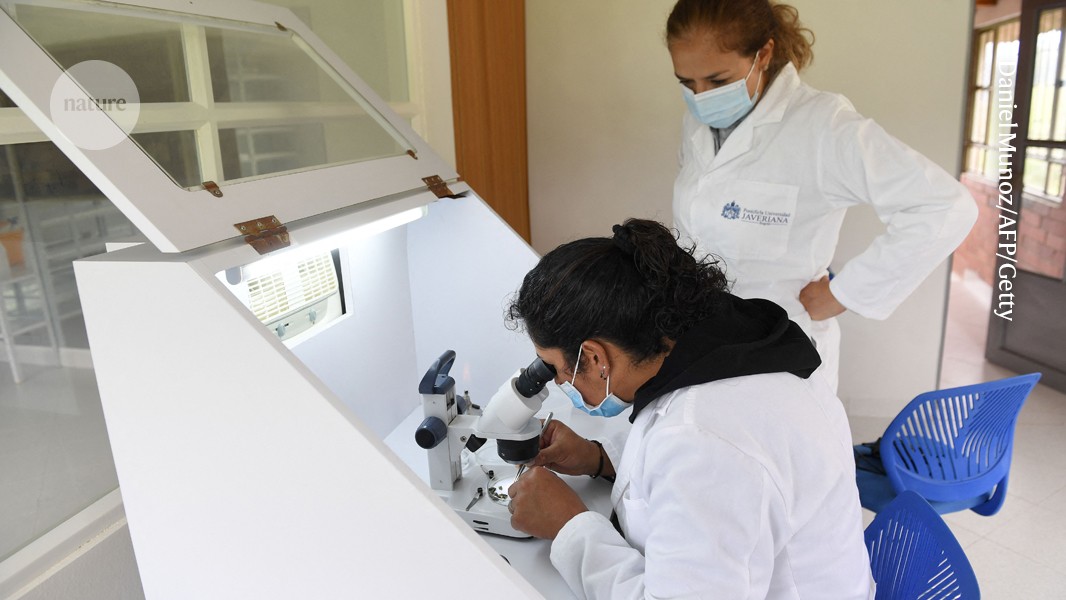
Researchers who get their start in small groups are more likely to stick with academia than those trained in large groups, analysis shows. Credit: Daniel Munoz/AFP/Getty
Postdoctoral students, graduate students and other junior scientists in large research groups are more likely to drop out of academia than are their peers in smaller groups, according to a new study of more than one million early-career researchers.
But the analysis also found that researchers trained in large groups who stay in academia have more career success. The work was published Monday in Nature Human Behaviour, amid a mass exodus of scientists from academia and a mental-health crisis among PhD students.
The findings are consistent with past anecdotal studies and survey results, but this is the first attempt to quantify the effects of different types of scientific mentorship, says co-author Roberta Sinatra, a social-data scientist at the University of Copenhagen.
“I hope that this helps guide the choices of PhD students,” she says.
Sinatra and her team analysed academic mentorship networks using two data sets: the crowd-sourced website Academic Family Tree, which includes global records of scientists, their advisers and their students in more than 50 academic fields, and the online research catalog OpenAlex, which features records of authors and their papers, institutions and citations. Their final data set included about 1.5 million scientists and 1.8 million mentorships in chemistry, physics and neuroscience. These fields had enough long-term data for the authors’ analysis and are heavily represented in the family-tree website.
The results showed that the percentage of researchers who remain in science for at least ten years is lower for those who were trained in big groups than for those who were trained in small groups (see ‘Survival advantage’). Between the 1980s and 1995, for example, the “survival rate” of big-group protégés was 38–48% lower than that of their small-group counterparts.
However, the big-group scientists publish papers that score higher on an index measuring average citations per year, and are more likely to be ranked among the most-cited scientists.
Source: Ref. 1
To understand why some big-group protégés succeed, the study’s authors examined papers on which a protégé was the first author and their mentor was the last author ― which suggests that the trainee had received substantial attention from their mentor. Big-group scientists who survived in academia had published “notably” more of these first-author papers than had the dropouts, the paper says.
“Now we also have quantitative evidence that attention is important,” says Sinatra. “It’s not simply speculation.”
or
doi: https://doi.org/10.1038/d41586-025-00644-9
Xing, Y., Ma, Y., Fan, Y., Sinatra, R. & Zeng, A. Nature Hum. Behav. https://doi.org/10.1038/s41562-025-02114-8 (2025).
Article PubMed Google Scholar
Download references
Reprints and permissions
 Why seek a single mentor when you can have three — or more
 This simple tool shows you how to choose your mentors
 My lesson from successful scientists: success can be learnt
 Nearly 50% of researchers quit science within a decade, huge study reveals
 Beware survivorship bias in advice on science careers
‘I was told to toughen up’: is academia getting resilience all wrong?
Career Feature
‘Scientists will not be silenced’: thousands protest Trump research cuts
News
Trans researchers under attack: LGBTQ+ biologists face hostile work environment
Career News
Sexual harassment allegations linked to drop in citations
News
China’s supreme court calls for crack down on paper mills
News
‘Omg, did PubMed go dark?’ Blackout stokes fears about database’s future
News
‘I was told to toughen up’: is academia getting resilience all wrong?
Career Feature
Trans researchers under attack: LGBTQ+ biologists face hostile work environment
Career News
The financial shackling of historically Black universities in the United States
Career Column
Université de Montréal’s Faculty of Medicine is one of the world’s leading French-language medical faculties. In both teaching and research, its mi…
Montréal, Quebec (CA)
Université de Montréal
IPI is seeking a Principal Scientist to drive research at the intersection of molecular neuroscience and protein science.
Boston, Massachusetts (US)
Institute for Protein Innovation
Tampa, Florida
H. Lee Moffitt Cancer Center & Research Institute
APPLICATION CLOSING DATE: April 13th, 2025 The integration of Artificial Intelligence, mathematical modelling, and advanced computational simulati…
Milan (IT)
Human Technopole
The Center for Computational Life Sciences offers multiple faculty positions in contemporary AI/ML and/or quantum computational sciences.
Cleveland, Ohio
Cleveland Clinic – Computational Life Sciences
Why seek a single mentor when you can have three — or more
This simple tool shows you how to choose your mentors
My lesson from successful scientists: success can be learnt
Nearly 50% of researchers quit science within a decade, huge study reveals
Beware survivorship bias in advice on science careers
An essential round-up of science news, opinion and analysis, delivered to your inbox every weekday.
Sign up for the Nature Briefing newsletter — what matters in science, free to your inbox daily.
© 2025 Springer Nature Limited
About The Author

More Stories
Solving Crime Without Breaking Encryption
Community Snapshot—May
From Refugee to Digital Leader: How Justin Is Helping to Connect Rhino Camp