
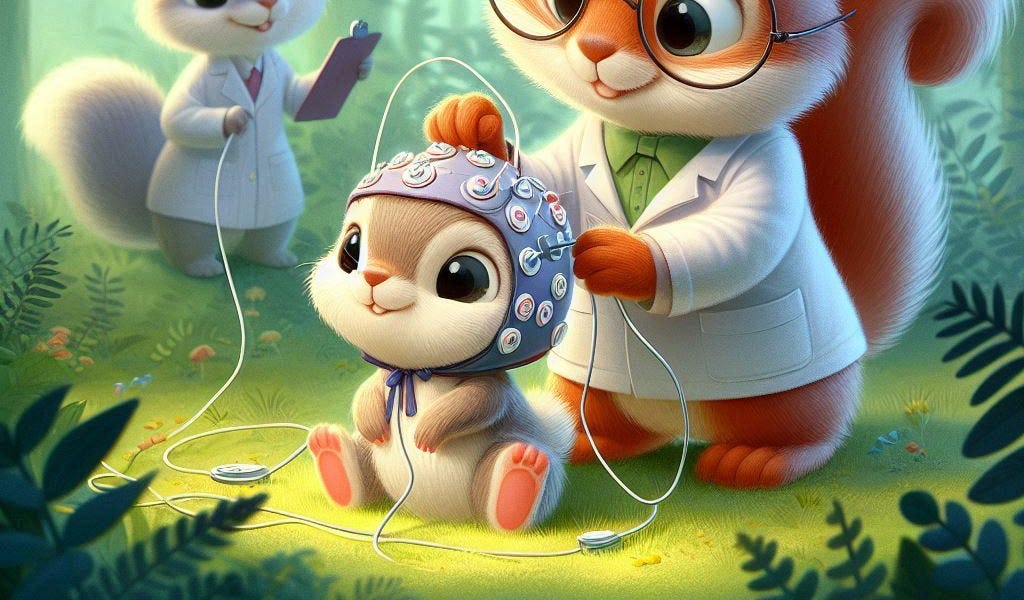
[Image: A whimsical forest scene with anthropomorphic squirrels dressed in academic attire (tiny lab coats, glasses, and clipboards), placing a helmet covered in electrodes on an anthropomorphic baby rabbit.]
Ever signed your kids up for a research study?
Well, I (Ashia) enthusiastically signed my kids up to be guinea pigs. It felt like a rite of passage, the Right Thing To Do For Society. As a young parent I was too tired to do science, but I could at least offer up my kid up to wear an electrode helmet for a couple hours.
I’m from Boston, home to a plethora of academic research institutions. Around here, there are two kinds of families: Attractive families who sign their kids up to be in GAP commercials, or dorky families who truck over to UMass so grad students can show your kid flash cards.
I married one of Needleman’s babies.1 We met in engineering undergrad. Our family had no hope to be anything but the dorky kind.
As a young parent, I had faith that scientists would do nothing but GOOD DEEDS with all this data.
I mean — I know about nuclear bomb testing. I I know about Henrietta Lacks. I know about chelation therapy studies. How we justify violence against targeted communities in the name of scientific progress.
But the studies I’m talking about — these are innocuous, consensual studies where folks just collect data from my babbling kiddos. It felt so wholesome and helpful, so integral to our identity as dorky do-gooders to start my kids early on the path of valuing and contributing to the human colossus of knowledge. Good deeds, right?
But deeds, it turns out, are not a binary Good/Bad situation. Deeds get wiggly.
How long my 6-month old stares at a smiling face. How my kiddo answers a question about girls and dolls. How much lead exists in the soil of our childhood home. It’s all data.
That data gets collected by the Official Science Squirrels, to do with what they please. And once we sign that paper sharing that data – they own it. Forever. They can stuff it in the trunk of a tree or warp it to skew a nasty report endorsing the use of chelation therapy.
You can’t change your mind. You can’t take it back. And you can’t set restrictions on how they use it.
They don’t have to share their findings with you, and they don’t have to give you a voice in how they share them. Do you want that data back? Too bad. The squirrels have a system, and sharing with you isn’t part of it.
We’re not telling you this as a paranoid conspiracy to keep your kids up at night afraid scientists are lurking in the closet.
Alison is a science squirrel. Most science squirrels truly do want to do good deeds. We’re telling you this because you have options — and we want your family to understand the system, it’s flaws, and how we do science better, together.
Like squirrels in your backyard, Science Squirrels have a knack for burying acorns data where you’ll never find them again.
The truth is that scientists, even Official Science Squirrels, aren’t any smarter than the rest of us. (I know, the lab coat is very convincing though.) We all get lazy sometimes. We all work within imperfect, stupid2 systems.
The scientific community, overall, is well-intentioned but prone to human error. We do unethical things, often by accident, all the time!
In an effort to make things A Little More Ethical, the Science Squirrels created Institutional Review Boards (IRBs).
Just saying that made me kind of zone out. So boring. Please just bear with us and the snore-fest ends in like 2 paragraphs, max.
IRBs are groups mandated by the US government to ensure “appropriate steps are taken to protect the rights and welfare of humans participating as subjects in the research.” Under the IRB model, it’s ethical to extract information from communities without sharing it back or considering community members’ own priorities, interpretations, or concerns.
Now, you might think that “protecting the rights and welfare of humans” means protecting the people we study, right? Well, not so much.
It’s more about making sure those acorns are safely tucked away in the Science Squirrels’ nests, with no pesky research participants (that’s you) asking for them back.
[Image Description: An animated squirrel dressed as a stern, bureaucratic official, complete with tiny glasses and a clipboard, sitting in front of a stack of acorns labeled “DATA.” The squirrel’s fur is meticulously combed, and there’s a “NO SHARING” sign on the tree trunk behind it.]
Well, we recently tried to get IRB approval to let participants—those who actually provided the acorns—have an ongoing say in what happens to their nuts. We wanted to give participants ongoing control over whether and how to share their own data.
In response to our gentle request, the IRB lost their minds and metaphorically3 barraged us with loud chirps, hysterically darting around while snapping their tails in alarm, pelting us with their tiny fists.
At least it felt like that. Emotionally. As if our suggestion was outrageous, the IRB immediately rejected our plan.
"Continued consent?" they squeaked. "Ongoing control over your own data? Preposterous! Once you give up your acorn, it’s ours forever. No sharing!!!!"
You see what I mean? Rejection hurts. I mean not in this case, we’re fine. But also even when it doesn’t hurt, it can be infuriating.
Under IRB rules, once participants consent to the idea of us sharing our data, we can’t ask them again if they’re still okay with this situation as things develop. Regardless of how the study changes, once they’ve handed over their acorns, participants aren’t allowed to change their minds.
[Image Description: A stern, bureaucratic group of squirrels laughing maniacally as they hoard acorns labeled “YOUR DATA” into a hole in a tree marked “IRB HQ.” A confused rabbit looks on, worried.]
“It’s just the way things are done around here!” Says the IRB Applicant Approval Squirrel, probably.
What.
Your voice? Your data? Your ability to say, “Hey, maybe I don’t want my acorn used in a study to justify the torture of Autistic kids?” Gone. Poof. Down the squirrel hole.
And anything built or fed by those acorns? It belongs to the squirrels. Whether it helps you, harms you, or leaves you feeling like you’ve been exploited and exposed, it’s all squirrel business now.
If we used this model of science, anything we discover together belongs solely to the researcher. No matter how uncomfortable, harmful, or horrendous the impact would be on you, the participant, as the origin of that data.
The IRB’s ‘it’s just the way we do things around here’ practice extracts and exploits vulnerable people. This methodology doesn’t just profit academia and shield researchers from consequences of sloppy science—we create real, life-or-death harm. Just look at how the Official Science Squirrels’ research on made-up concepts like ROGD fuels harm to kids like Nex Benedict.
[Image: Anthropomorphic squirrels dressed in academic attire (tiny lab coats, glasses, and clipboards) study a baby bunny wearing a helmet covered in electrodes. The baby bunny cradles his own acorn in his cute tiny paws.]
Instead of hoarding data, Participatory Action Research (PAR)4 flips the script. By treating participants as co-researchers, PAR ensures that communities have a say in how their acorns are used.
Continued Consent takes this a step further. Instead of a one-time "yes," we keep the conversation going, giving us the power to update our consent as our work together evolves.
This is about accessibility and agency—ensuring that people, not institutions, control our own stories and experiences.
Instead of being silenced after signing on the dotted line. PAR and Continued Consent offer a more ethical, inclusive way to contribute to science and use our acorns for what we define as Good Deeds.
No source, it was a huge headline-breaking multi-decade lead study starting in the late 70’s/early 80’s, but he was a kid and he doesn’t remember the details.
I wish I had a better, less ableist term than ‘stupid’ but I can’t think of one. We welcome your alternative suggestions.
Legal disclaimer: This is a joke. The IRB are not actual literal squirrels, and they didn’t actually lose their minds, chirp, or tail-dart, and no scientists or squirrels were physically or emotionally harmed during this application process. But I had to hype it up because this is sparkle confetti mirror of the blog PAR For The Discourse. So if you want to know the actual boring (but still relatively dramatic and ridiculous) story of what actually happened, you’ll need to read it on Alison’s version here.
That’s us! PAR is the thing we’re doing here!!! Aren’t you so excited to see what’s next?!
Share
No posts
Ready for more?
About The Author


More Stories
Local Infrastructure, Lower Costs: How Peering Is Moving the Needle on Internet Affordability
On Global Accessibility Awareness Day, An Internet for Everyone Must Include Everyone
An Open Fiber Data Standard to Make the Internet for Everyone