
Thank you for visiting nature.com. You are using a browser version with limited support for CSS. To obtain the best experience, we recommend you use a more up to date browser (or turn off compatibility mode in Internet Explorer). In the meantime, to ensure continued support, we are displaying the site without styles and JavaScript.
Advertisement
You can also search for this author in PubMed Google Scholar
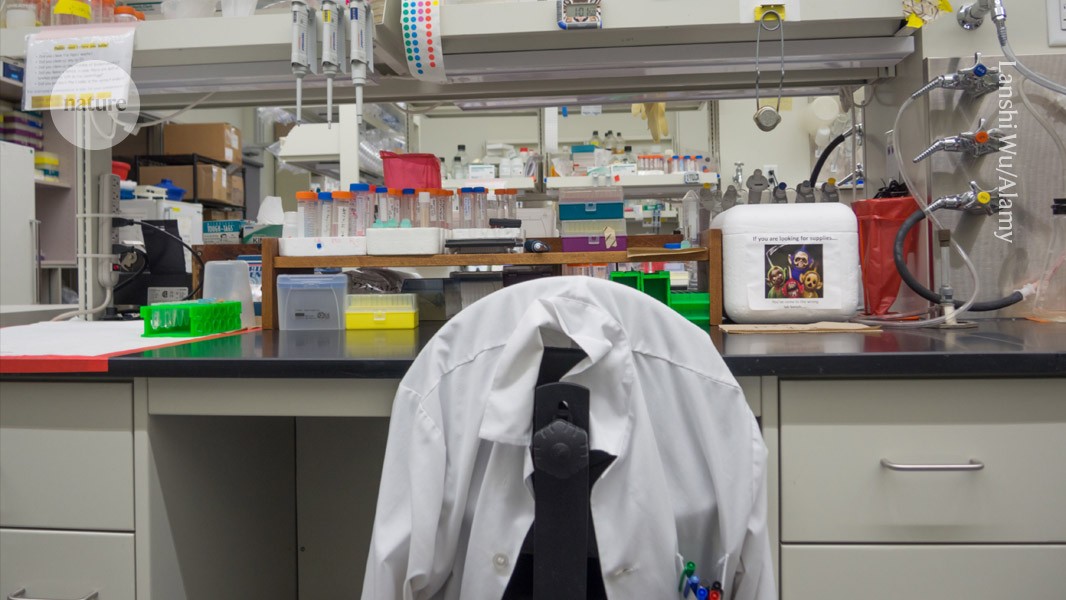
There are more postdocs than faculty positions available in many countries.Credit: Lanshi Wu/Alamy
More than 40% of postdoctoral researchers leave academia, according to a study of some 45,500 researchers’ careers1. Those who stayed and landed a coveted faculty position were more likely to have had a highly cited paper, changed their research topic between their PhD and postdoc, or moved abroad after receiving their doctorate.
The study, published in Proceedings of the National Academy of Sciences on 20 January, looked at researchers around the world who had progressed from a PhD to a postdoc — a temporary position for further professional training, development and expanded research — and then, in some cases, on to a faculty position. The study covered 25 years and 19 academic disciplines and used data from Microsoft Academic Graph, a corpus containing 257 million publications. The researchers filtered the data using an online professional network (presumably LinkedIn, although the authors did not say) to match researchers’ CVs.
Previous studies have focused mainly on how important the prestige of PhD-granting institutions is to landing a faculty job2. Bedoor AlShebli, a computational social scientist at New York University Abu Dhabi, United Arab Emirates, and her co-authors wanted to fill a gap in the research and quantify the significance of postdoctoral training to gaining a faculty position and early-career success.
“Our research highlights that the postdoctoral years are just as critical as the PhD years when evaluating a scientist’s likelihood of successfully entering academia and securing a faculty position,” she says.
In many countries, there are more postdocs than faculty positions available. This creates a bottleneck. The team’s data set shows that 41% of postdocs end up leaving academia. AlShebli says that researchers who publish less during their postdoc than they did during their PhD are more likely to leave.
For researchers who stick around, what determines success? To answer that question the team developed a measure of scientific output — called the η-index — as a proxy for success. This measure is based on the h-index, a count of a researcher’s citations, but focuses only on papers published between two and four years after securing a faculty position.
or
doi: https://doi.org/10.1038/d41586-025-00142-y
Duan, Y. et al. Proc. Natl Acad. Sci. USA https://doi.org/10.1073/pnas.2402053122 (2025).
Article Google Scholar
Clauset, A., Arbesman, S. & Larremore, D. B. Sci. Adv. 1, e1400005 (2015).
Article PubMed Google Scholar
Download references
Reprints and permissions
 I had three children during my PhD: here’s what I learnt
Seven work–life balance tips from a part-time PhD student
 How PhD students and other academics are fighting the mental-health crisis in science
 Canada just hiked PhD and postdoc pay — here’s how to get your country to do it, too
 Canadian science gets biggest boost to PhD and postdoc pay in 20 years
 How we landed job interviews for professorships straight out of our PhD programmes
‘Publish or perish’ culture blamed for reproducibility crisis
Career News
Has Bluesky replaced X for scientists? Take Nature’s poll
News
Retractions caused by honest mistakes are extremely stressful, say researchers
News
For open communication, give researchers a permanent e-mail alias
Correspondence
Build a DNA database to help identify children stolen in conflicts
Comment
Science on the go: bringing labs into the field
Career Feature
For open communication, give researchers a permanent e-mail alias
Correspondence
Faced with funding cuts, collaborate to define research priorities
Correspondence
Leaky pipelines: I track the ‘pink collar’ parallels between nursing and academia
Career Q&A
Research into the synthesis of near-infrared emitting/absorbing functional soft materials and polymer composite materials.
Tsukuba, Ibaraki (JP)
National Institute for Materials Science (NIMS)
Xiaoliang Sunney XIE’s Group is recruiting researchers specializing in Alzheimer's disease (AD).
Beijing, China
Changping Laboratory
The Beijing Laser Accelerator Innovation Center at Peking University invites applications for Applied Physics faculty.
Beijing, China
Peking University (PKU)
We are looking for 10 highly motivated PhD candidates to fill positions across 7 top European research centres/medical university hospitals.
The Netherlands, Belgium, Germany, France, Spain, Italy, Czech Republic, United Kingdom
MIRACLE – Leukemia
The main focus of this position is the creation and evaluation of spintronics-based neuromorphic computing devices (e.g., physical reservoir comput…
Tsukuba, Ibaraki (JP)
National Institute for Materials Science (NIMS)
I had three children during my PhD: here’s what I learnt
Seven work–life balance tips from a part-time PhD student
How PhD students and other academics are fighting the mental-health crisis in science
Canada just hiked PhD and postdoc pay — here’s how to get your country to do it, too
Canadian science gets biggest boost to PhD and postdoc pay in 20 years
How we landed job interviews for professorships straight out of our PhD programmes
An essential round-up of science news, opinion and analysis, delivered to your inbox every weekday.
Sign up for the Nature Briefing newsletter — what matters in science, free to your inbox daily.
© 2025 Springer Nature Limited
About The Author


More Stories
On Global Accessibility Awareness Day, An Internet for Everyone Must Include Everyone
An Open Fiber Data Standard to Make the Internet for Everyone
How RightsCon Is an Unexpected Stress Test for the Multistakeholder Model of Internet Governance