
Top10VPN is editorially independent. We may earn commissions if you buy a VPN via our links.
Samuel Woodhams was our Digital Rights Lead. His research has been featured in the BBC, Reuters, Financial Times, The Guardian, and Business Insider. Read full bio
This guide explains the best methods to bypass internet restrictions, filters, and blocks. You’ll find instructions for circumventing the most common types of internet censorship, along with advice on exactly which tools you should use and when.
In many countries, governments limit the websites that can be seen or accessed online. China, Russia, and Iran are well-known for imposing strict internet restrictions, but almost every country restricts online content in some way.
Here are the best ways to bypass internet restrictions and website blocks:
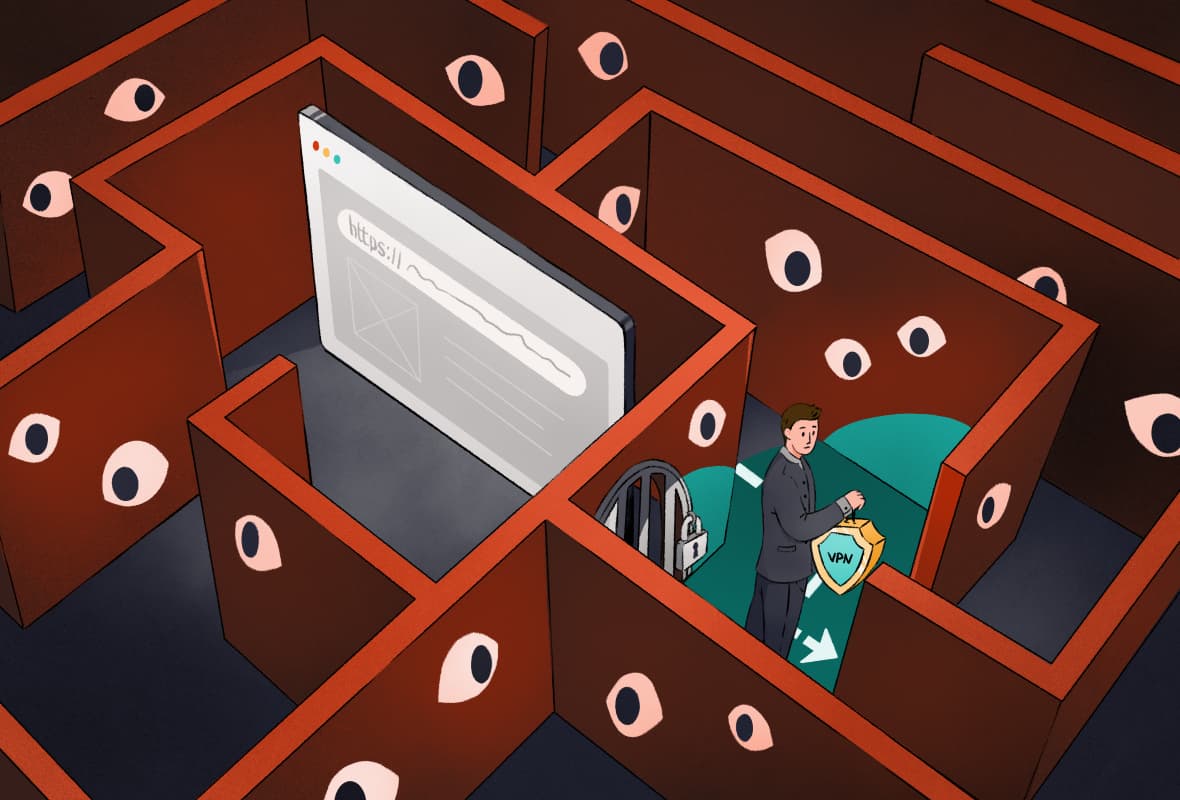
In most cases, the best way to bypass internet restrictions, censorship, and website blocks is to use a Virtual Private Network (VPN). VPN software encrypts your internet traffic, obfuscates it, and then reroutes your data through a remote server. This lets you safely access websites that are blocked or filtered by geo-location, IP address, URL, or DNS address.
In our tests, Astrill VPN bypassed sophisticated website blocks more successfully than any other VPN service. However, if you can’t pay for a VPN, Windscribe Free also works as a safe and 100% free-to-use alternative.
The simplest and most effective tool for bypassing government censorship is VPN software.
VPNs temporarily assign you a new IP address, allowing you to circumvent location-based restrictions. Their use of encryption and obfuscation also prevents censors from seeing the websites you’re accessing.
Custom DNS can also help bypass censorship that’s implemented via DNS tampering, and proxy servers or SSH tunneling can help to unblock some content that isn’t available to you.
In some cases, internet censorship can be extremely difficult to overcome. Iran, India, and Ethiopia are among a growing number of countries that have shut down internet access completely.
A VPN won’t help if your ISP or government completely shuts off the Internet. However, there are still some steps you can take to prepare and react to a full internet shutdown.
In this article, we’ll tell you how to bypass internet censorship and restrictions using readily-available tools and techniques, and how to prepare for an internet shutdown.
Around the world, governments work with ISPs and other communications companies to block websites that are considered illegal or harmful.
Unfortunately, there’s little agreement on what is truly harmful. In some countries, governments use internet censorship and restrictions to stifle debate, silence opposition, prevent protest, or to enforce controversial social norms.
China is famous for being the most censored country in the world. It blocks independent news outlets, social media sites, and much more. The so-called Great Firewall of China achieves this using a combination of techniques including deep packet inspection, DNS spoofing, IP blocking, keyword filtering, and throttling to disrupt undesirable connections.
But China is far from alone in restricting access to online content. According to Freedom House, 76% of the online population live in countries where citizens have been arrested for publishing content about social, political, or religious issues.
The table below compares the most common methods for bypassing internet restrictions. It explains how each method works, the types of internet censorship each method works to circumvent, and their limitations:
The most suitable method for you will depend on the censorship technique in use, and the resources you have available.
Before we explain each method in details, there are a few additional aspects to consider in order to make an informed decision:
Here’s a more detailed look at each method:
A VPN reroutes your data through a remote server via a secure, encrypted tunnel. The encrypted tunnel stops your ISP from seeing your online activities, while the remote server temporarily replaces your IP address with another IP address from a different region.
A VPN is the most effective way to bypass most forms of internet restriction. VPN encryption prevents censors from blocking your connection based on the website you’re visiting.
By connecting to a VPN server in a different country, VPNs also let you access content that’s typically blocked in your location. Many VPN services also have their own DNS servers, so you’re also protected from DNS tampering.
Tests with our Shanghai server in 2025 prove that PrivateVPN unblocks Medium in China.
When choosing a VPN to bypass censorship, look for:
We’ve tested and reviewed 61 VPNs and found that Astrill is the most reliable VPN for avoiding censorship.
In the last three months, Astrill has worked to unblock censored websites in China 100% of the time. Astrill does not have a kill switch on its mobile apps though, so we recommend ExpressVPN instead if you’re primarily using an Android or iOS device.
Bypassing sophisticated internet censorship requires significant resources, so the most effective VPNs will typically require a monthly fee. However, there are a few trustworthy free VPNs, too.
EXPERT ADVICE: VPN websites are often blocked in countries with strict internet censorship. If you can’t access a VPN’s download page, search for a mirror website or file-sharing hosts through a private search engine such as DuckDuckGo. Otherwise, try to set up your VPN while abroad. Remember: VPNs are illegal in some countries, so exercise caution.
Proxy servers are similar to VPNs in some respects: they route your internet traffic through a remote server, spoofing your physical location and masking your IP address from other websites and services you connect to on the internet.
Unlike VPNs, proxy servers are often free to use — but they do not encrypt your data by default.
A proxy is useful for circumventing censorship in two situations:
There are several different types of proxy server. Some types only reroute the data from a particular application (such as your browser), while others work for your whole device.
HTTPS and SOCKS5 proxies are the most secure options for bypassing censorship. HTTPS proxies use HTTPS encryption by default. SOCKS5 has no encryption built-in, but it can support encryption if configured correctly.
Other types — like common web proxies — are much less secure, and are typically only used to unblock banned websites in schools and workplaces.
SOCKS5 proxies can use the TCP or UDP connection protocols, which is similar to what most VPN protocols use. Much like VPN obfuscation, this improves your chances of bypassing local censorship without being blocked by your ISP.
In fact, VPNs that work in China and other highly-censored countries often use a protocol called ShadowSOCKS, which mimics the kind of TCP connection used by SOCKS5 proxies.
A small number of VPNs now provide SOCKS5 proxy servers as part of their service. This allows you to choose between a VPN server or a SOCKS5 proxy server. Be wary, though — the SOCKS5 option will not always encrypt your data.
In our tests, NordVPN’s SOCKS5 proxy did not encrypt our torrenting traffic.
Unless you use a VPN with SOCKS5 support, the most effective proxies are typically quite difficult to configure.
Even when configured currently, a proxy doesn’t offer you the same security or privacy as a VPN. We recommend only using a proxy if your communications do not require additional privacy and security, or if the website blocks you’re bypassing are relatively rudimentary.
EXPERT ADVICE: Similar to a web proxy,Google Translate can fetch a website for you and show it in the browser. You don’t even have to change the language. Similarly, SodaPDF can create PDFs from web pages and may be able to fetch content you can’t access directly.
The Tor Browser encrypts your traffic and routes it through three randomly-assigned servers, called nodes. It’s free to use and highly anonymous: no server can see both your IP address (who you are) and your web traffic (what you’re doing).
Tor is slow, so it’s not ideal for transferring large files, but it changes your IP address and bypasses URL filters effectively.
Connected to Windscribe free and the Tor browser, we accessed ProPublica’s onion site.
Though it can be a good choice for activists or whistleblowers sharing sensitive information, Tor isn’t always safe. Malicious exit nodes could insert malware in your traffic, and there is proof that some users can be de-anonymized.
Your ISP can see you’re using Tor and might flag you for surveillance. Put simply, Tor needs to be set up carefully if you want to be completely anonymous online.
The Tor browser also gives you access to the dark web, which is often used for illegal content but can be legitimately used to share information that is unreasonably restricted or subject to censorship.
Tor Snowflake can also be a useful tool in bypassing government censorship. You can install the extension on Firefox, Chrome and Edge. It works much like a proxy app and obfuscates your traffic allowing you to access blocked websites.
If Tor traffic is blocked, you can hide it by connecting to a VPN before running Tor. However, your VPN provider will see your true IP address and exit nodes can still see your traffic.
When you visit a website, DNS servers convert its web address (e.g. www.example.com) into the IP address of the server that hosts the website. The IP address is used to route your communications through the internet.
Your DNS resolver finds out the IP address for a website, so your device can connect to its server.
DNS servers can be made to enforce censorship by blocking access to sites or diverting you to compromised alternatives. If you use your ISP’s DNS server, your ISP can monitor which websites you visit.
To avoid DNS filtering, DNS spoofing, and ISP surveillance, you can try using a custom DNS server. We’ve compiled a list of safe, free DNS servers alongside our DNS checker tool, and you can find setup instructions in our guide comparing the differences between DNS and VPNs.
It’s worth noting that this method is unlikely to work against sophisticated censorship techniques such as IP blocking or deep packet inspection. These techniques do not use DNS to impose their restrictions.
Note: Many VPN services — including VyprVPN and Hide.me — use their own first-party DNS servers. By connecting to a VPN server operated by these services, you can combine the benefits of both a VPN and a custom DNS server.
DNS traffic isn’t usually encrypted, so it’s vulnerable to eavesdropping and man-in-the-middle attacks. That means state agencies could track the websites you’re visiting and redirect your traffic to censored sites.
To avoid this, you can use DNS over HTTPS, which uses HTTPS encryption to protect your communications with the DNS server.
DNS over HTTPS increases user privacy and prevents eavesdropping.
Your ISP would still see your DNS requests if it operates the DNS server, so encrypted DNS is best used together with custom DNS in strictly censored countries.
Encrypted DNS is now supported in Windows 11, iOS, Android, and macOS. The Firefox browser uses DNS over HTTPS in the US, and the Tor Browser used DNS over HTTPs by default.
DNS over TLS is a similar solution based on a different encryption technology.
However, your internet traffic can still be disrupted after the DNS lookup stage. For this reason, encrypted DNS alone is unlikely to bypass most forms of government censorship alone.
Secure Shell (SSH) Tunneling provides a secure method to bypass network restrictions and content filters by routing your traffic through an encrypted tunnel to an SSH server.
The server can be in another country, which may help in unblocking geo-restricted resources. Much like a VPN, the encrypted tunnel stops your ISP and others from snooping on your web traffic.
It’s also possible to use SSH tunneling to hide your OpenVPN traffic, though this is quite complicated and not recommended for technically inexperienced users.
Use PuTTY to create an SSH tunnel on Windows.
For most people, a VPN is a more user-friendly option than SSH. That said, SSH is a good alternative if you already have a remote server you can use, or if you can’t access a VPN service. You can find SSH servers available to rent online.
To create an SSH tunnel, use PuTTY on Windows or the SSH command on Mac and Linux.
Mirror sites are copies of blocked content that are hosted on different URLs. They can provide a quick and easy way to access blocked or restricted content without any technical setup.
However, they come with significant drawbacks. Firstly, they’re unlikely to work against sophisticated state censorship. If they do, it’s likely they’ll be blocked or removed quickly once identified by censors.
Mirror sites also pose some security risks, depending on the sensitivity of the content they’re hosting. Most importantly, they lack any kind of encryption, and they do nothing to protect your digital privacy.
If there’s a particular site you want to access that has been blocked, there are several ways you can try to access its content:
Here’s how the most common censorship methods are bypassed with the appropriate tool:
As you can see, using a trustworthy VPN provider is the easiest and most effective way to bypass the vast majority of internet restrictions and censorship techniques. VPN software is much faster and less complicated than the Tor Browser, and it’s much easier to use safely.
A VPN will hide your browsing activity and IP address from your ISP and the websites you visit, respectively. The VPN provider can technically see your real IP address and your web traffic, but a reputable and well-reviewed service will not monitor or log either.
Governments around the world have shut down the internet to stop protesters organizing, to suppress the flow of information during contested elections, and even after natural disasters.
Internet shutdowns can target a specific geographic region, particular applications (such as social media), or the entire country.
Since 2019, there have been more than 500 government-mandated shutdowns globally. These include:
Social media shutdowns can be bypassed in much the same way as ordinary censorship. However, a complete internet blackout is much harder to circumvent.
Governments shut down the internet by ordering telecommunications companies to power off equipment, or by doing it themselves when they have control of critical infrastructure.
They can also push certain users offline by manipulating the Border Gateway Protocol (BGP) which routes internet traffic; or they can block websites using IP addresses or DNS filtering. Sometimes, DPI is used to block specific keywords; or the protocols used by instant messaging services are blocked to stop them working.
Here are some techniques you can use to keep communicating during an internet shutdown. It’s worth planning ahead: it may be difficult to obtain the software required or to set up these processes without access to the internet.
A mesh network works by using device-to-device communications when people are close together, for example at a protest. The devices can pass messages between them until they reach their destination.
Bridgefy, for example, uses Bluetooth communications which are effective over distances of about 100 meters, so you can communicate without a mobile network or WiFi.
If the person you’re communicating with is further away, Bridgefy passes your encrypted message through other people’s phones until it reaches its destination. Bridgefy includes a broadcast option to share messages with other users around you.
NewNode (previously known as Fireside Messenger) is a similar app for encrypted messaging. As long as one of the devices in the network is connected to the internet, all devices have internet connectivity.
Both Bridgefy and NewNode support device-to-device messaging without an internet connection. Briar also enables offline messaging, where messages are synchronized using WiFi or Bluetooth, or over Tor when the internet is available.
Messages can also be synchronized by exchanging memory cards. Briar Mailbox works a bit like email — downloading messages when there is a connection.
If you’re concerned that your internet access might be blocked or censored in the future, take a copy of valuable data now.
Once you have it, you can share it with others by re-uploading it to the internet or copying it from device to device.
You may wish to collect and copy versions of security and privacy software, contact details, or books. Music, art, and literature can come under attack — especially in times of conflict — and can also be preserved digitally.
A sneakernet is where people share data by transporting it on physical storage media, such as USB keys.
In Cuba, for example, few people can afford internet access and the internet is censored by the government. Citizens can get the latest movies, TV shows, news, and software from overseas by picking up El Paquete Semanal.
It’s a weekly 1TB compilation of data that trades on the black market for as little as $1 if you only want some of the data.
If you’re close to the border, you might be able to use a SIM card from a neighboring country. In 2021, citizens in Sudan used international SIM cards to break through an internet shutdown and send information about government oppression outside the country.
Governments sometimes force app stores to remove apps they wish to censor, including privacy and encryption software.
On Android, you can install apps without going through the Google Play store — a technique called “sideloading”. This may only be a partial solution: for VPNs, you’ll need to subscribe to the VPN provider’s service as well as installing the software’s APK file, which might be difficult if their website is blocked.
We used F-Droid to sideload Proton VPN onto our Android.
If social media services are blocked, finding a way to sideload the app won’t help if the government is also blocking communication with the app’s servers. In this case, a VPN can help you get around the block.
F-Droid is an alternative app store for Android devices which distributes open source software. F-Droid itself isn’t available through Google Play, so you’ll need to sideload it.
When you sideload an app, make sure it’s trustworthy. App stores aren’t perfectly secure, but they do perform some checks on the software they distribute to reduce your risk.
To circumvent the internet shutdown in Iran, the Toosheh app enables citizens to receive data through their TV satellite dish. Each day, there is an 8GB download available which includes VPN software and news from overseas.
This type of data distribution is only one-way, so it doesn’t enable citizens to get their information out of the country. However, the VPN software helps citizens to share information when the internet is working.
This technique is relatively safe. It’s hard for the authorities to track whether someone has accessed the data by satellite, and once the app has been installed, it’s totally independent from the internet.
To bypass internet restrictions for free, try using a safe free VPN service such as Windscribe Free or other free software like the Tor browser.
Web proxies such as Hide.me are free to use and can help access some blocked websites, and custom DNS servers used with encryption can bypass censorship implemented with DNS tampering.
Governments that censor the internet often ban or restrict independent VPNs to try to stop people circumventing censorship.
VPNs are illegal in Belarus, Iraq, North Korea and Turkmenistan. They’re legal everywhere else, but there may be restrictions. Independent VPNs are banned in China, Iran, Oman, Russia, Turkey and the UAE, for example.
If you use a government-approved VPN in those countries, it won’t help you to circumvent the government’s censorship.
The best VPN protocol to bypass censorship is Astrill’s proprietary StealthVPN protocol. In the past 3 months, it has been 100% successful at bypassing the Great Firewall of China. If you don’t have Astrill, try using OpenVPN TCP and Port 443.
VPN, DNS and Smart DNS: What’s the Difference?
How to Unblock Websites with or without a VPN
What Is Internet Censorship & How Does It Work?
We've been testing and reviewing VPN services since 2016. We also publish VPN research and advice to help protect your internet privacy and security.
About
Contact
Top10VPN.com is operated by PrivacyCo Ltd. | © 2016-2025. All rights reserved.
About The Author




More Stories
What Happens When a Community Wires Itself: Lessons from Colville on the Power of Indigenous-Led Connectivity
From Curiosity to Confidence: CodificaKids Builds Digital Trust in Rural Brazil
Community Snapshot—August