
This article first appeared in Digital Edge, The Edge Malaysia Weekly on December 30, 2024 – January 12, 2025
Solutions like Internet of Things (IoT) and artificial intelligence (AI) are key to transforming Malaysia’s agriculture, boosting productivity and ensuring food security. However, reliance on imports and limited research and development leave the sector vulnerable to price fluctuations and supply chain risks. Smallholder farmers face funding barriers, hindering access to technologies that could ease labour shortages and improve efficiency.
In an effort to address these concerns, the Malaysia Digital Economy Corporation (MDEC) is spearheading digital adoption in agriculture under the Malaysia Digital initiative to boost productivity, sustainability and growth.
In 2018, MDEC launched a smart fertigation pilot for chilli farmers in PPK Kuala Langat through its Malaysia Digital AgTech programme (previously known as e-Ladang), partnering with key stakeholders to drive innovation.
“Since the initial project, MDEC has facilitated the development of a digital agricultural ecosystem by bridging connections between technology providers and users. Over 20 digital technology-enabled pilot projects have been developed, enabling farmers and agribusinesses to leverage cutting-edge technologies,” says Datuk Fadzli Abdul Wahit, head of digital transformation at MDEC.
Building on the success of its initial pilot, MDEC is working with agritech partners to scale and commercialise these solutions, expanding their reach nationwide. By integrating IoT and AI, both local innovators and government agencies are tackling the “dirty, dangerous and demeaning” stigma associated with agriculture, creating a more attractive and modernised sector.
Biotechnology advancements are also contributing to this transformation. For instance, Qarbotech Sdn Bhd, a leader in omics research, highlights the positive growth in the agriculture industry, from job creation to technological breakthroughs aimed at increasing crop yields.
“AI is becoming really prevalent right now, even in research. We aspire to go towards that direction as well, not just to jump on the [bandwagon] but really to provide better service for our customers. For example, we are keen to develop new research, particularly omics research,” says Chor Chee Hoe, co-founder of Qarbotech. Omics research encompasses disciplines like genomics, transcriptomics, metabolomics and proteomics, focused on studying large-scale biological data.
“[Delving into omics research] can help better explain how our [biocompatible carbon quantum dots] enhance photosynthesis by understanding what’s going on within the plant. By understanding that, we can cater our product to perhaps more specific crops because our product is rather general now, [so our product can become] even more powerful.”
Agritech start-ups offering practical, cost-effective solutions are emerging, while less efficient technologies risk being phased out, says Chor.
“The recent announcement in Budget 2025 actually opened up for all the players to bid for some fertiliser contracts. I think it’s a very bold move and it actually gives all the players equal ground to play,” he says.
Under Budget 2025, Prime Minister Datuk Seri Anwar Ibrahim said the government would initiate a pilot project for the procurement of fertilisers through an open tender process.
Cultiveat Group Sdn Bhd delivers pesticide-free vegetables while balancing vertical and outdoor farming. Founder John-Hans Oei sees untapped potential in outdoor farming through tech-driven productivity. Using smart irrigation and climate control, Cultiveat eliminates guesswork by growing vegetables in a controlled environment.
“There is a play for vertical farming in the local sustainable agriculture ecosystem [but] I think the majority of it still has to be grown outdoors by utilising our natural resources,” says Oei.
While technology is valuable, he cautions against viewing it as a cure-all, stressing the need to address deeper issues in agriculture.
“I think there are bigger things that we should be looking into, like what is the entire market dynamics like? What is the distribution of the vegetables like? Is there fair play among prices for farmers? Is there proper logistical infrastructure? Is there proper support from the government?” says Oei.
Ethical practices, quality produce and market viability need to be improved, he says, stressing that even with IoT and AI, selling the harvest remains essential.
“If you don’t sell your produce, there is no point in being able to grow 10 or 15 times the yield compared to traditional farming. In the end, nobody buys it and there will be wastage.”
Moreover, food security requires aligning local produce with national needs. “Technology must strike a balance between higher yields and producing what people want,” says Oei.
Starting his business at 25, Oei faced scepticism from traditional farmers. “It took six years for others to see the benefits of tech in farming,” he explains, noting that sustainability should extend beyond production to business viability.
Oei hopes for more government support to integrate technology into traditional farming, including fair access to resources like affordable land. He believes in building a strong foundation for all agricultural players, using technology as a tool for sustainable growth rather than the primary focus.
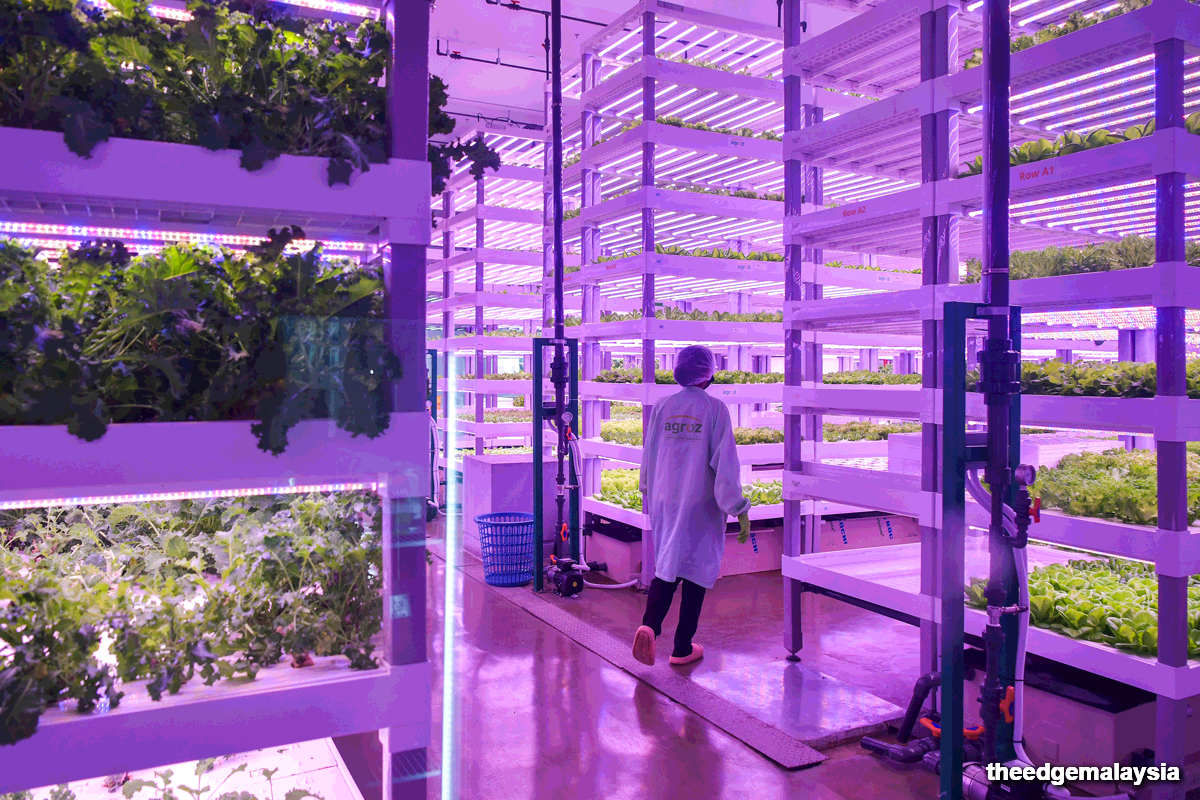
Agroz Group Sdn Bhd, a vertically integrated agritech company, is making strides in indoor vertical farming with educational setups in AEON malls across the Klang Valley. CEO Gerard Lim aims to cut reliance on imported non-native produce.
“What we also try not to do is to compete with our local farmers. As a result, you don’t see us growing some of the other Asian leaves, which predominantly are grown locally,” says Lim.
Agroz’s partnership with AEON is aimed at having its operations close to where its produce is consumed. The company launched its 8,000 sq ft indoor farm, Agroz EduFarm-in-City in AEON Alpha Angle in 2023. The Edufarm has its own experience centre to showcase how its technology produces clean and pesticide-free vegetables in the city for families and visitors.
“We have devices to measure the temperature and humidity of the environment. We have sensors that automate watering intervals in our farm too. So, depending on what the crops need, the system detects it through sensors and automates the farming,” says Lim.
One of the challenges that farming presents is the unpredictability of climate change. With climate change, weather conditions are changing, which can affect production.
“We are growing baby spinach and fulfilling the market demands in Malaysia and Singapore. Baby spinach was actually imported from Australia but since last year, [factors like] climate change have impacted productivity. As such, there’s a shortage in the market. We are able to meet the demands because we are growing it in a controlled environment.”
Agroz utilises a high-tech nutrient delivery system for its vertical farm. Sensors monitor the nutrient mix, temperature and pH in one tank while pipe water is filtered and stored in a clean water tank.
The nutrient solution is pumped into the vertical farm and then any excess solution will be recycled back to the nutrient tank. An ultraviolet chamber kills bacteria, viruses and algae before it is reused. This system significantly reduces water usage compared to traditional methods.
“Our main focus is to provide the technology to the everyday farmers. I think a lot of people think that the use of technology is expensive. Yes, it does cost a bit more money, but it’s not as expensive as it used to be,” says Lim.
Teaching traditional farmers to embrace technology can be challenging, but Lim is optimistic about the younger generation’s openness to innovation.
“Technology increases not only yield and productivity, but also helps to reduce costs. For example, if you don’t use pesticide, insecticide and so on, not only is it safer and healthier, [you also would not need your] workers to spray pesticides on your crops,” he says.
Looking ahead, Agroz hopes for more support for agritech, particularly through lower energy tariffs. As tech adoption in farming increases, so does electricity usage, and Lim believes reducing energy costs could lower entry barriers for agritech businesses.
Not all agritech start-ups start with a love for farming. Originally a telecom venture, FishSpeak pivoted to AI and IoT-powered fish farming for small and medium farms when a Slim River fish farm sought its help with internet connectivity.
In the process, Faisal Shadli, founder of FishSpeak and co-founder of Pacton Technologies Sdn Bhd, learnt that the farm was struggling to manage fish mortality rates.
“It was a seven-acre farm and harvested around three million tonnes of tilapia at one go. When we came in, the mortality rate was around 17%. If a 10,000 sq ft pond has 100,000 fish inside valued at RM10 for each fish, the money lost would be RM170,000,” says Faisal.
Fish farmers face challenges such as rising fish prices (charged by middlemen), which cut their profits and increase consumer costs. To tackle mortality rates and ensure fair play, FishSpeak launched a smart aquaculture management platform powered by IoT and AI.
“By using our smart fish feeder, we hope that we can reduce at least some percentage of the feed usage for the farm, so that they don’t waste it. The system calculates the feed conversion ratio — for example, how much feed is being used to [raise] one fish. So, the lower it is, the better the yield for the farmers,” says Faisal.
The platform enables farmers to monitor water quality, access advanced chart analyses and receive real-time updates on fish and pond conditions.
“The most intelligent part of the system is that our technology understands the personalised conditions of specific ponds in the farm based on data given on its previous SOPs (standard operating procedures), to give advice to farmers on how to manage their farm,” says Faisal.
FishSpeak is leveraging ChatGPT’s application programming interface (API) to train its AI model, and the software is then integrated into WhatsApp conversations with the farmers. It is able to advise farmers on the preventive measures for detecting diseases in fish ponds.
“Some farmers do not want to go into the website or an app because they are old and might not be accustomed to it. We want it to be seamless and conversational. The live interaction with the robot is based on data from the system, which also records the history of fish sales and can even generate invoices,” says Faisal.
The AI model can extract handwritten notes from photos, transferring invoice data to the platform’s database. It supports multiple languages, including Malaysia’s unique “rojak” mix or code-switching.
“We are doing this to make the farmer’s life easier. We want to enable farmers to get [financial support] and for that, proper data and records are needed — be it for bank loans or even getting subsidies,” says Faisal.
To date, FishSpeak has managed to reduce around 70% of the mortality rate for the farm in Slim River, which translates into RM75,000 net benefit per pond.
FishSpeak aims to provide small-scale farmers with accessible technology while generating valuable data to inform agricultural policies and support funding for agritech ventures.
“That’s why I’ve been going around and getting people to be interested and invest in this technology. So that I can fund the capital expenditure to enable a subscription model for smaller scale farmers,” says Faisal.
In the long term, Faisal wants to build a unified fisheries data platform to provide real-time insights into protein availability and harvest schedules, enabling accurate market trend forecasting.
Save by subscribing to us for your print and/or digital copy.
P/S: The Edge is also available on Apple’s App Store and Android’s Google Play.
Copyright © 1999-2025 The Edge Communications Sdn. Bhd. 199301012242 (266980-X). All rights reserved
About The Author


More Stories
Local Infrastructure, Lower Costs: How Peering Is Moving the Needle on Internet Affordability
On Global Accessibility Awareness Day, An Internet for Everyone Must Include Everyone
An Open Fiber Data Standard to Make the Internet for Everyone