
Thank you for visiting nature.com. You are using a browser version with limited support for CSS. To obtain the best experience, we recommend you use a more up to date browser (or turn off compatibility mode in Internet Explorer). In the meantime, to ensure continued support, we are displaying the site without styles and JavaScript.
Advertisement
Scientific Reports volume 15, Article number: 768 (2025)
1250
Metrics details
Individuals with intellectual disabilities (ID) often exhibit lower levels of physical fitness compared to the general population, including reduced strength, endurance, flexibility, and coordination. Dynamic neuromuscular stabilization (DNS) training can potentially improve the performance of adults with ID caused by weak motor skills due to a lack of desirable nerve growth during childhood and before puberty. Also, DNS training proposed to improve physical fitness in this population, but the effectiveness and durability of DNS training on specific fitness components have not been well-established. This study employed a randomized controlled trial design to investigate the effects of an 8-week DNS training program on the strength, endurance, and flexibility of adults with ID. A total of 31 participants were randomly assigned to either an intervention group (n = 16) or a control group (n = 15). Muscular strength, endurance, and flexibility were assessed at baseline (pre-test), immediately after the intervention (post-test), and 2 months following the intervention (follow-up) using the 30-second chair stand (30sCS) test, sit-ups test, trunk lift test, and chair sit-and-reach test. Participants in the intervention group engaged in the DNS training program for 8 weeks, with 3 sessions per week, while the control group maintained their usual activities. The analysis of the outcome measures revealed significant time, group, and time-group interaction effects. Post-hoc analyses indicated that the DNS group exhibited significantly greater improvements in 30sCS, sit-ups, trunk lift, and chair sit-and-reach compared to the control group (p < 0.01). These improvements were maintained at the 2-month follow-up assessment in the DNS group. This randomized controlled trial demonstrates that an 8-week DNS training program significantly improves muscular strength, endurance, and flexibility in adults with ID, with benefits maintained at a 2 month follow-up. Further research is needed to replicate these findings and investigate underlying mechanisms, but the study highlights the potential of DNS training to promote physical fitness and well-being in individuals with ID.
Trial registration RTC, prospectively registered in the Clinical Trial Registry (UMIN000053560) on 24/03/2024.
Intellectual disabilities (ID) affect approximately 3% of the global population1, presenting significant challenges in intellectual functioning and adaptive behavior, which encompass conceptual, social, and practical skills2. Adults with ID often face difficulties across various domains, including cognitive processing, communication, self-care, and social interaction3. Research consistently shows that these individuals frequently exhibit deficits in physical fitness components such as muscle strength, endurance, flexibility, and coordination4. These limitations stem from a combination of impaired cognitive abilities, reduced attention span, decreased motivation for physical activities, poor motor coordination, and underlying motor development issues5,6,7,8. Addressing the multifaceted needs of individuals with ID requires a comprehensive approach that targets both physical and cognitive-behavioral aspects to improve overall functioning, enhance quality of life, and promote social inclusion9,10.
The significance of improving physical performance in individuals with shorter life expectancies is profound. Physical inactivity can lead to numerous adverse health outcomes, including muscle and bone deterioration, type 2 diabetes, obesity, hypertension, and neuromuscular disorders9. Conversely, engaging in physical activity positively impacts brain function and mitigates health issues like hypertension and abnormal brain lipid profiles, potentially lowering mortality rates10. Enhancing muscle strength and endurance can foster a more active lifestyle, reducing health problems and boosting self-confidence and social interaction in individuals with disabilities11,12.
Well-designed exercise interventions have been shown to improve factors such as strength and muscle balance in various populations13. However, there remains a gap in the literature regarding the most effective training approaches for significantly enhancing the physical performance of individuals with disabilities. To bridge this gap, research is needed to identify and evaluate the most impactful training interventions that can improve the physical fitness and overall health outcomes of individuals with reduced life expectancy.
Individuals with ID often struggle with motor skill performance, particularly complex movements, due to underlying muscle function issues14. Therefore, it is crucial to develop motor skills to help these individuals lead more independent lives and maintain appropriate levels of muscle strength and endurance15. Implementing training programs tailored to their specific needs is essential. Dynamic neuromuscular stabilization (DNS) exercises have shown promise in improving muscle strength and endurance by enhancing neuromuscular system coordination and integration16.
DNS, a rehabilitation concept proposed by Pavel Kolar and influenced by Vaclav Vojta’s work on reflex locomotion therapy, focuses on posture, breathing patterns, and joint centration16. This approach emphasizes core stability provided by the neck flexors and extensors, diaphragm, transverse abdominis, and multifidus muscles17. Dynamic Neuromuscular Stabilization (DNS) has been effectively employed in the rehabilitation of a diverse range of neurological, musculoskeletal, and sports-related injuries17. By targeting specific regions involved in balance and stabilization that are critical during developmental stages, DNS seeks to activate neural circuits responsible for orchestrating complex movement patterns. This therapeutic approach holds promise for enhancing motor performance in adults with intellectual disabilities (ID), who frequently exhibit impaired motor skills stemming from insufficient neural development during childhood and adolescence14.
Several studies have demonstrated the effectiveness of DNS. For instance, Oppelt et al. reported significant improvements in sleep patterns, mobility, body mechanics, and emotional outlook in a stroke patient following a 32-week DNS intervention16,18. Additionally, Son et al. found that DNS is a promising intervention for facilitating deep core muscle activation and improving functional activities in participants with ID16,19.
This study aims to evaluate the effects and durability of a DNS training program on strength, endurance, and flexibility in adults with ID. Adequate physical fitness in these domains is crucial for maintaining independence and quality of life among this population. By focusing on core stability, breathing, and movement patterns, the DNS approach may enhance muscle function, endurance, and flexibility, supporting independent living and community participation in adults with ID20.
The current study was conducted in full compliance with the ethical guidelines established by the Ethics Committee of Shahroud University of Medical Sciences in Semnan, Iran (protocol code: IR.SHAHROODUT.REC.1402.031). This study has a clinical trial that This RTC, prospectively registered in the Clinical Trial Registry (UMIN000053560) on 24/03/2024. The ethical procedures followed the principles outlined in the Declaration of Helsinki, as well as additional criteria specific to sport and exercise science research. Prior to participation, all individuals provided written informed consent, ensuring their voluntary involvement in the study.
Participants were recruited from Hekmat Rasht for the Disabled, an organization affiliated with the Rasht Welfare Association, through direct contact with the administrator by the principal investigator. The purpose of the study, including the procedures involved and the potential benefits of participating in the training program, was clearly communicated to all prospective participants. The research was conducted from May to September 2024.
To be considered for inclusion, individuals had to meet specific eligibility criteria, such as being between 30 and 55 years of age, having a diagnosed ID with an IQ score ranging from 50 to 70, and demonstrating the ability to participate independently in an exercise program. Exclusion criteria were also established, which included a diagnosis of Down syndrome, participation in a structured exercise program within the past 6 months, current smoking status, and/or ongoing medication use. The implementation of these inclusion and exclusion criteria aimed to ensure the homogeneity of the study population and minimize potential confounding factors that could influence the outcomes of the exercise intervention.
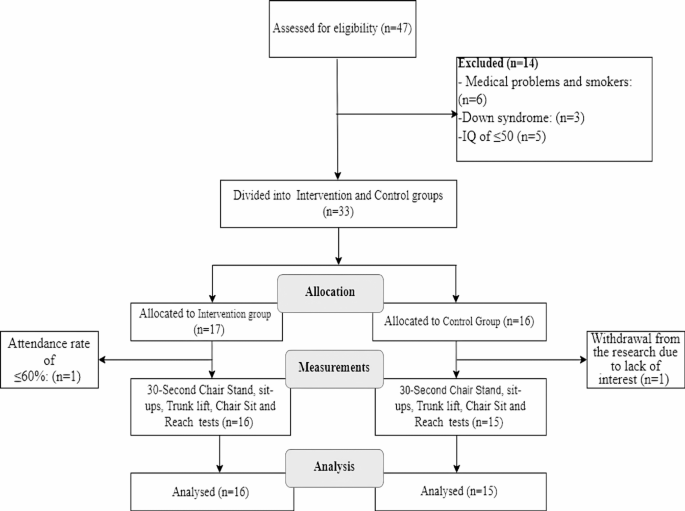
Flow Chart.
The study protocol consisted of three distinct phases: pre-test assessment, 8-week intervention, 8-week post-intervention assessment, and 2-month follow-up assessment. In this study, the CONSORT guidelines were followed. During the initial assessment, participants completed an informed consent form and underwent a series of anthropometric and physical fitness measurements, including assessments of height, weight, muscle strength, and mobility. Muscle strength, and mobility were measured using the Trunk lift test and chair sit-and-reach test respectively. In a separate session, muscular endurance was evaluated through sit-up and 30-second chair stand tests. To mitigate the risk of participant fatigue, a 15-minute rest period was provided between each test. Each field test was performed twice, with the most favorable result recorded for each individual. Research variables were measured at pre-test, after 8 weeks of intervention (post-test), and after 2 months of follow-up.
In total, 47 Adults with Intellectual Disabilities were identified, of whom 14 excluded because they did not meet the inclusion criteria. Six subjects were excluded due to medical problems and smokers, 3 due to Down syndrome, and 5 individuals were removed for IQ of ≤ 50. A sum of 33 participants were selected as the statistical sample according to the inclusion and exclusion criteria in this study. One of the researchers divided the subjects randomly into two groups of 16 and 17, including the control group and the training group, respectively using the random number generator software. One person from the control group was excluded from the study due to absence in the post-test and one person from the training group was excluded from the study due to absence from the sessions of training.
Finally, 31 individuals underwent the screening process and were subsequently assigned to either the control group (n = 15) or the DNS intervention group (n= 16). The sample size was calculated using the G*Power software, determining that a sample size of 16 individuals per group was necessary for the repeated measures statistical test, with an alpha level of 0.05 and a beta level of 0.23. This sample size was selected to achieve a statistical power of 0.80, which is deemed adequate for experimental research21,22. The control group participated in center-based activities, while the DNS intervention group engaged in targeted training exercises at the center from 8:00 AM to 1:30 PM. Participants who either chose not to participate in the DNS interventions or had an attendance rate below 60% were excluded from the data analysis (see Fig. 1).
During the 8-week intervention phase, eligible participants in the DNS group engaged in 25 to 30 min of supervised DNS exercises at the center. The DNS program emphasized key components such as posture, breathing patterns, and core stability, highlighting the importance of proper activation of the diaphragm and deep abdominal muscles prior to any targeted movements.
The implementation of a comprehensive assessment protocol, a structured DNS exercise intervention, and a follow-up evaluation adheres to the methodological rigor expected in high-quality exercise science research23. The exclusion of participants who did not meet the eligibility criteria or failed to adhere to the intervention further enhances the internal validity of the study. This approach facilitates the establishment of a more homogeneous sample and allows for a precise evaluation of the effects of the DNS intervention.
The 30-second chair stand (30sCS) test was utilized to assess the muscular endurance in the study participants. Participants were instructed to perform the 30sCS test by sitting and standing on a chair for 30 s without using their hands. The test result was determined by the total number of successful repetitions completed within the given time frame. At the beginning of the test, participants were instructed to sit on a chair with their feet flat on the floor and their knees bent at a 90-degree angle24.
The validity and reliability of the 30sCS test have been well-established in the general population. The psychometric properties of the 30sCS were further examined in older adults with ID, demonstrating moderate to high feasibility and test-retest reliability. Specifically, the intraclass correlation coefficients (ICCs) for a same-day interval and a two-week interval were 0.72 (95% CI 0.32–0.91) and 0.65 (95% CI 0.19–0.87), respectively25,26.
The inclusion of the well-validated 30sCS test in the assessment protocol aligns with the recommended practices for evaluating physical fitness in individuals with ID. The robust psychometric properties of this measure, as demonstrated in previous research, further strengthen the methodological rigor of the current study.
The sit-up test was utilized to assess the muscular endurance of the abdominal muscles. During this test, participants were instructed to lie on their backs with their knees bent and the soles of their feet flat on the floor. Participants were then required to perform as many correctly executed sit-ups as possible within a 30-second time frame, with their arms reaching towards their knees during the movement.
The sit-up test is a well-established measure of core muscular endurance that has been widely used in both clinical and research settings. The scoring of this test is based on the total number of properly completed sit-ups within the 30-second time limit, providing a quantitative assessment of abdominal muscle strength and fatigue resistance. The inclusion of the sit-up test in the assessment protocol aligns with the recommended practices for evaluating physical fitness components, particularly muscular endurance, in individuals with ID. This measure has been extensively validated and has demonstrated reliability in various populations, making it a suitable choice for the current study27.
The trunk lift test was utilized to assess trunk muscle strength in the study participants. During this assessment, participants were instructed to lie in a prone position with their hands placed under their thighs. They were then asked to lift their chin as high as possible off the mat by pushing through their back. The distance from the mat to the bottom of the lower jaw was measured twice using a tape measure, with the best result recorded.
The test-retest reliability of the trunk lift test has been well-established in the literature. A previous study conducted by the researchers found the test to have adequate reliability, with an intraclass correlation coefficient (ICC) of 0.89 when assessed at two-week intervals in adolescents with intellectual impairment. Additionally, studies have demonstrated the logical validity of this test, as well as its ability to discriminate between different age groups (18–25, 26–35, 36–45, and > 45 years) in adults with Down syndrome28,29.
The inclusion of the trunk lift test in the assessment protocol aligns with the recommended practices for evaluating physical fitness components, particularly trunk muscle strength, in individuals with ID. The robust psychometric properties of this measure, as reported in the existing literature, further strengthen the methodological rigor of the current study and its applicability to the target population.
The mobility of the study participants was assessed using an extended version of the modified back-saver sit-and-reach test. This test involved the participant sitting on a chair, bending forward, and extending one leg onto a second chair. The distance between the distal tip of the middle finger and the lateral malleolus was measured as the participant leaned forward30. The test was performed on both legs, and to align with previous research, 6 cm was added to the measured distance to standardize the findings31.
The modified back-saver sit-and-reach test has demonstrated a high degree of validity and test-retest reliability in the general population. For males, the correlation coefficients for the low back and hamstring criteria ranged from 0.47 to 0.67, while for females, the coefficients ranged from 0.23 to 0.54 (3). Additionally, the intraclass correlation coefficients (ICCs) for test-retest reliability were 0.96 for men and 0.97 for women, indicating excellent reproducibility26.
Previous research has also examined the psychometric properties of this test in older individuals with ID. The ICC values for the left leg were 0.96 and 0.63 for the same day and 2-week intervals, respectively, while the right leg had values of 0.95 and 0.71 for the same day and 2-week intervals, respectively. These findings suggest that the modified back-saver sit-and-reach test is a reliable measure of mobility in this population.
The inclusion of this well-validated assessment of flexibility and range of motion aligns with the recommended practices for evaluating physical fitness components in individuals with ID. The robust psychometric properties of the modified back-saver sit-and-reach test, as demonstrated in the existing literature, further strengthen the methodological rigor of the current study.
The DNS exercise intervention was implemented by the researchers over an 8-week period. The program consisted of three supervised sessions per week, each lasting 25 to 30 min. Participants in the DNS training group completed their sessions from 8:30 am to 1:30 pm and were paired to allow for close monitoring of exercise execution accuracy.
The pairing of participants during the DNS sessions was a strategic decision to address the potential difficulties in learning and executing the exercises, which can be common in individuals with ID32,33. By providing close supervision and individualized support, the researchers aimed to ensure the successful performance of the DNS exercises by each participant.
Furthermore, the DNS exercises were adapted to the specific abilities of each participant to facilitate proper technique and engagement. This personalized approach is crucial when implementing exercise interventions for populations with ID, as it allows for the tailoring of the program to individual needs and capabilities.
The structured and supervised nature of the DNS intervention, along with the adaptations made to accommodate the participants’ learning needs, aligns with the recommended best practices for exercise programming in individuals with ID. This methodological rigor enhances the internal validity of the study and increases the likelihood of observing meaningful improvements in the targeted physical fitness outcomes (Table 1).
In the study, the demographic data of the study participants were recorded and the Levene test was used to determine the homogeneity of variance. The data included the mean, standard deviation, and 95% confidence interval. A 2 × 3 mixed model analysis of variance (ANOVA) was performed to examine the effects of therapy at different intervals. The study consisted of an experimental and a control group and specific time intervals (baseline, eight weeks, and follow-up). A post-hoc Bonferroni analysis was performed to determine significant differences between the intervals. In addition, a repeated measures ANOVA was used to compare differences between groups. Independent t-tests were used to compare the groups. A statistical significance threshold of p < 0.05 was set. All statistical analyses were performed using SPSS software (version 26.0; SPSS Inc., Chicago, IL, USA).
A total thirty-one participants with mild ID with the ages range of 30 and 55 agreed to take part in the study. The intervention and control groups were similar in terms of gender, age, height, weight, BMI, and IQ. There were no significant differences (p > 0.05) in demographic characteristics between the two groups at baseline. Table 2 shows the results of the data.
Table 3 shows the mean and standard deviation (SD) of the variables for both groups in three time intervals. The baseline data for the 30sCS, sit-ups, trunk lifts, and chair sit and reach tests between the experimental and control groups showed no statistical differences (p ≥ 0.05).
Table 3 shows the results of the tests of the intervention program. The 30sCS scores showed significant differences by time point (F = 31.19, p = 0.001, ηp2 = 0.51) and group (F = 48.81, p = 0.001, ηp2 = 0.63). The interaction effect of group × time was also significant (F = 25.27, p = 0.001, ηp2 = 0.46). In the post hoc analysis, the follow-up test (T3) showed an increase of 7.50 points in the intervention group compared to the pre-test (T1) (Fig. 2). In contrast, the control group showed an increase of 0.27 points, indicating a statistically significant difference between the groups (p = 0.001). The intervention group showed a clear increase of 6.69 points after the test (T2) compared to the pre-test, while the control group showed a smaller increase of 0.53 points. This difference between the two groups was significant (p = 0.001) and large, with a Cohen’s d of 2.26. Table 3 provides further details on the within-group comparison.
Sit-up scores differed significantly by time (F = 79.07, p = 0.001, ηp2 = 0.73) and by group (F = 44.26, p = 0.001, ηp2 = 0.72). In addition, the interaction effects of group × time were also statistically significant (F = 51.81, p = 0.001, ηp2 = 0.64). In the posttest analysis, the intervention group showed an increase of 11.94 points compared to the pretest. In contrast, the control group showed an increase of 1.07 points, which differed significantly from that of the intervention group (p = 0.001). The intervention group showed a significant increase of 10.87 points in the follow-up test (T3) compared to the pre-test (T1) (Fig. 2). In contrast, the control group showed a decrease of 1.40 points, indicating a significant difference between the two groups (p = 0.001). Table 3 contains additional information on the comparison within the groups.
The values for trunk lifting showed significant differences by time (F = 9.95, p = 0.001, ηp2 = 0.25) and group (F = 18.36, p = 0.001, ηp2 = 0.38). In addition, the interaction effects of group × time were also statistically significant (F = 14.15, p = 0.001, ηp2 = 0.32). In the post hoc analysis, the intervention group showed an increase of 1.75 points in the post-test (T2) compared to the pre-test (T1). In contrast, the control group showed a slight increase of 0.07 points, which differed significantly from that of the intervention group (p = 0.001). The intervention group, on the other hand, showed a significant increase of 2.87 points in the follow-up test (T3) compared to the pre-test (T1) (see Fig. 1). The control group, on the other hand, showed a decrease of 0.27 points, indicating a significant difference between the two groups (p = 0.001). This was a large effect with a Cohen’s d of 1.55. Further details on the comparison within the groups can be found in Table 3.
Chair sit and reach scores showed significant differences by time point (F = 24.47, p = 0.001, ηp2 = 0.45) and group (F = 17.47, p = 0.001, ηp2 = 0.37). In addition, the interaction effects of group × time were also statistically significant (F = 14.88, p = 0.001, ηp2 = 0.33). In the post hoc analysis, the intervention group showed an increase of 8.62 points in the post-test (T2) compared to the pre-test (T1). In contrast, the control group showed an increase of 1.40 points, which differed significantly from that of the intervention group (p = 0.001). The intervention group showed a significant increase of 9.50 points in the follow-up test (T3) compared to the pre-test (T1) (Fig. 1). In contrast, the control group showed a decrease of 0.93 points, indicating a significant difference between the groups (p = 0.001). These findings indicate a large effect, with a Cohen’s d of 1.51. Further details on the comparison within the groups can be found in Table 3.
Comparative Analysis of Variables Across Different Time Periods.
The primary objective of this study was to evaluate the impact of a DNS training program on the strength, endurance, and flexibility of individuals diagnosed with ID. Individuals with ID often experience challenges in physical fitness and motor function, which can negatively impact their overall health and quality of life. DNS techniques have emerged as a promising approach to address these issues, as they focus on enhancing neuromuscular control and core stability. However, the empirical evidence regarding the efficacy of DNS training for individuals with ID remains limited.
Our analysis revealed a remarkable correlation between changes in core strength, lower extremity muscle resistance, and flexibility (P < 0.05), emphasizing the beneficial results of DNS exercises. Furthermore, subsequent observations indicated the sustained effect of DNS exercises on these parameters (P < 0.05). By examining the changes in these key physical attributes, the researchers aimed to provide valuable insights into the potential benefits of DNS interventions for this population.
The findings of the present study align with previous research demonstrating the beneficial effects of structured physical training programs on the physical fitness of individuals with intellectual ID. Asonitou et al. (2018) conducted a study that showed a 4-month physical exercise program, which included strength and endurance exercises, improved muscle flexibility, strength, and endurance in adults with mild ID3. Similarly, Gutiérrez et al. (2023) emphasized the effectiveness of resistance exercises using one’s own body weight and external loads to increase physical performance in adults with mild to moderate disability34.
The current study’s results are also consistent with the findings of Dehghani and Qasemi (2021), who investigated the effects of DNS exercises on improving trunk muscle strength and endurance in mentally disabled students32. The present research extends these previous findings by demonstrating the positive impact of a DNS training program on the core strength, lower extremity muscle endurance, and flexibility of individuals diagnosed with ID.
The observed improvements in these key physical attributes underscore the potential benefits of incorporating DNS techniques into the rehabilitation and fitness regimens of the ID population. The enhanced neuromuscular control and core stability developed through DNS exercises may contribute to the observed gains in strength, endurance, and flexibility, which can subsequently improve overall physical function and quality of life for individuals with ID.
These findings highlight the importance of tailoring physical activity programs to the specific needs and capabilities of individuals with ID, as opposed to a one-size-fits-all approach. The development and implementation of adapted physical activity programs, such as the DNS training program utilized in this study, can play a crucial role in promoting an active lifestyle and improving the physical well-being of this population.
Muscle strength and endurance typically decline with age, a phenomenon commonly attributed to the aging process and the associated reduction in muscle mass35.However, it is primarily exacerbated by the reduced physical activity characteristic of older people. Similar to the general population, there is a positive correlation between the level of physical activity and muscle strength, endurance, and flexibility in adults with ID. This means that increasing the level of physical activity and mitigating the degree of disability can improve these parameters. These observations are consistent with the results of an intervention study conducted in adults with ID, which found the positive effects of physical activity on physical fitness36. Previous research has shown that people with ID who exercise less have poorer physical fitness and sedentary lifestyles compared to their non-disabled peers35,37. Consequently, increasing the level of physical activity, regardless of its duration or intensity, is promising to improve the physical fitness of people with ID and promote their overall health38.
The DNS technique strives to cultivate dynamic muscular stability by adhering to the DNS paradigm39. Each joint position within the kinetic chain aims to achieve a central or neutral alignment supported by coordinated muscular contractions of the local and global muscles to stabilize the joints40. The mechanics and stiffness of the spine are subject to various influences, particularly intra-abdominal pressure (IAP). Kolar assumes that stabilization of the spine requires harmonious activation of the spinal extensor muscles and the deep flexor muscles in the cervical and upper thoracic spine as well as activation of the diaphragm, the pelvic floor, the abdominal wall, and the spinal extensor muscles in the lower thoracic spine41.
The intrinsic stabilizing muscles of the spine play a central role in promoting dynamic spinal stability by generating stiffness in response to intra-abdominal pressure (IAP)42. There is also empirical evidence that exercises targeting the abdominal muscles can improve flexibility by allowing controlled contraction and relaxation43. The results of the study suggest that neuromuscular stabilization exercises performed in different positions and contexts have the potential to improve flexibility. This observation is in line with previous studies that investigated the effects of stability exercises with external loads on physiological parameters44.
In this study, the goal of the DNS exercises was to improve strength, endurance, and flexibility by positioning the patient in various developmental postures while ensuring optimal support and alignment of the joint structures. Participants were first given verbal and manual instructions to differentiate between the various postural configurations. They were then instructed to maintain the ideal alignment during different activities. Given the close relationship between postural positions and breathing patterns, the DNS assessment also included an evaluation of respiratory mechanics. Both stability and respiratory function were considered during the exercise programs44. The overall goal of DNS is to teach people how to integrate appropriate breathing patterns and stability into their daily activities. In general, DNS exercises rely on the unconscious activation of specific muscle groups to modulate diaphragmatic reflexes and engage other central muscles, making them particularly beneficial for individuals with impaired proprioceptive awareness or motor control45.
People with ID often face limitations in central nervous system development, leading to a more isolated lifestyle with fewer opportunities for social and economic engagement compared to neurotypical individuals. The DNS exercises aim to address these challenges by focusing on establishing stability of the cranial column, activating the upper centers of the central nervous system, and promoting the emotional-motor pathways45.
The primary goal of the DNS exercises is to improve neuromuscular coordination, thereby promoting proper muscle function and reducing muscle tension, which in turn can improve strength and endurance. By practicing and reinforcing the correct breathing patterns as well as the movement patterns seen in typical child development, the DNS exercises stimulate the brain to automatically perform movements correctly and efficiently. The automatic integration of correct movement patterns into daily activities leads to improved functioning in people with ID45.
Previous research has demonstrated the effectiveness of various exercise modalities, including sports and resistance training, in improving muscle strength, endurance, and flexibility in people with ID. Simultaneous activation of the diaphragm, abdominal, and lumbar muscles increases intra-abdominal pressure, helping to stabilize the trunk. Training plans should therefore focus on activities that promote stability without placing excessive strain on the superficial muscles45.
The DNS exercises not only focus on localized muscle strengthening but also emphasize neuromuscular coordination and spinal integrity. By performing them in different positions that mirror everyday movement patterns, these exercises represent a novel approach to maintaining core stability without being overly challenging46. In this regard, functional and muscular rehabilitation exercises should emphasize the stabilizing role of muscles in addition to dynamic anatomical function. Accordingly, the DNS technique used in this study appears to be a valuable tool for the assessment and training of muscles in all aspects of their physiological function20.
Improved strength, endurance, and flexibility achieved through DNS exercises can significantly contribute to maintaining independence in daily life for people with ID45. The comprehensive approach of the DNS technique, focusing on both neuromuscular coordination and spinal stability, makes it a promising intervention for enhancing the physical and functional abilities of individuals with intellectual disabilitiy.
The findings of this study suggest that the DNS technique represents a promising approach for improving muscle strength, endurance, and flexibility in individuals with ID. By emphasizing neuromuscular coordination and spinal integrity, the DNS exercises aim to enhance overall muscle function and reduce tension, leading to better physical fitness. Previous research has demonstrated the effectiveness of various exercise modalities in this population, but training plans should focus on activities that promote stability without excessive strain on the superficial muscles. The simultaneous activation of the diaphragm, abdominal, and lumbar muscles during the DNS exercises increases intra-abdominal pressure, helping to stabilize the trunk. Functional and muscular rehabilitation exercises should emphasize the stabilizing role of muscles, and the comprehensive approach of the DNS technique, focusing on both neuromuscular coordination and spinal stability, makes it a valuable intervention for enhancing the physical and functional abilities of individuals with ID.
Limitations include the small sample size and difficulty controlling for factors influencing educational practices. Further research is warranted. The study focused exclusively on adults with a disability, and the results may not be applicable to other related syndromes characterized by different pathophysiological features.
This study demonstrates that an 8-week DNS training program significantly improves physical fitness in adults with ID. Participants in the DNS group showed notable enhancements in muscular strength, endurance, and flexibility, as evidenced by superior performance in the 30-second chair stand, sit-ups, trunk lift, and chair sit-and-reach tests compared to the control group. These gains were sustained at a 2-month follow-up. The findings suggest that DNS training is an effective intervention for enhancing physical fitness in this population, though further research is necessary to confirm these results and explore the underlying mechanisms.
The data that support the findings of this study are available on request from the corresponding author.
Pestana, M. B., Barbieri, F. A., Vitório, R., Figueiredo, G. A. & Mauerberg-deCastro, E. Effects of physical exercise for adults with intellectual disabilities: A systematic review. Journal of Physical Education 29. (2018).
Kesumawati, S. A. & Rahayu, T. Activity model of playing ‘My Hero is my mother’to improve Basic Movement skills of mild Mental Retarded Children. J. Phys. Educ. Health Recreation. 4 (1), 52–61 (2019).
Article Google Scholar
Asonitou, K., Mpampoulis, T., Irakleous-Paleologou, H. & Koutsouki, D. Effects of an adapted physical activity program on physical fitness of adults with intellectual disabilities. Adv. Phys. Educ. 8 (3), 321–336 (2018).
Article Google Scholar
Walsh, D. et al. A comparison of physical activity, physical fitness levels, BMI and blood pressure of adults with intellectual disability, who do and do not take part in Special Olympics Ireland programmes: results from the SOPHIE study. J. Intellect. Disabil. 22 (2), 154–170 (2018).
Article PubMed MATH Google Scholar
Vuijk, P. J., Hartman, E., Scherder, E. & Visscher, C. Motor performance of children with mild intellectual disability and borderline intellectual functioning. J. Intellect. Disabil. Res. 54 (11), 955–965 (2010).
Article PubMed MATH Google Scholar
Hahn, J. E., Fox, S. & Janicki, M. P. Aging among older adults with intellectual and developmental disabilities: setting national goals to address transitions in health, retirement, and late-life. Inclusion 3 (4), 250–259 (2015).
Google Scholar
Klavina, A., Ostrovska, K. & Campa, M. Fundamental movement skill and physical fitness measures in children with disabilities. Eur. J. Adapted Phys. Activity 10 (1). (2017).
Skowroński, W., Winnicki, W., Bednarczuk, G., Rutkowska, I. & Rekowski, W. Analysis of correlations between gross and fine motor skills, physical fitness, and the level of functioning in schoolchildren with intellectual disabilities. Pol. J. Sport Tourism. 25 (1), 16–22 (2018).
Article Google Scholar
Baumbusch, J., Mayer, S., Phinney, A. & Baumbusch, S. Aging together: caring relations in families of adults with intellectual disabilities. Journals Gerontol. Ser. B: Psychol. Sci. Social Sci. 57 (2), 341–347 (2017).
Google Scholar
Emerson, E., Hatton, C., Baines, S. & Robertson, J. The physical health of British adults with intellectual disability: cross sectional study. Int. J. Equity Health. 15 (1), 1–9 (2016).
Article Google Scholar
Bondár, R. et al. The effects of physical activity or sport-based interventions on psychological factors in adults with intellectual disabilities: a systematic review. J. Intellect. Disabil. Res. 64 (2), 69–92 (2020).
Article MathSciNet PubMed MATH Google Scholar
Bahiraei, S., Hosseini, E. & Lou, R. A. J. The test–retest reliability and limits of agreement of the balance evaluation systems test (BESTest) in young people with intellectual disability. Sci. Rep. 13 (1), 15968 (2023).
Article ADS PubMed PubMed Central MATH Google Scholar
Obrusnikova, I., Firkin, C. J., Cavalier, A. R. & Suminski, R. R. Effects of resistance training interventions on muscular strength in adults with intellectual disability: a systematic review and meta-analysis. Disabil. Rehabil. 44 (17), 4549–4562 (2022).
Article PubMed Google Scholar
Klotzbier, T. J., Holfelder, B. & Schott, N. Associations of motor performance and executive functions: comparing children with Down Syndrome to chronological and mental age-matched controls. Children 9 (1), 73 (2022).
Article PubMed PubMed Central Google Scholar
Borland, R., Hu, N., Tonge, B., Einfeld, S. & Gray, K. Participation in sport and physical activity in adults with intellectual disabilities. J. Intellect. Disabil. Res. 64 (12), 908–922 (2020).
Article PubMed Google Scholar
Bokarius, V. Long-term efficacy of dynamic neuromuscular stabilization in treatment of chronic musculoskeletal pain. Age 18 (25), 3 (2008).
Google Scholar
Wickstrom, R. L. Developmental kinesiology: maturation of basic motor patterns. Exerc. Sport Sci. Rev. 3 (1), 163–192 (1975).
Article PubMed MATH Google Scholar
Kobesova, A. & Kolar, P. Developmental kinesiology: three levels of motor control in the assessment and treatment of the motor system. J. Bodyw. Mov. Ther. 18 (1), 23–33 (2014).
Article PubMed MATH Google Scholar
Myer, G. D., Ford, K. R., Brent, J. L. & Hewett, T. E. The effects of plyometric vs. dynamic stabilization and balance training on power, balance, and landing force in female athletes. J. Strength. Conditioning Res. 20 (2), 345–353 (2006).
Google Scholar
Frank, C., Kobesova, A. & Kolar, P. Dynamic neuromuscular stabilization & sports rehabilitation. Int. J. Sports Phys. Therapy. 8 (1), 62 (2013).
Google Scholar
Wang, S., Yu, H., Lu, Z. & Wang, J. Eight-week virtual reality training improves lower extremity muscle strength but not balance in adolescents with intellectual disability: a randomized controlled trial. Front. Physiol. 13, 1053065 (2022).
Article PubMed PubMed Central Google Scholar
Gholami-Borujeni, B., Yalfani, A. & Ahmadnezhad, L. Eight-week inspiratory muscle training alters electromyography activity of the ankle muscles during overhead and single-leg squats: a randomized controlled trial. J. Appl. Biomech. 37 (1), 13–20 (2020).
Article PubMed Google Scholar
Owoeye, O. B., Rauvola, R. S. & Brownson, R. C. Dissemination and implementation research in sports and exercise medicine and sports physical therapy: translating evidence to practice and policy. BMJ Open. Sport Exerc. Med. 6 (1), e000974. (2020).
Oppewal, A. & Hilgenkamp, T. I. Adding meaning to physical fitness test results in individuals with intellectual disabilities. Disabil. Rehabil. 42 (10), 1406–1413 (2020).
Article PubMed MATH Google Scholar
Hilgenkamp, T. I., van Wijck, R. & Evenhuis, H. M. Feasibility of eight physical fitness tests in 1,050 older adults with intellectual disability: results of the healthy ageing with intellectual disabilities study. Intellect. Dev. Disabil. 51 (1), 33–47 (2013).
Article PubMed Google Scholar
Hilgenkamp, T. I., Van Wijck, R. & Evenhuis, H. M. Feasibility and reliability of physical fitness tests in older adults with intellectual disability: a pilot study. J. Intellect. Dev. Disabil. 37 (2), 158–162 (2012).
Article PubMed Google Scholar
Yanardağ, M., Arıkan, H., Yılmaz, İ. & Konukman, F. Physical fitness levels of young adults with and without intellectual disability. (2013).
Boer, P. & Moss, S. Test–retest reliability and minimal detectable change scores of twelve functional fitness tests in adults with Down syndrome. Res. Dev. Disabil. 48, 176–185 (2016).
Article PubMed MATH Google Scholar
Terblanche, E. & Boer, P. H. The functional fitness capacity of adults with Down syndrome in South Africa. J. Intellect. Disabil. Res. 57 (9), 826–836 (2013).
Article PubMed MATH Google Scholar
Hilgenkamp, T. I., van Wijck, R. & Evenhuis, H. M. Physical fitness in older people with ID—Concept and measuring instruments: a review. Res. Dev. Disabil. 31 (5), 1027–1038 (2010).
Article PubMed Google Scholar
Hui, S. C. & Yuen, P. Y. Validity of the modified back-saver sit-and-reach test: a comparison with other protocols. Med. Sci. Sports. Exerc. 32 (9), 1655–1659 (2000).
Article PubMed MATH Google Scholar
Dehghani, E. & Ghasemi, G. Effects of eight week of dynamic neuromuscular stabilization exercises on posture, strength and trunk endurance in educable mentally retarded students. Stud. Sport Med. 13 (29), 229–252 (2021).
Google Scholar
Mahdieh, L., Zolaktaf, V. & Karimi, M. T. Effects of dynamic neuromuscular stabilization (DNS) training on functional movements. Hum. Mov. Sci. 70, 102568 (2020).
Article PubMed MATH Google Scholar
Gutiérrez-Cruz, C., Roman-Espinaco, A., Muñoz-López, S., Ruiz-Perálvarez, F. J. & García-Ramos, A. Effect of a resistance training programme implemented with high levels of effort on physical fitness in people with intellectual disabilities living in group homes: a randomised controlled trial. J. Intellect. Disabil. Research: JIDR. 67 (8), 770–781 (2023).
Article Google Scholar
Hsu, P. J. et al. Sedentary time, physical activity levels and physical fitness in adults with intellectual disabilities. Int. J. Environ. Res. Public Health. 18 (9), 5033 (2021).
Article PubMed PubMed Central MATH Google Scholar
Kapsal, N. J. et al. Effects of physical activity on the physical and psychosocial health of youth with intellectual disabilities: a systematic review and meta-analysis. J. Phys. Activity Health. 16 (12), 1187–1195 (2019).
Article MATH Google Scholar
Bahiraei, S., Oviedo, G. R. & Hosseini, E. The effects of postural training on gait kinematics in individuals with intellectual and developmental disabilities. Symmetry 15 (5), 1062 (2023).
Article ADS MATH Google Scholar
Warburton, D. E., Nicol, C. W. & Bredin, S. S. Health benefits of physical activity: the evidence. Cmaj 174 (6), 801–809 (2006).
Article PubMed PubMed Central MATH Google Scholar
Madle, K. et al. Abdominal wall tension increases using dynamic neuromuscular stabilization principles in different postural positions. Musculoskelet. Sci. Pract. 62, 102655 (2022).
Article PubMed Google Scholar
Gordon-Murer, C., Stöckel, T., Sera, M. & Hughes, C. M. Developmental differences in the relationships between sensorimotor and executive functions. Front. Hum. Neurosci. 15, 714828 (2021).
Article PubMed PubMed Central Google Scholar
GULRANDHE, P. & KOVELA, R. K. The effect of dynamic neuromuscular stabilisation on Core Strength: A literature review. J. Clin. Diagn. Res. 17, 7 (2023).
Google Scholar
Son, S., Jeon, B. & Kim, H. Effects of a walking exercise program for obese individuals with intellectual disability staying in a residential care facility. J. Phys. Therapy Sci. 28 (3), 788–793 (2016).
Article Google Scholar
Son, S. & Jeon, B. Effects of an abdominal muscle exercise program in people with intellectual disabilities residing in a residential care facility. J. Phys. Therapy Sci. 29 (7), 1196–1200 (2017).
Article MATH Google Scholar
Kobesova, A. et al. Functional postural-stabilization tests according to dynamic neuromuscular stabilization approach: proposal of novel examination protocol. J. Bodyw. Mov. Ther. 24 (3), 84–95 (2020).
Article PubMed MATH Google Scholar
Yoon, H. S., Cha, Y. J. & You, J. S. H. Effects of dynamic core-postural chain stabilization on diaphragm movement, abdominal muscle thickness, and postural control in patients with subacute stroke: a randomized control trial. NeuroRehabilitation 46 (3), 381–389 (2020).
PubMed Google Scholar
Sharma, K. & Yadav, A. Dynamic neuromuscular stabilization-a narrative. Int. J. Health Sci. Res. 10 (9), 221–231 (2020).
MATH Google Scholar
Download references
The authors would like to express their gratitude to all the study participants.
None.
Department of Sports Biomechanics and Motor Behavior, Faculty of Sport Sciences, University of Mazandaran, Babolsar, Iran
Hamed Babagoltabar-Samakoush
Department of Sports Injuries and Corrective Exercises, Faculty of Physical Education and Sport Sciences, University of Guilan, Rasht, Iran
Behnoosh Aminikhah
Department of Sport Injuries and Corrective Exercises, Faculty of Physical Education and Sport Sciences, Shahid Bahonar University of Kerman, Kerman, Iran
Saeid Bahiraei
You can also search for this author in PubMed Google Scholar
You can also search for this author in PubMed Google Scholar
You can also search for this author in PubMed Google Scholar
H.B-S and S.B conceived, designed, and helped write and revise the manuscript; H.B-S, and B.A were responsible for coordinating the study, contributed to the intellectual content, and reviewed the manuscript. H.B-S, S.B and B.A helped write and revise the manuscript. All authors contributed to the study design, critically reviewed the manuscript, and approved the final version.
Correspondence to Hamed Babagoltabar-Samakoush.
The authors declare no competing interests.
Shahroud University of Medical Sciences, Semnan, Iran. code: IR.SHAHROODUT.REC.1402.031.
Springer Nature remains neutral with regard to jurisdictional claims in published maps and institutional affiliations.
Open Access This article is licensed under a Creative Commons Attribution-NonCommercial-NoDerivatives 4.0 International License, which permits any non-commercial use, sharing, distribution and reproduction in any medium or format, as long as you give appropriate credit to the original author(s) and the source, provide a link to the Creative Commons licence, and indicate if you modified the licensed material. You do not have permission under this licence to share adapted material derived from this article or parts of it. The images or other third party material in this article are included in the article’s Creative Commons licence, unless indicated otherwise in a credit line to the material. If material is not included in the article’s Creative Commons licence and your intended use is not permitted by statutory regulation or exceeds the permitted use, you will need to obtain permission directly from the copyright holder. To view a copy of this licence, visit http://creativecommons.org/licenses/by-nc-nd/4.0/.
Reprints and permissions
Babagoltabar-Samakoush, H., Aminikhah, B. & Bahiraei, S. Effectiveness of dynamic neuromuscular stabilization training on strength, endurance, and flexibility in adults with intellectual disabilities, a randomized controlled trial. Sci Rep 15, 768 (2025). https://doi.org/10.1038/s41598-024-85046-z
Download citation
Received:
Accepted:
Published:
DOI: https://doi.org/10.1038/s41598-024-85046-z
Anyone you share the following link with will be able to read this content:
Sorry, a shareable link is not currently available for this article.
Provided by the Springer Nature SharedIt content-sharing initiative
Advertisement
© 2025 Springer Nature Limited
Sign up for the Nature Briefing newsletter — what matters in science, free to your inbox daily.
About The Author

More Stories
US Supreme Court Unanimously Defends Internet Access for Millions
Keeping the Internet Open for Business
Connecting Remote Glaciers to Protect Communities in Kyrgyzstan