
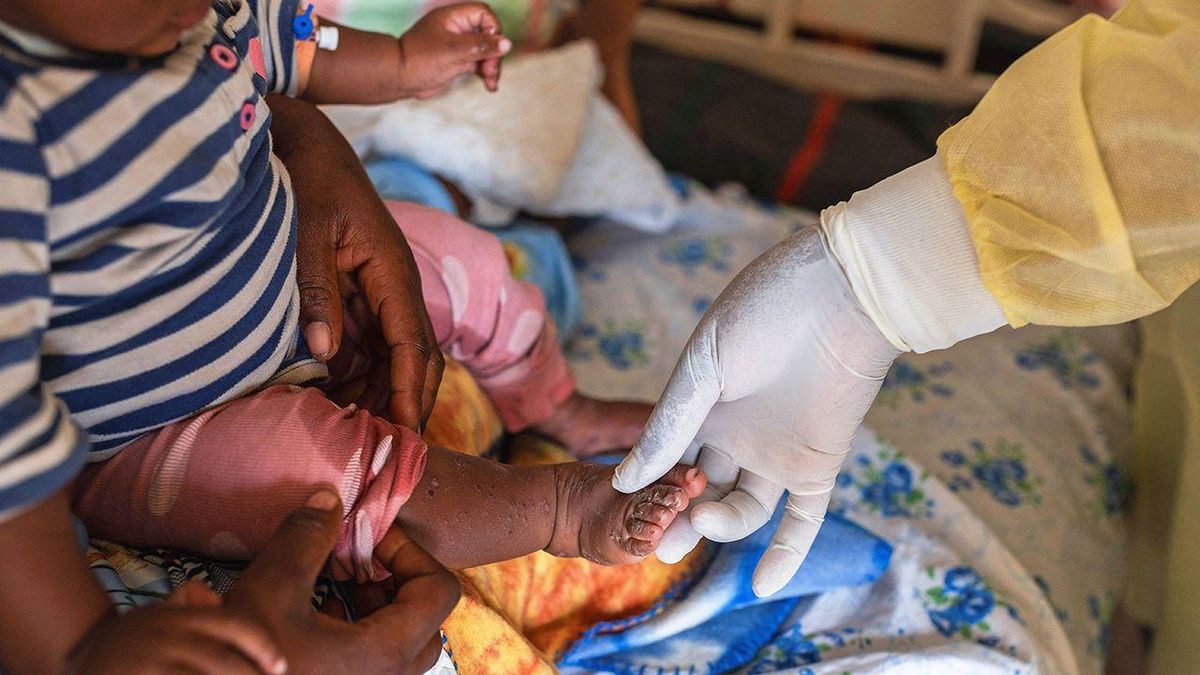
Goma, Democratic Republic of the Congo (DRC) – The Mpox outbreak is raging across Africa, with the DRC suffering significantly as violence and displacement exacerbate the situation. The Africa Centers for Disease Control and Prevention (Africa CDC) recently issued grave warnings about the health crisis threatening the region amid rising conflicts.
During a recent briefing, Africa CDC Director-General Jean Kaseya, MD, MPH, detailed the current state of the outbreak, reporting nearly 10,000 suspected cases and 85 related deaths across 12 African countries, with the DRC remaining the epicenter. “Out of these countries, we mostly have DRC, Uganda, and Burundi, where we have a huge number of reported cases,” Kaseya stated.
According to Kaseya, fighting surrounding Goma has overwhelmed local hospitals, causing widespread destruction, power outages, and medical shortages. The city, which is home to three million people, including one million displaced individuals, is struggling with inadequate health services, prompting concerns over rising morbidity and mortality rates.
The current conflict involving the M23 rebel group has displaced more than one million individuals around Goma. These extreme conditions have allowed the Mpox virus to mutate, leading to the emergence of the deadly Clade 1b variant, which Kaseya notes is highly sexually transmissible and has already claimed lives primarily among children and young people.
This outbreak has not only triggered Mpox cases but has also contributed to widespread measles and cholera outbreaks throughout Goma and the eastern DRC. With almost 9,000 suspected cases reported this year alone, Kaseya warns of dire consequences if the public health crisis is not contained. “It’s important to note children aged 15 years and younger account for 49.3% of the confirmed cases,” he added.
Despite the dire circumstances, Kaseya shared some optimism stemming from the implementation of new vaccination strategies over the past ten days, which focus on distributing vaccines to hot spots. The plan aims to vaccinate around 3.5 million people, but millions more remain at risk, particularly among the displaced populations.
Kaseya addressed the challenges posed by the conflict, stating, “We have seen people fleeing from the armed conflict in Goma, which significantly increases the risk of spreading Mpox.” The struggle to provide adequate medical care is intensified by the chaos of warfare and the necessity for humanitarian access to vulnerable populations.
Outside the DRC, neighboring countries are also on alert due to the outbreak. The urgency of the situation is reflected globally, as demonstrated by the report of the eighth clade 1b imported case of Mpox identified in the United Kingdom. This traveler had just returned from Uganda, where the outbreak continues to expand.
“Overall, the risk to the general population remains low,” the UK Health Security Agency stated, but they acknowledge the situation could see more imported cases. The emergence of such cases highlights the concern about international spread and the importance of containment measures being effective back home.
While Africa CDC has worked tirelessly to secure vaccines and other health commodities for the DRC, officials remain clear about the necessity of peace and security to deliver these life-saving supplies effectively. “I am ready to fly there myself to deliver these life-saving interventions—but we need safe access,” Dr. Kaseya expressed, underscoring the urgency of resolving conflict to protect public health.
These health emergencies, exacerbated by conflict-induced displacement, are not just crises within Africa; they represent global challenges. According to projections from the Africa CDC, without urgent intervention, the situation could lead to preventable and treatable diseases overwhelming public health systems, potentially resulting in millions of excess deaths annually.
Dr. Kaseya issued a poignant call to action for African leaders: “End this unnecessary war. If you fail to act, it will not be bullets but major outbreaks and pandemics arising from this region, sparing no one and devastating economies and businesses.”
This dire prediction serves as both alarm and rallying cry, emphasizing the importance of collaborative strategies and local investments to bolster health infrastructures across the continent. The Africa CDC maintains the push for innovative financing solutions as the number of health emergencies surges from 153 outbreaks noted from 2022 to 2023, skyrocketing to 242 outbreaks reported just last year.
Negotiations for humanitarian assistance have gained momentum, primarily due to the engagement of the Africa CDC with global health stakeholders, but the challenges remain steep. Goma’s current state, with its high population density of 39,620 people per square kilometer, is proving to be unconducive for the proper management of health crises. The intertwined relationship between security and health demands urgent and actionable solutions.
The impacts of delayed interventions resonate beyond immediate health risks, as they can contribute to significant economic losses, costing African nations billions and pushing millions more people back toward extreme poverty.
This situation is still developing, and the Africa CDC continues to advocate for immediate, effective actions both from local governments and international communities. With the looming threat of cascading health crises, the call for peace and health interventions goes beyond politics—it is about safeguarding lives and the future of millions.
For the community around Goma and the wider DRC, the hope remains not just for vaccines to arrive, but for durable peace to pave the way for health recovery and infrastructural development.
We’ve launched what we proudly call the “Intelligent Journalism” era: a bold approach to journalism that prioritizes verifiable facts, eliminates unnecessary fluff, restores the rigor of classic journalistic principles, and delivers news in a clear, compelling format—all powered by our innovative AI algorithms.
Support Intelligent Journalism with a tip to help us understand the stories you love most, so we can bring you more of what matters!
We always aim for accuracy, but we recognize that errors can occasionally slip through. We value your feedback and are committed to making corrections whenever needed. If you spot a factual mistake in our stories, please let us know, and we’ll address it promptly.
Please use this feedback form solely for reporting factual errors, rather than for sharing personal opinions. We appreciate your help in keeping our content accurate and reliable.
We always strive for thorough and accurate reporting, and we value any verified information that can help us better understand the stories we cover. If you have relevant knowledge, insights, or evidence related to a news piece we’ve reported, we encourage you to share it with us. Please remember that we require credible proof or documentation to ensure the integrity of our journalism.
When submitting your tip, explain your connection to the case and provide verifiable evidence. This can include links to documents, photographs, recordings, or other supporting materials, as long as they are securely hosted on reputable cloud-based platforms like Google Drive or Dropbox. We cannot accept direct uploads. Please include your contact information (email and phone number) if you would like us to follow up with you regarding your tip. Our editorial team will review your submission, and if necessary, we will reach out for more information. Your help plays a crucial role in helping us deliver accurate, reliable news to the public.
THE PINNACLE GAZETTE, a platform established by Tree of Evolution LLC, is your premier source for the latest news across a diverse array of topics. Our website offers comprehensive coverage on science, technology, current events, art, and sports, ensuring that you stay informed and gain fresh perspectives.
About The Author

More Stories
US Supreme Court Unanimously Defends Internet Access for Millions
Keeping the Internet Open for Business
Connecting Remote Glaciers to Protect Communities in Kyrgyzstan