
Microsoft plans to push a new Outlook version to all customers. This new version will replace the Mail and Calendar apps of Windows in 2024, and the Outlook desktop application in the future.
A new update for Outlook is now available that Microsoft hopes will make things clearer for users. This update adds the word classic to the desktop version of Outlook. The version was named Outlook only until now.
Here is a screenshot of the old status quo: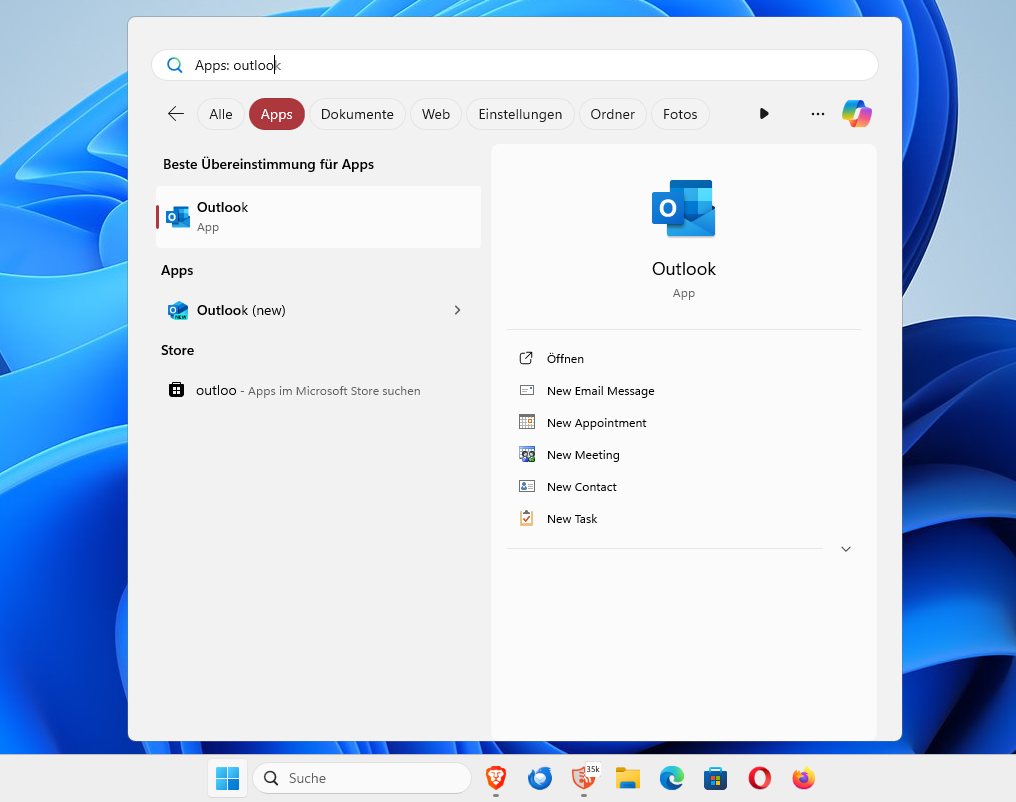
If you have not paid attention to Microsoft’s announcements, and most users have not, then it is confusing to see two Outlook apps installed on the device.
The idea behind the name change, likely, is to make it clearer to users that the desktop Outlook that some have used for decades is not the one that they should use. While classic Outlook won’t be deprecated until at least 2029, it is a clear indication that it will go away at one point.
The new Outlook is the future, according to Microsoft. It is not liked universally though, as it lacks features that classic Outlook supports. It seems likely that Microsoft will remove “new” from its name at one point to complete the switcheroo.
As for Mail and Calendar, these will be crippled starting July (via Dr. Windows). The app will be set to read-only mode by Microsoft. In other words, you can’t use it anymore to retrieve or send emails.
This is the first step to push Windows users to use the new Outlook version. It remains to be seen how well this works out for Microsoft. There are several other email programs out there, including classic Outlook but also the free Thunderbird, that could be used as replacements.
Microsoft has a habit of making confusing decisions. Remember the Teams fiasco? There was a Microsoft Teams for consumers and one for businesses. Problem was, it was never clear which would open when you clicked on links that were designed to open in Teams. They even had the same name in Start and an icon that was nearly identical as well.
Another example was the release of a new OneNote, which sat next to the classic OneNote app for a long period. The two apps, OneNote 2016 and OneNote for Windows 10, even had the same icons. Microsoft decided furthermore that it would be a great idea to rename OneNote 2016 to just OneNote.
Windows users who do not need one or both of the Outlook apps may uninstall them. This is done with a right-click on them in the Start menu, or under Settings > Apps > Installed Apps. Eventually, users of the desktop Outlook app, and Mail and Calendar, are forced to make a decision.
What about you? Do you use an email application?
We tried it on the company laptops. It is near useless. It lacks important features, but the worst part is that the reminders and notifications are extremely inconsistent. It needs some serious SERIOUS work. It is a cheap, hollow skeleton compared to the full outlook app.
Considering the millions of companies where Outlook is integral to their business for more than sending at receiving email, this is totally disconnected from reality. We have an in-house customer relationship app that integrates with Outlook to auto generate emails when there are critical updates, to remind them when licenses are within 60/30 days of expiration, as two examples. These do not interoperate with web based Outlook. And its not a matter of rewriting it to do so – it just doesn’t work that way.
Outlook what?
Thanks for the article!
:]
Proton users are amused, once more.
Microsoft just can’t make a clean break from anything. Always making a naming mess or other confusing choices that are not clear or decisive.
What happens when the software department is run by a brain-dead marketing fools on their MacBook’s, who are not using Windows or any Microsoft products.
I’ve never used it other than when it was called Hotmail. But that was decades ago.
I have a paid for webmail account with Tuta (formerly Tutanota) which also includes a desktop client and a mobile app. They have a free version, but I’m not sure whether it includes the desktop client or not. https://tuta.com/
Ghacks is a technology news blog that was founded in 2005 by Martin Brinkmann. It has since then become one of the most popular tech news sites on the Internet with five authors and regular contributions from freelance writers.
About The Author

More Stories
Community Snapshot—March
DNS Blocking: Mind the Unintended Consequences
Digital Inclusion and Indigenous Connectivity